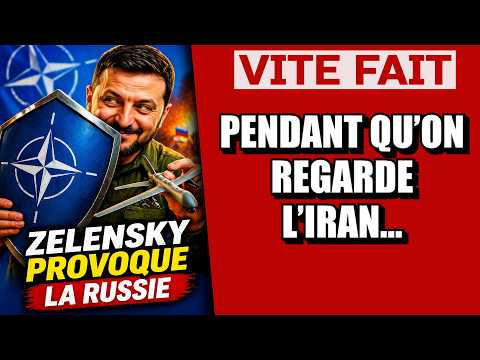
🚨Alerte ! Zelensky veut provoquer la guerre entre l’OTAN et la Russie !!!
AI Summary
This discussion highlights a critical issue concerning drones originating from Ukraine crashing in NATO countries, specifically Estonia, Latvia, and Finland, and the media's portrayal of these incidents. Initially, an article was cited that ambiguously reported drones from Russia hitting a power plant chimney in Estonia and another crashing in Latvia. However, upon closer inspection of the article, it became clear that the drones were Ukrainian and were crashing in NATO countries, despite the initial insinuation that Russia was to blame.
A subsequent article from "Observateur continental" clarified the situation with a direct title: "Two Ukrainian Drones Explode in Latvia and Estonia." This article detailed how authorities in Estonia and Latvia confirmed that a drone had struck a power plant chimney, causing an explosion, and that initial findings confirmed its Ukrainian origin. It was revealed that these Ukrainian drones were attempting to reach the Saint Petersburg region in Russia, a crucial hub for Russian oil and gas exports and potentially arms production. To avoid traversing Russia or Belarus, where they would likely be intercepted, the drones were rerouted through Poland, Lithuania, Estonia, and Latvia, bringing them closer to Saint Petersburg and potentially into Finnish territorial waters, reducing Russia's interception capabilities.
This implies that the authorities of these NATO countries have granted authorization for Ukraine to use their airspace to launch attacks against Russia. Since March 22nd, over 100 drones have been destroyed near Saint Petersburg, a record for the duration of the joint military operation. These drones targeted companies like Vigor and the port of Ust-Luga. In Lithuania, a Ukrainian drone crashed on the night of March 24th. The Latvian Prime Minister stated that the device was diverted from its trajectory by electronic attacks and was actually headed towards Russia. Latvian and Estonian authorities also confirmed the Ukrainian origin of the drone wreckage found the day before.
Currently, Russia is intercepting these drones over NATO territory using non-physical means, such as electronic attacks and jamming, rather than physical interception methods. This situation has led to a serious precedent where Poland and the Baltic states have consented to Ukraine using their airspace to attack Russia. This has resulted in drones crashing within their territories.
On March 29th, Finnish President Stubb announced that drones had penetrated Finnish airspace that morning, with one confirmed as Ukrainian, though it was noted that both were. Due to jamming and other electronic warfare, drones are reportedly flying erratically and crashing in various locations. Some speculate that these Ukrainian drone deviations might be intentional, aimed at creating incidents to then blame Russia.
There's a suggestion of a potential "blackmail" scenario, where if financial aid is not provided to Ukraine, critical infrastructure in countries like Finland could be targeted by drones, with the blame potentially shifted to Russia by claiming the drones were Russian or diverted by Russian forces. The transcript mentions that Ukraine is testing Finland's defenses and seeking to push Finland into attacking Russia, viewing these drone strikes as a tactic.
On March 29th, two Ukrainian drones crashed near Kouvola in southeastern Finland, 70 km from the Russian border, presumably en route to Russia but diverted. Finnish authorities identified the drones without engaging them. The Finnish Prime Minister commented on the serious nature of this territorial violation and suggested that the crashes might be due to Russian electronic warfare systems, implying Russian responsibility.
The fundamental point is that the use of Ukrainian combat drones over Russian territory via the airspace of NATO third-party countries is only possible with the consent of the highest authorities in those countries. This situation is described as a "casus belli," a pretext for a declaration of war, akin to Iran's response to neighboring countries hosting American bases from which attacks were launched against them. When a country's territory is used as a base for attacks against another, it is expected that the attacked country will retaliate, making the host country a target.
The Baltic states and Poland are identified as particularly aggressive in their stance on the conflict, actively seeking to involve the entire continent in war. By allowing Ukraine to attack Russia from their soil, these countries become de facto parties to the war. Russia, therefore, is justified in preventing these devices from hitting its territory. While currently using electronic means, Russia might be compelled to use physical methods like interceptor drones or missiles. The concern is the potential for these physical interceptions to go wrong, leading to an interceptor missile or drone crashing in a NATO country, potentially causing casualties, which would then be presented as an unprovoked, brutal Russian attack, devoid of context.
The media's complicity in this narrative is criticized, with accusations that they are deliberately pushing for a conflict between NATO and Russia. It's suggested that Ukrainian President Zelensky, with the complicity of European states, is attempting to provoke such a war, using European funds and potentially lives. The speaker expresses a grim possibility of Zelensky's premature departure due to his increasingly dangerous actions, including allegedly threatening European leaders like Orbán over financial disputes.
The discussion also revisits previous instances of media manipulation concerning alleged Russian drones. It's argued that for months, the public has been conditioned to believe in Russian drones attacking civilian airports and government facilities, but these claims are often unsubstantiated or exaggerated in the actual articles, beyond sensationalized headlines. The fear is that any real incident involving Russia on NATO territory, however minor, would be used to legitimize a full-scale conflict, with the media fueling public outrage against Russia.
The speaker draws parallels with the media's portrayal of Iran, where a sudden shift in narrative painted Iran as a dangerous threat to justify military action. The current media landscape, which once promoted the European Union as a beacon of peace and diplomacy, is now accused of turning a blind eye to or actively participating in a march towards war, with a "criminal and pathetic" complacency. This behavior is seen as a betrayal of journalistic ethics, particularly given journalists' dependence on public and private subsidies, which might influence their reporting. The segment concludes by emphasizing the importance of independent journalism in light of the perceived poor quality of mainstream media.