Is the AI Bubble Cracking? OpenAI’s $1.5 Trillion Problem
AI Summary
The discussion centers on whether the AI bubble is cracking, following reports that OpenAI missed internal revenue and user targets. This comes ahead of the MAG7 earnings reports from Amazon, Microsoft, Meta, and Google, which are anticipated to be major market events. The speaker dismisses the FOMC meeting as less significant, urging focus on tomorrow's earnings and potential broader implications beyond OpenAI's issues.
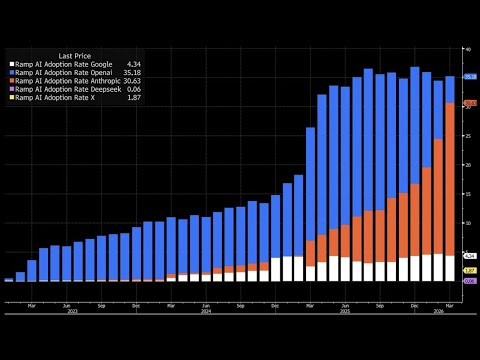
The speaker believes OpenAI's product offering is inferior to Anthropic's, citing personal observations of users migrating from ChatGPT to Claude. A chart illustrates Anthropic's significant user growth, while ChatGPT's remains stagnant. Google's cloud CEO stated that AI demand will outstrip supply for the next decade, making tomorrow's earnings forecasts and CapEx spending crucial.
The "circle jerk" of deals involving OpenAI, Oracle, and NVIDIA is highlighted, with Oracle and CoreWeave identified as "weak links" due to recent stock dips. Microsoft and AMD, in contrast, were relatively stable. The speaker expresses concern about Oracle's expectations and the fragility of the OpenAI-Oracle relationship, though they don't believe this signals the end of the AI build-out, but rather a rotation.
The timing of OpenAI's CFO expressing concerns about future computing contracts if revenue doesn't grow fast enough is questioned, especially given Anthropic's rapid revenue growth. The ongoing court case with Elon Musk over OpenAI's transition from non-profit to profit is also noted. While OpenAI might be a weak link, its potential failure is unlikely to derail the entire AI build-out, as competitors like Google and Microsoft would likely absorb its compute capacity.
The market is currently absorbing recent events, and the MAG7 earnings will provide crucial insights into CapEx spending, a key red flag. Companies like Meta are increasing spending and even borrowing, raising questions about market reception if they pull back.
Semiconductors show an "island reversal," and the NASDAQ has seen an "unprecedented move," up 19-20% in less than two weeks, reminiscent of the dot-com bubble. A weekly engulfing candle on the NASDAQ would signal a deeper correction.
Geopolitical tensions are also a concern, specifically the Strait of Hormuz situation. Iran's proposals regarding its nuclear program and Trump's firm stance could lead to significant ramifications for oil prices if no resolution is found. Conversely, a resolution could cause oil prices to drop sharply. The UAE's departure from OPEC, aiming to increase oil output, adds another layer of complexity.
Bitcoin is undergoing a retest of a breakout structure, with a close above resistance indicating a potential bottom, while a close below support suggests a bear flag. Ethereum is at a break-even short. NVIDIA is down 3% due to the OpenAI news, with Oracle and CoreWeave also experiencing drops.
The speaker reiterates that OpenAI's success or failure won't halt the overall AI build-out, but rather lead to a consolidation or rotation. The market has lost the CTA bid, but buybacks are expected, providing a significant market bid.
The speaker is finalizing "stock V4 templates" and praises a solution from "Brownie Brown" that looks at both buy and sell sides, in contrast to their own buy-side-only approach. They express a desire to integrate Brownie Brown's sell-side into their model.
The speaker maintains a skeptical view of OpenAI, citing "Sam's" past actions. While ChatGPT serves a role, Claude Code is considered superior for coding. Concerns about a degrading experience with Claude Code are attributed to a lack of compute, which Anthropic might address through a potential IPO by year-end. The speaker questions ChatGPT's long-term viability.
SoftBank, Larry Davidson, and Oracle are identified as being exposed to OpenAI, while Microsoft seems to be cutting ties, potentially explaining its stock performance. Despite Microsoft's significant Azure revenue from OpenAI, the speaker believes any failure of OpenAI or similar entities would result in a rotation of resources to other leading competitors, highlighting the importance of competition in the U.S. hyperscale market.