How New Students Should Start Part 5 \ Back Testing Properly
Audio Summary
AI Summary
This video, part five of a series, aims to simplify smart money concepts for trading, emphasizing practicality and personal engagement over complexity. The speaker addresses common complaints about overcomplication, asserting that the concepts are simple but require effort, not laziness.
A significant portion of the discussion focuses on backtesting and the importance of real-time price action observation. The speaker strongly discourages the use of "market replay" features, which only show the opening and closing ticks of a candlestick, arguing that this does not accurately represent the "breath and lifespan" of a candle's formation. Instead, he advocates for watching recorded, even delayed, price feeds to observe the entire development of each candlestick. This method, he explains, allows traders to see how prices move, create highs and lows, and ultimately settle, which is crucial for understanding market dynamics across all timeframes. He suggests using Windows' built-in screen recording feature (Alt + Windows key + R) for video backtesting, allowing users to record their observations in their own voice, which he considers a superior method for learning.
The speaker stresses that backtesting is not about predicting the future but about conditioning oneself to recognize patterns and characteristics through repetition. By consistently recording observations, traders embed these patterns into their subconscious, enabling them to interpret live price action more effectively. He recommends a minimum of six weeks of backtesting both historical and recent data, promising a significant improvement in price action interpretation.
A key aspect of this backtesting methodology is the detailed annotation of charts. The speaker advises treating these annotations as a "love letter" to oneself, focusing on positive and constructive observations rather than negative self-talk or dwelling on losses. This positive reinforcement, he argues, tricks the subconscious into shunning fear and toxicity, making the learning process more enjoyable and building confidence. He likens this to motivational coaching, where positive self-talk and reinforcement of correct actions help shorten the learning curve. This personal trading journal is private, allowing for complete honesty without fear of judgment.
The speaker then delves into specific elements to annotate, building upon the three pillars of smart money concepts introduced in part four: pre-market session hours (7:00-9:00 a.m. Eastern Time), relative equal highs and lows within that range, and the opening range for regular trading hours, followed by the "silver bullet" concept for the 10:00 a.m. hour.
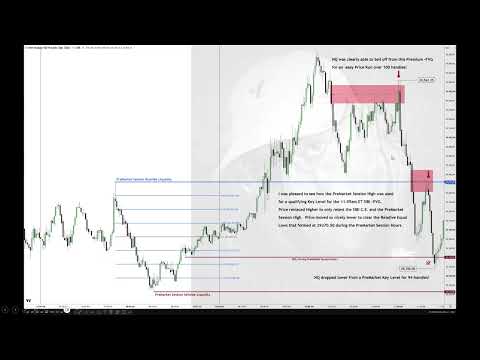
For pre-market session analysis, traders should identify the highest high and lowest low between 7:00 a.m. and 9:00 a.m. Eastern Time, drawing a Fibonacci retracement across this range. These levels are projected into the day, and their interaction with the opening range (9:30 a.m. to 10:00 a.m.) is observed to identify stronger key levels. Annotations should include specific prices for highs, lows, opens, and closes, emphasizing precision. For instance, if the market rallies off the pre-market high, this should be noted, along with any subsequent fair value gaps or liquidity grabs. The speaker provides an example of observing how the Nasdaq sold off from a premium bearish fair value gap, yielding over 100 handles, and how the pre-market high was used as a key level for a bearish fair value gap at 11:09 a.m.
He reiterates the importance of identifying relative equal lows and highs within the 7:00-9:00 a.m. range, as algorithms often refer back to these levels. When recording, traders should note how price interacts with these levels, such as the market trading down into relative equal lows.
The speaker moves on to the "opening range gap" for regular trading hours. This involves comparing the closing price of the previous day's regular trading session (4:14 p.m. Eastern Time) with the opening price of the next day's session (9:30 a.m. Eastern Time). If the opening price is lower, it's a discount opening range gap; if higher, it's a premium opening range gap. The "consequent encroachment," or midpoint of this gap, is a crucial level to observe. The speaker demonstrates how the Nasdaq opened with a 69-handle discount opening range gap, and its consequent encroachment was delivered just five minutes after the 9:30 a.m. opening. He also shows how standard deviations (e.g., negative 1.0 projection using a Fibonacci tool from the previous day's close to the opening price) can accurately predict the high and low of the morning session.
Finally, the discussion turns to the "silver bullet" for the 10:00 a.m. hour. The speaker emphasizes identifying the "first presented fair value gap" at 10:00 a.m. However, he introduces a refinement: a "first presented fair value gap with displacement" takes greater command over price delivery. Displacement is characterized by an up-close candle (bissy) that takes out previous highs, indicating a strong move. This type of gap, he explains, trumps a simple initial fair value gap. He illustrates how such a gap can lead to a significant sell-off, and how blending this concept with the "lunch macro" (where the market seeks a low formed during the 10:00 hour) provides a stronger trading narrative. For instance, if a 10:00 a.m. low is established and then price rallies, a shorting opportunity arises if price returns to a fair value gap, especially if it's a "reflection fair value gap" or "bearish inversion fair value gap."
When annotating hypothetical trades, traders should record realistic entry points (e.g., consequent encroachment or one tick below it for a bearish fair value gap), stop losses (e.g., the high of a specific candlestick plus one tick), and targets. This process should include calculating the total risk involved and the "heat" or drawdown incurred, which helps condition traders to expect price movements against their position. This detailed recording of hypothetical scenarios, including partial profits at key levels like relative equal lows, helps build realistic expectations and experience that market replay cannot provide.
The speaker concludes by reiterating the importance of avoiding market replay and embracing detailed, recorded backtesting. He highlights that this method allows traders to understand how candlesticks book in real-time, including their open, close, highest high, and lowest low, and how often they create new highs and lows while active. He asserts that the human mind, through this detailed observation and interpretation, can outperform AI, which can only process finite, closed candlestick data, whereas humans can interpret active candlestick formation.