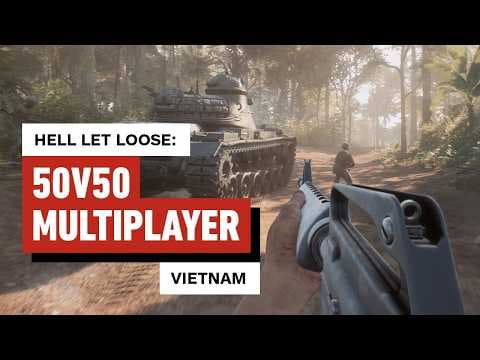
Hell Let Loose: Vietnam Preview: There’s No Hand-Holding in This Milsim FPS
Audio Summary
AI Summary
My experience with the two-hour preview of Hell Let Loose Vietnam was largely defined by frequent deaths and a steep learning curve, yet by the 90-minute mark, I began to appreciate the hardcore 50-versus-50 Vietnam-era military simulation that Expression Games has crafted. This game, while retaining most of the classic Hell Let Loose formula, including its resource-driven meta where commanders manage manpower, munitions, and fuel like an RTS general, introduces the North Vietnamese Army and shifts the setting from the Western Front to Vietnam.
I played the preview on Tan Hoa Bridge, a map inspired by the historical Dragon's Jaw from Operation Rolling Thunder. This environment is a dense jungle interwoven with rice paddies, river crossings, and villages, where much of the intense combat and dying occurs. The game's personality is heavily influenced by the high frequency of player deaths.
My setup for the preview included a PC with a 4070 Ti, Ryzen 3900X CPU, and 32 GB of RAM, running on a 3440x440p monitor at high settings with DLSS set to quality, frame generation to medium, and reflex switched on. The build was clearly in a preview state, with noticeable foliage pop-in, frame pacing stutters during intense effects, and one instance where I was stuck in water for 20 seconds. While these technical glitches didn't worry me at this stage, the absence of an accessibility tab in the settings menu did. For a military simulator with such a steep learning curve and sensory minimalism, this omission could alienate a significant portion of its potential player base.
The controls and gameplay mechanics are distinct from typical shooters like Battlefield or Call of Duty. It's a slower, more deliberate experience with fewer sensory inputs. For instance, as an American rifleman, I started with an M16, bandages, and a combat knife, but no pistol, which was surprising given the game's commitment to authenticity. Equipping a bayonet by tapping Caps Lock and deploying it with B felt clunky, mirroring the game's overall weighty reloads and slight aiming lag. Unlike modern shooters, you can't sprint, mantle, and shoot simultaneously, which can be frustrating for players accustomed to such fluidity.
The game enforces team play through its role kits. As a rifleman, I could drop ammo boxes for teammates, a crucial feature given the limited starting ammunition. When rifleman slots were full, I played as a medic, a role that included morphine curettes to automatically mark critically wounded allies within 100 meters, allowing for revivals. Medics are also supposedly able to drag downed teammates faster and fire a sidearm one-handed while dragging, though I didn't get to experience this during the preview.
The core class distinctions are subtle in loadout but create significant differences on the battlefield. Functions that modern shooters often condense into one loadout are here split across five different roles. This design means that even basic battlefield tasks, such as keeping a teammate alive, resupplying them, or building critical infrastructure, require coordination with someone who chose the correct specialty before the round began. This granular class system, reminiscent of old-school Battlefield titles like Battlefield Vietnam but with even greater detail, enhances immersion when coordination is effective. Conversely, a lack of coordination often led to long, uneventful treks through the swamp followed by quick deaths.
Tan Hoa is one of six maps planned for launch, with others inspired by real engagements such as Operation Starlight, the Battle of Dak To, the Kaman logistics port, and Quang Ngai. Even after two hours on Tan Hoa, I struggled to understand many of its sightlines. The game offers no hit indicators, minimal directional damage arrows before collapsing, and once downed, help is usually too far away. While the settings menu includes toggles for "show killer's name" and "show cause of death," the default leans towards a "find out the hard way" approach. Even with helpers on, the game doesn't point to the muzzle flash you missed, relying solely on sound and visible elements through the canopy. This sensory minimalism made me consider that the game might be better suited for VR, as it demands a "head on a swivel" situational awareness that VR naturally fosters.
Upon redeploying, players spawn at garrisons behind friendly lines—team-wide deployables capped at eight per side, placed by squad leaders or commanders using specialist-dropped supplies. Alternatively, players can spawn at outposts, which are unit-only versions planted by squad leaders near objectives. Direct spawning on squadmates or unfortified captured points is not possible. During the preview, I mostly spawned at garrisons. From there, I had two options: wait for a dev-piloted transport helicopter or walk. Since player vehicle controls were locked, riding the chopper was rarely an option, often forcing a five-minute jungle sprint from the rear garrison to the front lines. This deliberate friction—a 5-minute walk, a quick death, a 30-second respawn wait, and another 5-minute walk—is a design choice that will define who loves Hell Let Loose Vietnam.
For hardcore players, this friction is a core part of the experience. The conquest mode features a finite morale ticker that depletes with every team redeployment, emphasizing careful play and strategic outpost placement over high kill counts. For others, this might feel like punishment. What kept me engaged during these long walks was the voice chat, which is critical to Hell Let Loose's gameplay.
Towards the end of my session, I switched to the NVA side to experience its asymmetrical gameplay. I ended up as an observer on a mortar team, scanning the jungle with binoculars and marking enemies for a non-existent gunner and support. This turned out to be the most relaxing part of my session. Later, I joined an empty recon team to try planting an outpost behind enemy lines, only to be repeatedly shot down by my former American teammates. Meanwhile, the NVA commander, a developer, was audibly urging us via comms to set up tunnels, showcasing the kind of emergent communication the game aims to produce.
The asymmetry is a genuinely new element for the franchise. The US faction primarily uses helicopters, while the NVA relies on tunnel networks. Tunnels can form a connected web on the tactical map, with NVA garrisons doubling as tunnel entrances, allowing for fast travel between nodes. Helicopters spawn from fixed helipads and transport variants can act as mobile spawn points. The NVA machine gunner can deploy static anti-aircraft placements, while the US counters underground threats with napalm strikes. This deep asymmetry means both factions must employ different strategies to win. Due to the vehicle lockout, I couldn't pilot a chopper or drive a tank, so the practical application of this asymmetry remains to be fully explored.
The game boasts a roster of 17 classes spread across infantry, armor, helicopter, recon, and mortar units. My squad primarily consisted of riflemen and myself as a medic. I rarely saw the two-person recon unit, whose spotter is the only class that can place a spawn outpost in locked enemy territory, or the two-person helicopter unit (pilot and logistics officer) utilized. Tank crews were also off-limits. The key question for the full release is whether developers can balance such a wide array of classes in a 50-versus-50 lobby, or if the meta will collapse into a few dominant picks.
I'm left with several open questions for the full release: Will all 17 classes feel mechanically distinct? Does the hyper-realism combined with the morale economy encourage careful, life-preserving play or simply punish losing teams more severely? For players craving a slow, communication-heavy military simulator that punishes misuse of time and are willing to navigate a rough learning curve, Hell Let Loose Vietnam remains true to its series' identity. This is good news for existing fans but a warning for newcomers.