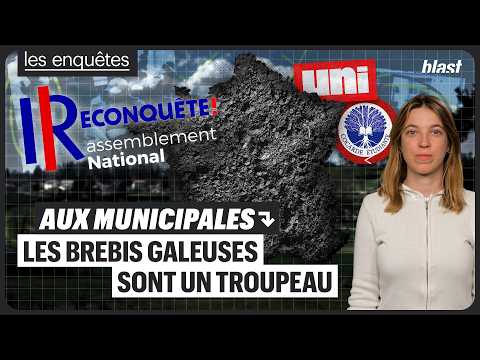
ENQUÊTE : AUX MUNICIPALES, LES BREBIS GALEUSES SONT UN TROUPEAU
AI Summary
The recent first-round results of the French municipal elections have defied mainstream media predictions, marking a significant breakthrough for the radical left and the near-total disappearance of the Macronist bloc from the political landscape. While right-wing and far-right parties have not won every gamble, an investigation by Blast reveals a deeper, more structural transformation occurring within the institutional right. The core of this shift is the systematic "recomposition" and radicalization of right-wing forces, moving beyond the simple narrative of "isolated incidents" or "bad apples."
The transcript challenges the popular media trope of the "brebis galeuse" (bad apple)—the idea that racist, negationist, or Islamophobic candidates are merely anomalies within an otherwise healthy political group. Jordan Bardella, leader of the Rassemblement National (RN), frequently uses this terminology to project an image of a "respectable" party that has purged its radical elements. However, the investigation argues that these views are not accidental deviations but the foundational core of the party. With organizations like Street Press identifying at least 235 problematic candidates on RN lists, the transcript suggests that these are not individual "slips" but evidence of a coherent ideological environment.
A significant portion of this radicalization is nurtured within student movements that serve as "nurseries" for right-wing parties. Two key organizations are highlighted: La Cocarde and the UNI (Union Nationale Interuniversitaire). La Cocarde, founded in 2015, presents itself as a non-partisan student renewal movement but maintains a staunchly "anti-woke" and "anti-globalist" line. It has documented links to the American libertarian think tank, the Atlas Network, and a history of physical violence against left-wing students. The investigation identified at least 29 candidates in the current elections who passed through La Cocarde, many of whom now serve as parliamentary assistants to high-ranking RN officials like Jordan Bardella or Fabrice Legger.
The UNI, a more traditional student union created after May 1968 to oppose Marxism, is also scrutinized. While it cultivates a "smooth" and consensual image, its history is rooted in the "Union of the Rights," bridging the gap between mainstream conservatives (Les Républicains) and neo-Nazi groups like the GUD. The UNI’s project is described as elitist and exclusionary, aiming to remove the children of workers and immigrants from universities. The investigation found 42 current or former UNI members on various right-wing, center, or even Macronist lists. This demonstrates a "porosity" where a single activist can move seamlessly between the presidential majority and Eric Zemmour’s Reconquête party.
Specific examples illustrate this radicalization. In Lyon, DFTsier, an assistant to an RN MEP and a candidate on an alliance list, reportedly follows neo-fascist social media accounts and promotes anti-Semitic literature. In Nantes, Max Rivet, a UNI leader previously accused of discriminatory and racist violence, appears on a joint list between Les Républicains and the Macronists. These cases suggest that the "sanitary cordon" once intended to isolate the far-right has effectively vanished.
This ideological erosion is most visible in the "Central Bloc" (Renaissance, Horizon). In Marseille, candidate Martine Vassal, supported by both the traditional right and Macron’s party, notably used the slogan "Work, Family, Fatherland"—a phrase historically synonymous with the Pétain regime. She also advocated for diverting funds from humanitarian organizations like SOS Méditerranée to the municipal police. Meanwhile, her opponent from the RN, Franck Alisio, is himself a former member of the mainstream UMP, highlighting how former Sarkozy supporters are now leading the far-right charge.
The scale of this transformation is massive. Across France, 842 candidates who ran on mainstream right-wing or "independent" lists in 2020 have joined far-right lists in the same communes this year. This shift is characterized as a "mutation of the herd" rather than a few stray black sheep. The transcript concludes that the French right is undergoing a process of "fascization" similar to political shifts seen in the United States. While the media and political establishment attempt to redirect the "sanitary cordon" against the radical left, the institutional right has fundamentally realigned itself with the far-right, forever changing the landscape of French public debate.