The 3% Rule Is Costing You Your Retirement (Here’s Why)
AI Summary
The discussion revolves around safe withdrawal rates in retirement, particularly challenging the common belief that a 3% withdrawal rate is universally appropriate. For the majority of retirees, a 3% rate is considered overly conservative, leading to over-restriction in retirement and under-living.
Current forward-looking research, notably from Morningstar, estimates a safe withdrawal rate of approximately 3.9% for a 30-year retirement in 2026. This number was 3.7% in 2025 and briefly over 4% in 2023 when yields were higher. This suggests a current range of 3.7% to 3.9% as a center of gravity for planners. It's important to note that these figures are derived from Monte Carlo simulations, which are forward-looking, intentionally conservative, assume lower future returns, stress test against a wide range of outcomes, and build in a margin of safety. Therefore, even these rates are based on a very conservative framework.
Shifting to historical data, such as research like the Trinity study and its modern updates, reveals different withdrawal rates. Historically, rates in the ballpark of 4.5% to 4.7%, and sometimes higher depending on the portfolio, have been sustainable. This is based on real market history, actual sequence of returns, and long-term outcomes.
A third layer of analysis considers flexible spending strategies. If retirees do not plan on spending the exact same amount every year but instead adjust to real-life market conditions, the data supports even higher withdrawal rates. Research from PGIM indicates that starting withdrawal rates of 5.5% or higher can be sustainable over a 30-year horizon, especially when using guardrails or dynamic strategies.
This creates a range of recommended withdrawal rates:
* 3.7% to 3.9%: Conservative, fixed spending, based on forward-looking Monte Carlo simulations.
* 4.5% to 4.7%: Historically supported, fixed spending.
* 5.0% to 5.5% or higher: Achievable with flexible spending strategies.
The data provides a range rather than a single number, and each approach involves trade-offs concerning risk tolerance, flexibility implementation, and desired income control.
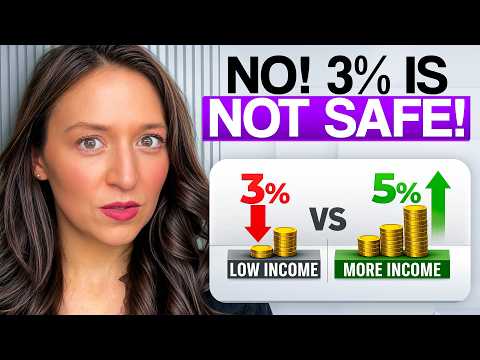
The 3% rule is no longer the average recommendation. It falls well below even conservative estimates, dramatically increasing the probability of success and reducing exposure to sequence of returns risk. Consequently, it also dramatically increases the odds of dying with very large balances. Even a 3.5% withdrawal rate has extremely high success rates (often 98%+) in many Monte Carlo simulations. Therefore, 3% is essentially in the "bulletproof zone." The cost of being too conservative is underspending for decades, delaying important experiences, and having a plan that is safe but ultimately unfulfilling.
However, there are specific situations where a 3% withdrawal rate might make sense:
1. **Early Retirement:** For those retiring at 50 or 55, a 40-year retirement horizon is more likely than a 30-year one. Morningstar's conservative forward-looking data shows that for a 35-year retirement, the safe withdrawal rate shifts to about 3.5%, and for a 40-year retirement, it moves into the 3.1% to 3.2% range. Extending the retirement timeline from 30 to 40 years reduces the safe withdrawal rate by about 20%. A longer retirement increases sequence risk, as there's exposure to more potential bad starting periods, and compounding starts working against the retiree due to longer withdrawals, inflation compounding, and prolonged portfolio volatility.
It's crucial to note that almost no thoughtful retirement plan uses a single fixed withdrawal rate for 40 years. Experienced planners often use a phased approach. In early retirement (e.g., age 50-67, before Social Security), a "bridge strategy" or "strategic spendown" might involve higher withdrawal rates (5-7%) because the portfolio is the primary income source and medical costs could be elevated. Once Social Security begins (e.g., age 67+), the pressure on the portfolio significantly reduces, and effective withdrawal rates from the portfolio might drop to 2-3%. Thus, for early retirement, it's about a dynamic plan where the withdrawal rate evolves with life stages and income sources, rather than a fixed 3% for the entire duration.
2. **Near Zero Risk of Failure:** If the goal is to never run out of money and ensure a massive surplus at death, or to have high confidence during a massive market downturn, a 3% withdrawal rate provides a huge margin of safety and stacks every card in the retiree's favor against sequence of returns risk.
3. **Large Portfolio Relative to Spending:** If a retiree has a substantial portfolio (e.g., $5 million) but modest spending needs (e.g., $120,000, which is a 2.4% withdrawal rate), they might naturally drift towards a 2% or 3% withdrawal. This is less about risk and more about optimization to meet actual spending needs, as there's no incentive to spend more simply because the ability exists.
4. **Desire for Flexibility and Optionality:** A 3% starting rate provides ample room to increase spending later in life, handle unexpected expenses, or adjust spending based on market performance. However, most retirees tend to spend more in their early, more active years (50s-60s) and less later in life (80s and beyond).
5. **Psychological Conservatism:** Human behavior often shows people clustering around 2.0% to 2.1% withdrawal rates, indicating they are more conservative than necessary. For individuals with a strong fear of running out of money, anchoring to a 3% withdrawal rate can combat this fear, even if it's lower than necessary. A 3% rate solves a specific problem of extreme caution, which most people don't actually have.
Conversely, a 3% withdrawal rate is likely too conservative in several situations:
1. **Standard 30-Year Retirement (around age 65):** For a traditional retirement age, current data does not support going as low as 3%. Even Morningstar's conservative forward-looking data places the safe withdrawal rate in the 3.7% to 3.9% range for a 30-year horizon. Dropping to 3% is an overcorrection, leading to underspending during the most active years and dying with more wealth than intended. Real-world longevity data indicates average retirement durations of 17-19 years for men and 19-22 years for women, with at least one spouse in a couple often having a 25-30 year retirement. These time horizons suggest 3% is too conservative for the vast majority of situations.
2. **Strong Guaranteed Income:** If a retiree has significant guaranteed income sources like Social Security, a pension, or an annuity, a large portion of their risk is already reduced. Essential expenses might be covered by these sources, reducing the burden on the investment portfolio. In such cases, retirees can generally safely spend more from their portfolio, not less.
3. **Flexibility with Spending:** This is a major shift in modern retirement planning. If a retiree is willing to be adaptable with spending—adjusting up when markets perform well and down slightly during downturns, or skipping an inflation raise in bad years—they can absolutely start with a higher safe withdrawal rate. Research shows that withdrawal rates of 5.5% or higher can be sustainable with such flexibility, especially when using guardrails. There's no reason to lock into an ultra-low 3% strategy if one is willing to be even slightly adaptable.
In conclusion, a 3% withdrawal rate is not the baseline and is not an income optimization strategy. Instead of focusing on 3% as the ideal rate, it's more productive to consider what specific problem a 3% withdrawal rate is trying to solve. While it addresses longevity risk (especially for early retirement, though often based on rigid models) and provides peace of mind, it generally falls short in maximizing lifestyle. A withdrawal strategy must both protect money and support the desired lifestyle, ensuring enjoyment of what has been worked for. Good planning involves knowing not only how much to save but also how much can be safely spent throughout life.