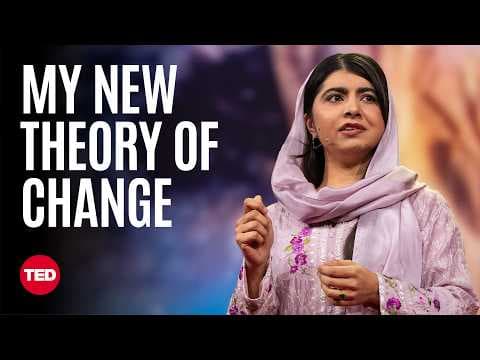
What I Got Wrong About Changing the World | Malala Yousafzai | TED
Audio Summary
AI Summary
As a child, I believed changing the world was simple: I'd inform leaders of problems, and they'd fix them. Living in a remote region of Pakistan, I thought our prime minister, hundreds of miles away, couldn't see our polluted rivers, broken school buses, or outdated hospitals. I was convinced that if I could only get their attention, these issues would be resolved.
At age 11, the Taliban took control of my town, banning girls from school. I knew this meant a future without choices, likely involving early marriage and multiple children by age 20. This was the moment to act. I became an activist, giving interviews, speaking on television, writing for the BBC, and appearing in a New York Times documentary, all to reach leaders and seek help. For speaking out, the Taliban shot me in the face at 15. I survived, and my story reached millions. Presidents and prime ministers wanted to meet me, and I finally had a platform to advocate for girls' education.
It was then I realized that change wasn't just about highlighting problems; it required arguing for every policy change and budget increase, gathering widespread support, and advocating for months or years to make even a small step forward. I came to believe change was slow but steady, incremental yet inevitable, built on hope, optimism, and faith that leaders would eventually do the right thing.
However, in August 2021, my belief in progress shattered. While recovering from surgery, I learned the Taliban had retaken Afghanistan. I was stunned, terrified, and angry. How could I maintain faith when an entire country was handed back to the very men who tried to kill me? Experts on TV claimed the Taliban had changed, but Afghan women I spoke with, activists working across the country, were frightened and disbelieved them. They were right.
Today in Afghanistan, girls are banned from school past sixth grade, and women, who were once doctors, politicians, engineers, and artists, are denied university and careers. Speaking in public is a crime for women, but the Taliban has decreed it legal for men to beat their wives and daughters. This is a system of gender apartheid.
For years, my purpose was to serve girls. After Afghanistan, my childhood optimism vanished, yet I couldn't abandon the cause, knowing exactly what Afghan girls were enduring. I understood the feeling of being overwhelmed and lost, but I also learned how to keep fighting.
First, you must start with something. Unable to undo the catastrophe in Afghanistan, I got out of my hospital bed to help. I began by supporting underground schools, as Afghan girls are risking their lives to continue learning through radio lessons, cassette tapes, and secret study groups. It’s not the education they deserve, but it's a start.
Second, working with others is crucial. This led me to unexpected places like movie theaters and football fields. I produced two films, "Bread and Roses" and "Champions of the Golden Valley," telling stories of Afghan men and women resisting the Taliban. I also joined the campaign of the Afghan women's national football team to push FIFA to let them compete in exile. The Taliban are erasing women from public life, and I am doing the opposite, showing Afghan women speaking, singing, playing sports, and standing up for their rights, connecting the world to their struggle and affirming every life's equal worth.
My final lesson is to stay ambitious. Even when losing a battle, the bigger the fight, the bolder you must be. What's happening in Afghanistan is a wake-up call. The Taliban's cruelty isn't new; they tried to silence me a decade ago in Pakistan and had stopped girls from school in parts of Afghanistan before I was born. Yet, there are no international laws against gender apartheid to hold perpetrators accountable. Afghan women are campaigning to add these abuses to the UN's crime against humanity treaty, and I've joined this movement to ensure change for women and girls globally.
It's a huge goal, and bringing the Taliban to justice may take years, but I will fight to prevent these crimes against another generation of girls. I want my 11-year-old self to be proud, to know that while changing the world isn't simple, I won't give up. I don't have all the answers, and progress is never guaranteed. No single speech, story, moment, or person can bend the arc of history alone. But if we start with something, work together, and stay ambitious, hope transforms from something we await to something we create.