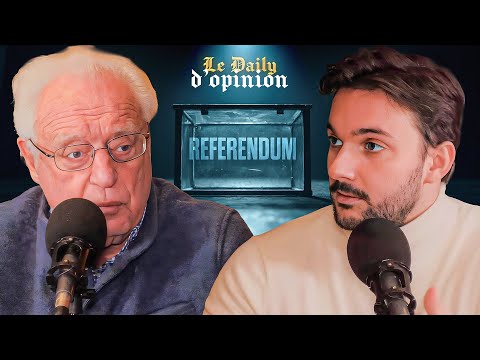
La fin de la démocratie représentative
AI Summary
The following summary explores the crisis of representative democracy and the potential for a shift toward direct democracy, based on the insights provided in the transcript.
### The Obsolescence of Representative Democracy
Representative democracy, once a necessary compromise for an era of slow communication, is increasingly viewed as obsolete. In the past, when it took weeks to travel between cities, electing representatives to make decisions was a practical requirement. However, in the modern digital age, information is instantaneous. The speakers argue that technology, such as blockchain, could now facilitate direct voting on various issues, yet the political structure remains stuck in an intermediate mode where the population elects individuals or parties rather than voting on specific ideas.
This system has led to a profound crisis of legitimacy. In many Western nations, particularly France, political leaders often govern with very low approval ratings. Even popular figures rarely command more than 50% of public trust. The "majoritarian fact" that underpins representative democracy is failing because the "legal" decisions made by the government no longer align with the "legitimate" desires of the people. A primary example cited is the 2005 European referendum, where the French public voted against a treaty, only to have it effectively imposed upon them later through the Lisbon Treaty.
### The Rise of the Administrative Class
A central theme of the discussion is the capture of power by a professional "administrative class." In France, the state’s share of the GDP has grown to nearly 60%, creating a massive bureaucratic structure that operates independently of the public will. Most modern politicians are themselves products of this administrative machine, often coming from civil service backgrounds. This creates a conflict of interest: those tasked with executing political orders are now the ones giving them.
This class prioritizes its own survival and the maintenance of the state apparatus over the interests of the citizenry. To protect their power, they have "externalized" law, making European or international courts superior to national sovereignty. By claiming that international law overrides the national constitution, this administrative elite can bypass the will of the people, a move the speakers characterize as a form of betrayal.
### The Disconnect and the Rise of the Radical Right
The rise of radical right-wing parties across Europe is framed not as a surge in extremism, but as a reaction to the failure of traditional parties. The speakers argue that conservatives have betrayed the nation, while social democrats have betrayed the workers. This has left a void filled by parties that demand a return to national sovereignty and stricter immigration controls.
Immigration is a flashpoint for this disconnect. The transcript suggests that the public’s frustration stems from the perception that taxpayer money is being diverted to support illegal immigration while essential services like hospitals and schools decline. Furthermore, the influence of non-governmental organizations (NGOs) is criticized. These organizations often receive massive state subsidies yet pursue agendas that may run contrary to the national interest, effectively acting as an unaccountable extension of the administrative class.
### The Swiss Model: Subsidiarity and Sovereignty
The Swiss model is presented as the ideal alternative. Unlike the French system, where the "people" are abstractly sovereign, in Switzerland, every individual citizen is sovereign. The system is built on "subsidiarity," meaning decisions are made at the most local level possible—the commune—and only move up to the canton or national level if absolutely necessary.
This structure ensures that the population feels a sense of ownership over political decisions. In Switzerland, citizens vote several times a year on specific projects or laws. This prevents the "theatre of shadows" seen in representative systems, where politicians engage in performative conflict while remaining part of the same elite circle. The speakers note that Swiss industrial production has grown faster than its GDP over the last 30 years, suggesting that direct democracy leads to greater economic efficiency and social stability.
### The Erosion of Liberal Values and Property Rights
The discussion touches on the decline of classical liberal values, specifically the right to property and freedom of speech. The speakers argue that the administrative state is gradually eliminating property rights through new taxes and regulations. They also warn against the suppression of "hate speech," noting that the definition of hate is often monopolized by the ruling class to silence dissent.
A poignant example of the dangers of technocratic rule is the debate over euthanasia or "end-of-life" laws. The speakers fear that such decisions, when left to an administrative state focused on fiscal efficiency, could lead to a "culture of death" where the elderly are pressured to end their lives to relieve the burden on social security. They argue that such profound ethical questions must be decided by the sovereign people via referendum, not by a technocratic elite.
### Conclusion: The Choice Ahead
The final conclusion is that to save democracy, it must become direct. The current trajectory is leading toward a form of technocratic dictatorship, similar to models seen in Asia, where economic growth is prioritized over political liberty. While such systems can be efficient, they carry a high risk of authoritarianism and corruption. For the West to thrive again, power must be stripped from the professional political-administrative class and returned to the individual citizen. Only when the sovereign speaks directly can a country achieve true stability and legitimacy.