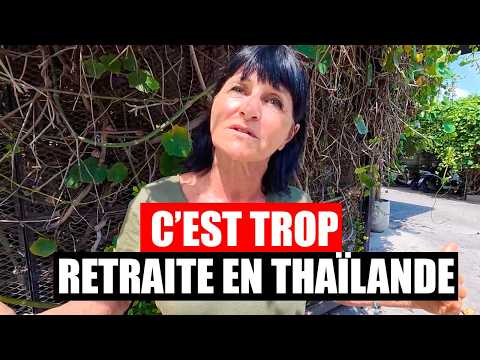
Elle ouvre une boulangerie familiale en Thaïlande ( Koh Samui)
AI Summary
In this interview, Sabri meets Madou, a French expatriate who has been living in Koh Samui, Thailand, for eight months. A former modern jazz dance teacher, Madou discusses her transition from a dynamic career in France to an active retirement abroad, centered around a family business and a deep commitment to cultural adaptation.
**The Path to Thailand**
Madou and her husband, Jean-Luc, are lifelong travelers who sought a retirement far removed from the "standard" French lifestyle of routine markets and repetitive sports. Before settling in Thailand, they explored various destinations, including North Africa and Senegal. While they enjoyed Senegal for short stays, they felt the culture was not suited for their long-term goals.
They eventually fell in love with Thailand’s "coolitude"—a relaxed atmosphere free from the high-pressure environment of Europe. After visiting pre- and post-COVID, they decided to make the move permanent. However, unlike many retirees who split their time between France and Thailand, Madou refused to be separated from her children and grandchildren. Her solution was to bring the entire family along. Today, her daughter and granddaughters are settled in Koh Samui, with the children attending a local French school.
**Cultural Adaptation and the Thai Way of Life**
Madou emphasizes that successful expatriation requires a mindset of curiosity and respect. She views the move as an "anti-aging" process for the brain, as it forces her to remain curious and learn daily. One of her primary pieces of advice is to learn the local language. Even knowing a few words of Thai significantly changes how locals perceive you, signaling respect and an intention to integrate.
She acknowledges the cultural differences, particularly the Thai approach to time and work. While the European mindset is often focused on speed and anticipation, Thais tend to live in the present moment. This can be challenging for business owners—such as when employees don't show up or fail to anticipate needs—but Madou views it as a lesson in patience and humility. She prefers the island life of Koh Samui over the noise and pollution of Bangkok, though she admits that the "high season" on the island brings its own challenges, including traffic and crowded beaches.
**The Family Business: Chez Kérian**
The heart of their daily life is "Chez Kérian," a French neighborhood bakery located in the Buffalo Market area. The business belongs to her son, Kérian, who currently splits his time between France and Thailand. Madou and Jean-Luc act as representatives and supervisors on-site.
The bakery is built on the concept of "family transmission." Every recipe has a history: the quiche comes from an aunt, the yogurt cake is a recipe from Jean-Luc’s mother, and the "coca" (a stuffed pastry) is a specialty from Jean-Luc’s grandmother. They aim to recreate the "cozy" feeling of a French neighborhood bakery where the smell of fresh croissants evokes childhood memories.
**Managing a Multicultural Team**
A significant portion of the interview focuses on the bakery’s staff, who are primarily from Myanmar (Burma). Madou describes a deep bond with her employees, many of whom fled the conflict in their home country. Because they are far from their own families, the staff has come to view Madou and Jean-Luc as parental figures.
Madou praises the Burmese staff for their investment, loyalty, and resilience. She notes that they are often more stable than local Thai workers, who may change jobs more frequently. The bakery operates as a "family of staff," where they eat together and maintain open communication. Madou even mentions speaking with the employees' parents in Myanmar via video calls to reassure them that their children are in good hands.
**Challenges of the Bakery Business**
Running a French bakery in the tropics presents technical hurdles, most notably the humidity. Madou explains that their French baker had to spend significant time experimenting with dehumidifiers, fans, and specific techniques to ensure the bread and pastries maintained their quality. Humidity often makes bread go soft quickly, a constant battle in the Thai climate.
Regarding the local market, Madou observes that while European tourists seek out the familiar taste of home, Thai locals are increasingly becoming fans of French pastries, particularly croissants and "chocolatines" (a point of lighthearted debate in the video regarding the regional naming of pain au chocolat).
**Reflections on the Expatriate Community**
The interview touches on the darker side of expat life in Thailand. Sabri and Madou discuss the issue of "denunciation," where some expats report others to immigration authorities, often for financial gain or to eliminate business competition. Madou finds this behavior shameful and stresses that newcomers must remain humble.
**Final Conclusions and Advice**
Madou concludes that Thailand is a land of opportunity for those willing to adapt. Her main takeaways for anyone considering a similar move are:
1. **Preparation:** Do not arrive in "conquered territory." Study the history and culture beforehand.
2. **Humility:** Accept that you are a guest and must adapt to the host country, not the other way around.
3. **Family Harmony:** For Madou, the success of her expatriation is measured by the fact that her family is together, sharing in the adventure of the bakery and the island lifestyle.
She remains eager for more travel, expressing a desire to explore Northern Thailand (Chiang Mai), Vietnam, and Japan, proving that her "active retirement" is just the beginning of a new chapter.