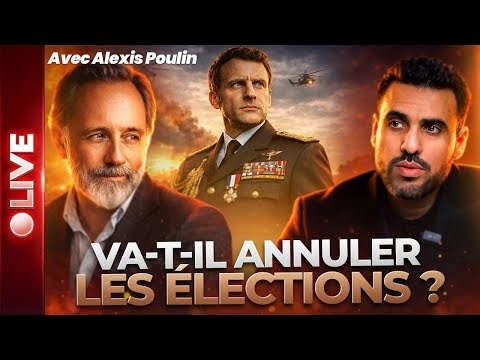
Comment Macron veut exploiter la guerre en Iran jusqu'aux élections de 2027
AI Summary
This summary explores the critical state of independent journalism, the geopolitical ramifications of the conflict in Iran, and the perceived erosion of democracy and human dignity under globalist agendas. Based on the provided transcript, the discussion highlights a disconnect between mainstream media narratives and the lived reality of citizens.
### The Crisis of Information and Energy
The dialogue begins by contrasting the French mainstream press with independent and international sources. The speakers argue that the French media landscape is increasingly restricted, whereas even Israeli citizen journalism provides a more diverse perspective on the Iranian conflict. This lack of transparency coincides with a domestic energy crisis in France, where diesel prices have soared to 2.50 euros per liter. This inflation is attributed to a combination of high taxes, market opportunism, and the potential blockade of the Strait of Hormuz. The government’s reassurance regarding fuel stocks is met with skepticism, as the long-term impact of expensive energy and imports threatens to destabilize the population.
### Military Improvisation and Historical Imperialism
The military operation against Iran is characterized as disorganized and poorly documented. Unlike the televised wars of the past, this conflict is shrouded in censorship. The speakers suggest that the U.S. and its allies underestimated Iran’s complexity and its decades-long preparation for such a confrontation. Historically, this follows a pattern of Western interventionism. Leaders like Mossadegh in Iran, De Gaulle in France, and Gaddafi in Libya were targeted not for being "dictators," but for seeking sovereignty—whether by nationalizing oil or proposing alternative currencies like the gold dinar. The transcript posits that the U.S. consistently labels sovereign leaders as "Marxists" or "terrorists" to justify regime changes that ultimately serve imperialist and financial interests.
### From Epstein to Digital Surveillance
A significant portion of the discussion focuses on the recent release of the "Epstein Files." The speakers argue that these documents prove the moral and financial corruption of a global elite that includes high-profile figures like Bill Gates, the Clintons, and Prince Andrew. However, they suggest that the "Epstein model" of physical blackmail has evolved. Today, mass surveillance is conducted through technology firms like Palantir and Meta.
Originating from DARPA’s "Total Information Awareness" project, these tools allow for the digital monitoring of entire populations. The transcript highlights the "Lavender" AI system used in Gaza as a chilling example of how technology now automates life-and-death decisions, removing human ethics from warfare. This transition from physical compromise to total digital control is viewed as the ultimate tool for the "Deep State" to maintain power without public consent.
### Macron and the Globalist Agenda
Emmanuel Macron is described not as a traditional president, but as a "pawn of globalism." His career is linked to the Rothschild banking house, and his policies are seen as prioritizing international financial institutions like BlackRock over French national interests. While Macron adopts the posture of a "war leader," French industrial sovereignty is declining, evidenced by the sale of Alstom’s turbines and the struggles of strategic naval suppliers.
The speakers express concern that Macron might use a state of emergency—citing the conflict in Ukraine or Iran—to suspend or cancel the 2027 presidential elections, following what they call the "Zelensky model." They argue that the French political system has been hollowed out, with "Young Global Leaders" from the World Economic Forum occupying key positions across the administration to ensure the permanence of "Macronism," regardless of who wins an election.
### The Dehumanization of Society
The dialogue critiques recent social trends, particularly the rise of assisted suicide and euthanasia. Using Canada as a warning, the speakers note that assisted suicide now kills more Canadians than World War II. They view this as a "death industry" designed to reduce the cost of caring for the elderly and the vulnerable. This is framed as a form of "administrative nazism" or eugenics, where human life is treated as a commodity to be managed by the state. This dehumanization extends to education and the "Woke" movement, which the speakers believe are used to destabilize traditional values and sexualize children, further eroding the foundation of society.
### Resistance and the Multipolar World
Despite the power of the "globalist machine," the transcript identifies a growing "Spring of the Peoples." The conflict in Iran is notably unpopular, and a multipolar world is emerging that challenges U.S. and Israeli hegemony. Figures like Victor Orban in Hungary are highlighted for resisting EU and Ukrainian corruption, such as the seizure of opaque funds and gold being transported across borders.
The speakers conclude that the only path forward is the proliferation of citizen journalism. They urge the public to stop relying on billionaire-owned media and to seek out independent voices. By becoming "grains of sand" in the machinery of global control, citizens can challenge the censorship and "moral vis" of the ruling elite. The goal is to reclaim democracy and human dignity before the window for free expression is closed forever by new laws and digital monitoring.