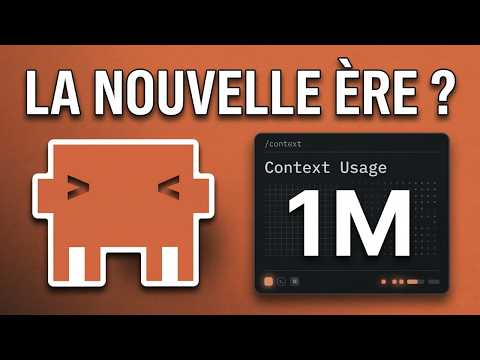
CLAUDE a RÉSOLU le plus GROS problème de l’IA.
AI Summary
This summary covers the recent announcement by Anthropic regarding the massive expansion of the context window for their latest artificial intelligence models, Opus 4.6 and Sonnet 4.6. Based on the provided transcript, the following points outline the technical shift, the performance benchmarks, and the practical business implications of this update.
**The Shift from Context Length to Context Rot**
The speaker, Simon de Lima, explains that while the headline news is the increase to a 1-million-token context window, the true breakthrough is the mitigation of "Context Rot." To understand this, one must distinguish between context length and context rot. Context length is the "working memory" of the AI—the maximum amount of text it can process in a single conversation. If you exceed this limit, the model simply stops "seeing" the earlier information.
Context rot, however, is a more subtle and frustrating problem where the AI's performance degrades as the conversation gets longer. Even if a model is technically capable of holding a large amount of information, it often becomes less precise, less reliable, and starts "forgetting" details long before the official limit is reached. Simon uses a desk analogy: context length is the size of the desk, while context rot is the clutter and disorganization that makes it impossible to find a specific folder, even if it is physically sitting on that desk. Previous studies, such as the Chroma study from last summer, highlighted that models would often "drown" in information, becoming unreliable as the context grew.
**The 8-Needle Benchmark**
To prove the superiority of Opus 4.6, Anthropic utilized the "8-Needle Test." This benchmark involves feeding the model a massive amount of data—up to 1 million tokens—filled with repetitive or similar content, such as various poems about dogs, cats, and cows. Hidden within this "haystack" of information are eight specific "needles" (specific poems about dogs) placed at different points in the conversation. The model is then asked to retrieve these specific pieces of information in a precise order.
This test is exceptionally difficult because the model must distinguish between very similar items across a vast field of data. The results shared in the transcript show a significant gap between Anthropic and its competitors:
* **Opus 4.6:** Achieved a 78% success rate at 1 million tokens.
* **GPT 5.4:** Achieved a 36% success rate.
* **Gemini 2.5 Pro:** Achieved a 26% success rate.
* **Sonnet 4.5:** Achieved an 18.5% success rate.
A key takeaway from these figures is the "slope" of performance degradation. While all models (and humans) eventually lose some precision as information loads increase, the drop for Opus 4.6 is remarkably gentle. Moving from a context of 256,000 tokens to 1 million tokens resulted in only a 14% drop in performance. Simon compares this to a modern car with a predictable fuel gauge; you can see the performance decreasing slowly and predictably, rather than the "engine" suddenly failing without warning as it did in older models.
**Business and Practical Applications**
For professionals selling AI solutions, this update changes the value proposition from "summarization" to "complete comprehension." Simon provides the example of an automated sales follow-up tool. Previously, due to context limitations, an AI generating a follow-up message on WhatsApp would have to work with "impoverished" data—perhaps just a summary of the last call or the last three messages.
With the 1-million-token window, the AI can now ingest the entire history of a prospect, including every call transcript, every message exchange, and every objection ever raised. This allows the AI to generate "surgical," highly personalized follow-ups that are far more effective. This capability makes AI solutions viable for industries that handle massive volumes of data, such as legal and judicial sectors, where analyzing long histories and complex documents is mandatory.
**Technical Updates and Pricing**
The update includes several practical improvements for users on the "Max" plan:
1. **Model Availability:** These features are specific to Opus 4.6 and Sonnet 4.6.
2. **Document Capacity:** The capacity for analyzing images, PDFs, and documents has increased from 100 to 600 pages or images, all while maintaining high performance.
3. **Linear Pricing:** Previously, Anthropic applied a "price penalty" for large contexts. Any tokens exceeding the 200,000 mark cost more than the initial tokens, making large-scale production expensive. This multiplier has been removed. The price for token number one is now the same as token number 900,000, making API costs flat and predictable.
**Conclusion and Outlook**
Simon concludes by emphasizing that while the technical jargon of benchmarks and tokens can be complex, the core message is simple: AI tools are now ten times more reliable than they were six months ago. This reliability stems from the model's ability to "read and retain" massive amounts of information without drowning. This accessibility reduces the need for complex technical infrastructure and opens the door for entrepreneurs to sell high-value, customized solutions to businesses.
To further explore these opportunities, Simon invites viewers to a live session on March 22nd at 8:00 PM. During this event, he plans to demonstrate how to use "Claude Code" to build and commercialize AI solutions. His goal is to show how to move beyond "playing" with AI and instead use it to build a real business, gain independence, and provide tangible value to companies in a changing economic landscape. He suggests that in the face of AI advancement, one must choose to be the person who implements these solutions rather than the one replaced by them.