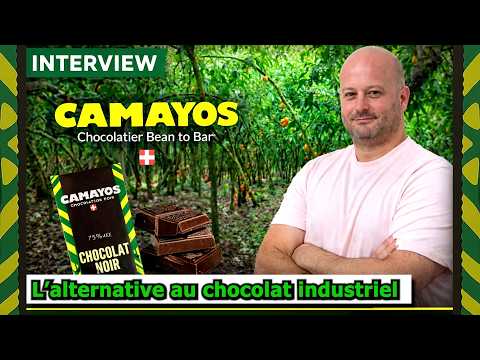
INTERVIEW – Fabrice révèle les secrets de l’industrie du chocolat ! Parrainez un cacaoyer Camayos !
AI Summary
In this discussion, Fabrice Petitjeunet, the founder of Camillos, provides an in-depth look at the chocolate industry, contrasting the deceptive practices of large-scale industrial producers with his own integrated, artisanal model in Cameroon. Having spent a decade building Camillos, Petitjeunet’s mission is to offer a clean alternative to the "industrial junk" often found on supermarket shelves by controlling the entire production chain—from the cocoa tree to the finished chocolate bar.
### The Failure of the Industrial Model
A central theme of the conversation is the current crisis in the global cocoa market. Approximately 60% of the world's cocoa comes from Ivory Coast and Ghana, where production relies on intensive, high-yield farming. This model uses hybrid trees, heavy pesticides, and chemical fertilizers, often at the expense of the forest. Petitjeunet explains that this model is reaching its limit; after 25 years of exhaustion, the soil and trees are failing, leading to a 5% to 15% drop in yields. While the industry blames climate change or fungi, Petitjeunet argues the real issue is an unsustainable agricultural model.
Because these two countries dominate the market, any slight dip in their production causes massive price volatility on the London Stock Exchange. Industrial chocolatiers are currently struggling with these price spikes, leading to a "dishonest game" where they boycott producers to force prices down, knowing that raw cocoa beans cannot be stored for long in tropical climates without spoiling.
### The Camillos Alternative: Agroforestry and Independence
Camillos operates on a completely different philosophy: agroforestry. By preserving the forest and planting cocoa trees in the shade of larger trees, they create a resilient ecosystem. Unlike industrial plantations that produce up to 3,500 kg per hectare, Camillos produces a more modest 500 to 800 kg. However, their production is stable and independent of stock market fluctuations.
Because Camillos owns its plantations in Cameroon (currently spanning about 96 hectares), their raw material costs have remained steady for a decade. This independence allowed them to support other artisans during recent price hikes by providing them with cocoa butter and chocolate at fair prices. Petitjeunet emphasizes that while the world believes there is a cocoa shortage, the reality is a disruption caused by the collapse of the intensive industrial model and market speculation.
### Sponsoring the Future: The Solayos Project
To expand this virtuous cycle, Petitjeunet launched the "Sponsor a Cocoa Tree" initiative through the association Solayos. For a €5 contribution, a donor can fund the planting and four-year maintenance of a cocoa tree until it begins producing. This project serves three goals: environmental preservation, social support, and economic stability.
Socially, the project provides local employment at nearly double the regional wage, including daily meals. Solayos also funds infrastructure like wells and schools and provides emergency medical assistance, such as financing cesarean sections for local workers. To ensure transparency, sponsors are invited to a WhatsApp group where Petitjeunet shares live updates and videos directly from the fields in Cameroon.
### Industrial Deception and the "Disappearing" Chocolate
The discussion reveals how industrial manufacturers manipulate consumers through marketing and labeling. Petitjeunet points out that brands like Milka or Lindt are increasingly removing the word "chocolate" from the front of their packaging. This is often because the products no longer meet the legal definitions of chocolate due to high sugar content or the substitution of cocoa butter with cheaper vegetable fats like palm or coconut oil.
Industrially produced chocolate is often "asceptized." Large companies harvest unfermented or poorly treated beans, roast them at high temperatures to kill bacteria and mask defects, and then rely on heavy doses of sugar and synthetic vanilla to create a standardized taste. Petitjeunet contrasts this with the artisanal "bean-to-bar" process, where the natural fermentation of the beans develops complex, terroir-specific flavors that vary from year to year, much like fine wine.
### Health Concerns: Cadmium vs. Hexane
Addressing recent health scares, Petitjeunet dismisses the controversy over cadmium as a distraction. While cadmium is a heavy metal found naturally in soil, the levels in Cameroonian cocoa are well below European safety standards. He argues the real health risk is the industrial extraction of cocoa butter. Many large-scale producers use hexane—a petroleum-based solvent—to chemically extract fat from cocoa beans. While the industry claims only traces remain, the long-term health impacts of consuming these residues are unknown. Camillos avoids this by using mechanical presses to extract their own pure cocoa butter.
### Innovation and the Future
The future of Camillos lies in further integration and sustainability. Petitjeunet recently began an experimental solar-powered production facility in Cameroon. By using solar panels to power machinery, they can extract cocoa butter and create cocoa mass on-site without relying on an unstable power grid. This reduces the weight of exports by 15%, cutting transport costs and carbon emissions while keeping more of the economic value within Cameroon.
Ultimately, Petitjeunet encourages consumers to become "experts" of their own consumption. By choosing artisanal, traceable products over industrial "ersatz" chocolate, consumers can fight against child labor and environmental destruction. Camillos stands as proof that a balanced model—benefiting the environment, the producer, and the consumer—is not only possible but sustainable for the long term.