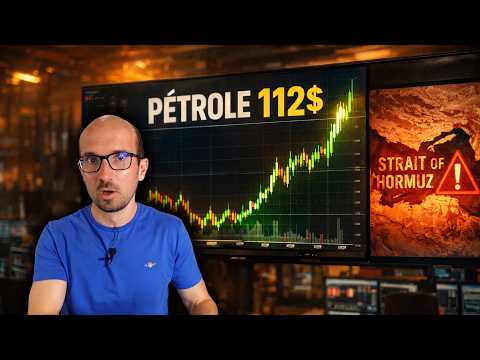
Pétrole à 112$, ultimatum le 6 avril : cette semaine peut tout changer
AI Summary
This summary provides an overview of the current geopolitical and economic situation, focusing primarily on the ongoing conflict in Iran and its widespread impacts on global markets. The speaker highlights key developments, market reactions, and future expectations, emphasizing the volatility and uncertainty pervading the financial landscape.
The primary topic revolves around the war in Iran and its economic repercussions. Donald Trump addressed the White House, stating that operations were nearing completion but also threatening severe strikes on Iran over the next two to three weeks, potentially sending the country "back to the Stone Age." This contradictory message, delivered within a 19-minute speech, has created significant uncertainty. The context includes an ultimatum set for April 6th, requiring Iran to reopen the strait, which has been closed. While Iran has selectively allowed some vessels (Chinese, Pakistani, Iraqi, Malaysian, Thai, and recently Filipino) through, it is on a case-by-case basis and not for everyone. Iran has set five conditions for a ceasefire and reopening the strait: an end to American and Israeli attacks, a guarantee that the war will not resume, payment for war reparations, recognition of Iranian sovereignty over the strait, and an end to all attack operations on Iran and its allies in Lebanon and Iraq. Despite Trump claiming negotiations are ongoing, Iran denies this, leading to a complete impasse.
This stalemate has complicated market conditions. On Thursday, before American markets closed and Euronext on Friday, oil prices continued to surge, with no signs of de-escalation. Even though Iran announced negotiations were on the table before the American market close, oil prices rose by 13% on Thursday, remaining around $112 a barrel. These levels haven't been seen since 2022 and are close to the highs of summer 2008. The consequences are evident: gasoline prices in the U.S. have increased to over $4 per gallon, leading to imported inflation globally. Airlines are struggling, and some countries, like the Philippines, have declared an energy emergency.
The dollar continues to strengthen, showing little signs of deflation, even if it calmed slightly on Thursday. Interest rates are stabilizing, remaining below 4.30-4.50%. Surpassing 4.5% would indicate a significant shift in economic conditions. Jerome Powell, speaking this week, reiterated that the Federal Reserve would react to the economic effects of the conflict once concrete data becomes available, suggesting a wait-and-see approach. The Fed is currently in a difficult position: it cannot lower interest rates due to inflation, nor can it raise them due to a struggling economy, as evidenced by recent U.S. employment figures. This situation points to the specter of stagflation—stagnant growth coupled with rising prices.
U.S. monthly employment figures were pending at the time of the recording, but the previous month saw nearly 100,000 job losses against an expectation of 50,000 creations. The unemployment rate remains at 4.4%. The upcoming figures for March will be crucial in assessing the initial impact of the Iran conflict on U.S. growth and employment. It's important to note that American markets are closed on Friday and will reopen on Monday, while Euronext will remain closed on Monday. This means reduced liquidity and increased volatility, often leading to significant market gaps after the weekend.
Next week, inflation figures for March will be released, incorporating the initial surge in oil prices from $70 to over $100-$110 per barrel. If inflation accelerates further, it could have severe implications.
Despite the turmoil, markets have performed relatively well this week. The S&P 500 and other American indices reacted positively to the 50-week moving average, marking the first positive week for U.S. markets since the conflict began. However, daily charts show strong resistance levels, indicating that the current movement is a technical rebound. Bearish moving averages persist on hourly and daily charts, and indices remain below previous range lows, warranting caution, especially with rising oil prices. The Nasdaq has been affected by Tesla’s disappointing delivery figures, which led to a more than 5% drop on Thursday.
European indices show similar trends. The DAX performed well but is returning to previous range lows from May, suggesting a bearish excess. The CAC 40 also faces significant resistance. The speaker mentions favoring sales on the CAC due to resistance, but quickly cutting positions when news of potential negotiations emerged, leading to market excitement. This highlights the importance of cutting losses quickly when the market proves one wrong, rather than hoping for a favorable outcome over several days.
Ultimately, markets seem to be anticipating an end to the conflict, which appears contradictory given the continued rise in oil, interest rates, and the dollar. This presents a conflict between technical rebounds and underlying contradictions, leaving the market highly susceptible to news, tweets, and misinformation.
Gold prices, after a 15% loss in one month (its worst performance since 2008), have performed well this week. Central banks continue to buy gold, with China extending its purchases for the 15th consecutive month. Anticipation of stagflation may also be driving investors towards gold. The speaker, who is part of IVT (an investment community), mentions having capitalized on this rise in gold prices, reaching a first profit target and nearly a second.
The speaker stresses the importance of adapting to extreme volatility and avoiding overreaction. Using the example of the defense sector, an investment that initially dropped 7% (on an ETF below €11) rebounded 11% in three days. This illustrates the current volatility and the need for a medium-term strategy with longer timeframes to allow the market to breathe. Over-investing and reacting emotionally to every piece of news is detrimental, as it rarely leads to success and hinders the ability to learn from mistakes.
Other news includes Sony raising the price of its PS5 to over $650 in the U.S. (a $100 increase), and the PS5 Pro to $900. This unprecedented price hike is attributed to economic pressures, rising component costs (driven by AI data centers absorbing memory components), and increased transport and energy costs due to the Iran conflict, demonstrating widespread inflation. Oracle, a major software publisher, announced massive layoffs of 20,300 employees (18% of its global workforce), including 12,000 in India. This is due to Oracle’s heavy investment in AI data centers, which consumes available cash, leading to cuts in human resources. Tesla’s deliveries were slightly below expectations (358,000 vs. 365,000-370,000 vehicles), and the company produced 50,000 more vehicles than it sold, indicating a demand issue. Despite this, Tesla recorded a near-historic high in France in March, with a 200% increase in deliveries compared to March 2025. The speaker remains invested in Tesla, having bought shares at $160-$180 and profited significantly.
In conclusion, the market is highly volatile, driven by the Iran conflict, impacting oil, interest rates, the dollar, gold, and risk assets. The Fed is constrained, and upcoming employment and inflation figures will be critical. Underlying concerns persist beyond immediate price increases. The speaker advises a progressive approach to investment decisions, focusing on a few priority assets, taking a long-term perspective, and avoiding emotional reactions. It's acknowledged that predicting market movements is difficult for everyone, and it's essential to rely on precise plans rather than succumbing to external pressures or overreacting to daily news.
The speaker ends on a positive note, wishing listeners a good Easter weekend and urging them to rest, as the coming week will be intense with the April 6th ultimatum, U.S. inflation data, and continued bullish trends in oil prices. The speaker expresses gratitude for listener support and encourages continued engagement despite difficulties.