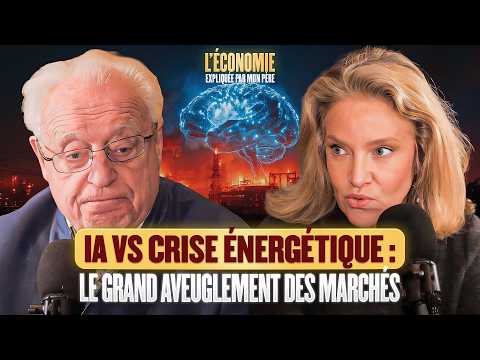
IA vs Crise Énergétique : Le grand aveuglement des marchés selon Charles Gave
AI Summary
The video begins with a reflection on the paradoxical nature of May 1st as a day of labor where work is forbidden, questioning the philosophical implications of a society dictating when one can and cannot work. This leads to a broader discussion about the current state of financial markets, which the speaker finds perplexing.
The S&P 500's 12-day consecutive rise and its recovery to pre-crisis levels are highlighted, juxtaposed with rising Treasury yields and oil prices. This disconnect prompts an investigation into the reasons behind this seemingly irrational market behavior. The speaker draws a parallel to a "Schrödinger's Cat" scenario for the situation in Iran, where the outcome is uncertain, and likens market movements to the unpredictable behavior of a drunk person in the short term, only becoming clearer over longer periods.
A key hypothesis explored is that strong market rebounds often occur during bear markets. The speaker cites the 1987 crash as an example, where despite a significant daily drop, September saw more upward than downward trading days. This phenomenon is attributed to market memory, where extreme volatility, whether upwards or downwards, creates a lasting impact that takes approximately six months to dissipate. The 2007 credit crisis, triggered by events like the collapse of Bear Stearns and BNP Paribas' inability to price certain funds, is also mentioned as an instance where an initial shock led to broader market instability. The prolonged "vibration" of the market after significant deviations is noted, with an estimated six-month period for markets to absorb and "forget" such events.
A significant portion of the recent market rally is attributed to the surge in semiconductor stocks. The speaker expresses surprise at Taiwan's market capitalization surpassing that of the UK, highlighting the dramatic rise of companies like Samsung Electronics and SK Hynix. This leads to a discussion about the influence of passive investing (indexation) and algorithmic trading, which now constitutes a large percentage of market transactions, potentially exacerbating short-term movements.
The possibility that the markets are in denial about geopolitical and energy crises, with the focus solely on Artificial Intelligence (AI), is raised. The speaker suggests that the current market optimism might be driven by the AI narrative, leading investors to heavily invest in semiconductors.
The discussion then shifts to China's resilience in the face of energy crises, contrasting it with past vulnerabilities. The speaker credits China's ability to learn from past mistakes, including the 2008 crisis exacerbated by a major earthquake and the subsequent global financial downturn. This period prompted China to develop resilience through strategic stock-piling and a push towards electrification, a strategy that was accelerated after facing US sanctions on semiconductors in 2016. This drive towards an "antifragile" economy, even at a higher cost, is presented as a sensible strategy in an increasingly complex world.
The cyclical nature of the semiconductor industry is emphasized, likening it to a "pig cycle" where shortages lead to price spikes, followed by gluts and price collapses. While acknowledging semiconductors as a long-term investment, the extreme volatility is cautioned against. The speaker also touches upon the idea that short-selling liquidations, coupled with short-term speculation and algorithmic trading, can create self-reinforcing upward movements.
The conversation delves into the capital-intensive nature of AI, contrasting it with the internet boom. The speaker notes that AI requires massive upfront investment, and the ability to raise capital is crucial for success, citing examples of battery manufacturers and data center projects that have faltered due to insufficient funding. The importance of savings being transformed into capital investment is stressed, a process that China is seen as excelling at, leading to economic growth, while Western countries are criticized for misallocating savings towards social transfers rather than capital development.
The fragility of European energy independence is highlighted, referencing the shocks from the Iran situation and the Ukraine war. The speaker urges a reevaluation of the mental model that assumes abundant and cheap oil, advocating for investment in diverse electrification methods like solar, wind, nuclear, and geothermal energy. The challenge of cross-border electricity pricing within Europe is also raised, where countries investing heavily in energy infrastructure might inadvertently subsidize others who do not. The need to modernize electrical grids and potentially reduce import duties on solar panels is suggested to foster national energy independence.
The discussion broadens to encompass a critique of political decision-making, particularly regarding energy policy and infrastructure. The speaker expresses skepticism about former Prime Minister Édouard Philippe's past decisions to close nuclear power plants, questioning his long-term vision. The importance of freedom of movement is underscored, referencing past public transport strikes in Paris. The speaker also criticizes a perceived disconnect between politicians focusing on long-term, abstract goals like saving the planet, while neglecting immediate, tangible issues impacting citizens' living standards.
The dilemma of the US dollar and its role in global finance is explored. The significant holdings of US Treasury bonds and corporate debt by foreign investors are noted. The speaker suggests that a potential shift away from the dollar as the sole currency for oil transactions could have profound implications. A possible explanation for the stock market rally is the decline in the bond market, leading investors to seek higher returns in equities. This "Turkish portfolio" approach, where investors sell less attractive assets (bonds) to buy more promising ones (stocks), is proposed as a driver of current market trends.
The military spending debate is touched upon, questioning the cost-effectiveness of aircraft carriers versus drones. The speaker criticizes the French government's decision to build a new aircraft carrier, "France Libre," deeming it an expensive and potentially obsolete investment. The importance of adaptability and interpreting reality, as opposed to adhering to rigid political directives, is emphasized.
The conversation turns to the economic prospects of China, Russia, and Latin America. China's investment in high-capital-intensive, long-duration projects like nuclear power plants is seen as a strategic move that will yield future returns, even if current cash flows are negative. The speaker contrasts China's approach to accounting, which may penalize official profits, with Western companies that tend to optimize for profit reporting.
Regarding investment portfolios, the speaker discusses a diversified approach including gold, energy ETFs, Asian ETFs, and Japanese bonds. Uncertainty about the future price of energy leads to a cautious stance on immediate investment in energy ETFs. Gold is seen as a hedge against potential debt crises in OECD countries, while Asian ETFs are viewed positively due to the region's economic growth, despite potential US sanctions.
The role of gold repatriation by the Banque de France is discussed, with the speaker suggesting it's primarily a measure to mask the bank's operational losses due to lending at negative interest rates. The speaker also touches on the potential for volatility in the Swiss franc as an investment, arguing that when adjusted for interest rate differentials, it may not be as attractive as perceived. The idea of investing in currencies of commodity-exporting countries, such as Canada and Australia, is presented as a more accessible way to gain exposure to commodity markets compared to direct investment in raw materials.
Finally, the speaker expresses bewilderment at the public pronouncements of politicians regarding their personal lives, contrasting it with a more discreet approach. The discussion touches on the increasing number of potential presidential candidates in France, humorously suggesting that even the speaker could consider running with a slogan like "Make way for the old." The conversation concludes with a reiteration that short-term markets are inherently unpredictable, and the current focus on AI might be overshadowing more significant underlying issues like the energy crisis, the full impact of which may become apparent in the coming months.