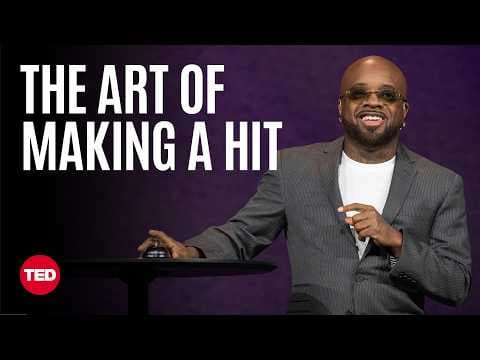
Jermaine Dupri on the Art of Making a Hit | On the Spot | TED
Audio Summary
AI Summary
The speaker expresses his passion for producing music, likening the creative process to having a baby. He describes how an initial idea transforms into a finished product, a process that can take anywhere from five minutes to two days. He relishes watching a song develop from nothing into something that listeners can then "digest."
Atlanta, specifically College Park on the South Side, has played a significant role in his success. He notes that when he began making music with Kris Kross in the early 90s, the entire city was undergoing a period of growth. While Atlanta had an existing music scene with artists like S.O.S. Band, Brick, and Peabo Bryson, it was still in its nascent stages. He believes his own success paralleled the city's development, leading him to jokingly refer to himself as "the mayor." He observed people taking other cities more seriously than Atlanta, recalling airport shirts featuring cities like Detroit, LA, Tokyo, and London, but never Atlanta. This prompted him to create "Welcome to Atlanta" as a way to highlight the city's beauty and attract more people, a goal he is happy to see realized with the audience present.
Regarding his songwriting formula, he advises that once a hit is achieved, one must trace back the elements that contributed to its success. He uses "Jump" as an example, explaining that while he couldn't exactly replicate the process, he identified the "little different things" that resonated with the audience, such as the repetitive hook. He compares this process to baking a cake, where the fundamental steps remain consistent even if the flavors or icing change. He applies this principle in the studio, often repeating certain actions without explicitly telling his collaborators. He cites Muni Long's "Made for Me" as an illustration. When Muni suggested the beat needed more "bounce," he recalled a TikTok mash-up of Mariah Carey's "We Belong Together" with artist Yeat, where young people were dancing to his original beat. Realizing that the hi-hats in the Mariah Carey track were a key element, he incorporated that same rhythmic pattern into "Made for Me," which subsequently became a number-one record. He acknowledges that while it sounds simple, it requires knowing how to "grab and catch" these successful elements.
On the topic of knowing "what's cool," he humbly states that he doesn't, but rather "tries things." He recounts an anecdote with Kris Kross, where one of the members wore an oversized Girbaud jumper. He suggested wearing it backward, a notion initially met with skepticism. Despite their hesitation, the individual complied, and upon visiting Lenox Square mall, the backward jumper garnered significant attention, appearing to be "the coolest thing they had ever seen." This experience taught him that trying something unconventional, something others aren't doing, often turns out to be cool.
When asked what song he wants to be remembered for, he chooses "We Belong Together," calling it the "song of the decade." He emphasizes that creating a song with such long-lasting impact is not something one can predict or plan for in the studio.
In a lightning round, he reveals his preference for hip hop over R&B, having started as a breakdancer and initially disliking R&B. He prefers working with "new stars" over legends, humorously noting that "legends always got ego." He opts for documentaries over reality TV, mentioning his new documentary "Magic City" on Starz. He generally favors melody over rhythm, though his preference can depend on what he's drinking. Finally, he credits his father for some mentorship, but primarily acknowledges learning from afar by observing figures like Teddy Riley, Quincy Jones, Berry Gordy, Andre Harrell, and Russell Simmons. He concludes by stating his ability to forecast personal aspirations, recalling how he envisioned himself speaking at a TED Talk, a dream he has now realized.