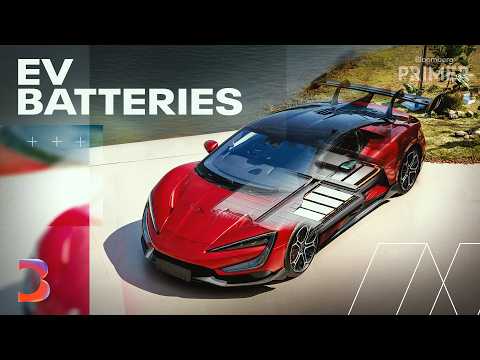
Inside the Effort to Disrupt China’s Grip on EV Batteries | Bloomberg Primer
AI Summary
The story of modern technology is intrinsically linked to the evolution of batteries, particularly the lithium-ion battery. Introduced about thirty years ago, this battery was a game-changer, offering lighter weight and more power, and it quickly revolutionized consumer electronics. Sony, recognizing its potential, sought to integrate this technology into as many devices as possible. As production scaled up, the cost of lithium-ion batteries decreased while their power capacity increased, a phenomenon explained by Wright's Law, which posits that increased production leads to lower costs.
This trajectory has now propelled another revolution: electric vehicles (EVs). In the 2020s, advancements in battery power and cost-effectiveness have made EVs increasingly accessible, mirroring the earlier impact on consumer electronics. The speaker emphasizes that driving an EV is essentially driving a battery. China has emerged as the global leader in battery technology and production. Chinese EVs are already more affordable than their gasoline counterparts, with four of the world's top five battery manufacturers located in China. BYD, a prominent Chinese company, even rivals Tesla for the title of the largest EV maker globally. This intense domestic competition has spurred Chinese companies to expand their reach internationally. While markets like the US and EU have shown some resistance to cheaper Chinese EVs, many emerging markets have readily adopted them, significantly shifting the global power balance.
The dominance of China in the lithium-ion battery sector has prompted companies worldwide to invest heavily in their own battery research and development, exploring new chemistries and manufacturing processes to challenge the status quo and capitalize on the immense profit potential in this field. The fundamental science behind a lithium-ion battery involves converting chemical energy into electricity. Internally, these batteries consist of layers: a cathode, often made of specialized metals; an anode, typically graphite; and a separator to prevent them from touching. Charged lithium atoms, or ions, move between the cathode and anode, while their electrons travel through an external circuit, generating electricity. A liquid electrolyte facilitates the ion flow.
The complexity arises from the supply chain. China has established a dominant position across nearly every stage of this chain. Raw materials like lithium, extracted from places like Chile's salt flats or Australia's mines, are shipped to China for processing into the refined chemicals and powders essential for battery production. Lithium is transformed into lithium carbonate and lithium hydroxide, and it is this refining stage where China has created a significant bottleneck. This vertical integration extends to battery cells, modules, and packs used in everything from smartphones to EVs and grid-scale energy storage.
The Chinese government's strategic investment, beginning as early as 2001 and formalized in the "Made in China 2025" plan, has been instrumental. Subsidies totaling hundreds of billions have fueled the EV industry, making batteries and EVs strategic priorities. The government employed a mix of incentives, such as easier license plate acquisition for EV buyers and making public transport electric, creating a stable environment for battery and EV companies to thrive due to guaranteed long-term demand. This sustained state support, coupled with a vertically integrated supply chain and a skilled engineering workforce, has enabled Chinese companies to commercialize battery chemistries and produce affordable EVs.
A prime example is BYD's Seagull, a popular and inexpensive EV in China, which uses a Lithium Iron Phosphate (LFP) battery. While LFP batteries, originally developed in the US but scaled up by China, were initially less energy-dense than Nickel Manganese Cobalt (NMC) batteries, continuous innovation by Chinese companies has improved their energy density and charging speed. This has led to LFP batteries powering most EVs manufactured in China today.
Despite this success, Chinese companies are beginning to invest more overseas due to overcapacity and price wars at home, with 2024 marking the first time Chinese investment abroad exceeded domestic investment. Meanwhile, established players like General Motors (GM) are striving to disrupt the market with new battery technologies. GM is investing in Lithium Manganese Rich (LMR) chemistry, which aims to reduce costs by increasing manganese and decreasing nickel and cobalt content, while maintaining competitive range. GM plans to launch LMR batteries for SUVs and pickup trucks by 2028 and intends to bring its entire battery supply chain outside of China by the same year. However, establishing such a supply chain in the US faces challenges due to policy shifts and the difficulty of competing with China's established infrastructure.
Startups globally are also raising significant capital to develop next-generation batteries, exploring various "ice cream flavors" of chemistry to find what works best. Chinese companies like Gotion are expanding globally, establishing factories in the US to produce LFP batteries for EVs and energy storage systems. Gotion's Illinois factory, a highly automated "Generation 7" facility, aims to bring advanced manufacturing back to the US. However, these expansions are not without hurdles, including concerns over ties to China and environmental impact, leading to project delays. China, in turn, is implementing export controls on its battery technology to maintain its competitive edge.
The global economic landscape, with the US driven by consumption and China by investment and production, necessitates overseas expansion for Chinese companies to find new markets for their vast manufacturing capacity. Despite geopolitical uncertainties, the demand for batteries in North America alone is projected to reach over 500 gigawatt hours, making it a critical market.
Beyond new production, battery recycling is emerging as a crucial element of a sustainable future. Companies like Hydrovolt in Norway are developing processes to dismantle and recycle EV batteries, turning waste into valuable raw materials like lithium, manganese, cobalt, and nickel. This "black mass" is then sent to chemical companies for refining, creating a circular economy that bypasses the environmental and human rights issues associated with traditional mining. While profitable recycling remains a challenge due to fluctuating metal prices and the slow development of Europe's battery supply chain, the increasing number of aging EVs presents a growing opportunity.
The journey of batteries, from their humble beginnings in devices like the Sony Handycam to powering the future of transportation, underscores their transformative power. As the world strives to meet climate goals, reduce energy costs, and embrace cool new technologies, batteries will continue to be central to progress. The EV revolution is underway, though its pace may vary. While some governments may favor traditional energy sources or roll back combustion engine bans, the long-term global competitiveness of car companies will depend on their ability to produce affordable EVs, with batteries being the key to unlocking this objective.