L’essence est-elle plus chère qu’en 2008 ? La réalité pourrait vous surprendre !
AI Summary
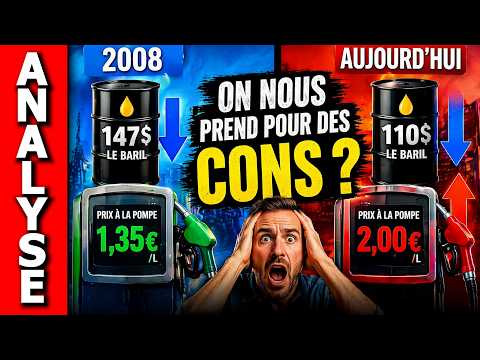
This analysis aims to determine if current gasoline prices are excessive, who is responsible for potential price inflation, and whether petrol is truly more expensive now than in the past, specifically comparing current prices to those in 2008. The discussion begins by addressing a common social media comparison that suggests a rip-off, as a barrel of oil in 2008 cost $147 with diesel at €1.35 per liter, while today, with a barrel at $110, diesel is €2 per liter.
To accurately assess this, the analysis first clarifies the context. A barrel of oil contains 159 liters. The initial comparison of ratios (crude oil price to pump price) showed a doubling from 1.08 in 2008 to 0.55 today, implying a significant increase in pump price despite a cheaper barrel. However, this comparison is based on peak prices in 2008, where the $147 barrel price was a temporary peak in July, and the pump price was closer to €1.70. Similarly, the €2 pump price today corresponds to a barrel price closer to $100, not $110.
After correcting these figures, the ratio in 2008 becomes 0.86, and today it's 0.5. This still indicates a 73% increase in the ratio of crude oil price to pump price between 2008 and today. Two primary factors explain this increase:
1. **Euro-Dollar Exchange Rate:** The euro's value against the dollar has fallen significantly since 2008, by approximately 30%. This directly impacts the cost of a barrel of oil, which is priced in dollars.
2. **Inflation:** Over the period from 2008 to 2026 (projected), inflation has been 33.2%. This affects the cost of refining, transport, and non-proportional taxes. Examining the evolution of the minimum wage also provides an alternative measure of living standard changes, showing a 40% increase from €1300 in 2008 to €1823 today.
Combining these factors, a 30% increase due to the euro's fall and a 33.2% increase due to inflation results in a total increase of approximately 73%, which precisely matches the observed difference in the ratio between the barrel price and pump price. This suggests that, as a first approximation, there is no actual degradation in the pump price relative to 2008 when adjusted for currency fluctuations and inflation.
Further calculations support this. If the 2008 pump price of €1.35 is increased by 73%, it reaches €2.33, which is close to the average diesel price observed on April 4th (€2.30). If the barrel price is at $110 and the pump price is €2.30, the ratio is 1.81, falling within the 73% to 82% increase range.
Beyond these monetary and inflationary effects, fiscal and technical developments have also influenced prices:
1. **Tax Adjustment on Diesel:** Following the "dieselgate" scandal, the tax advantage for diesel was reduced. In 2008, there was an 18-cent difference in TICPE (domestic consumption tax on energy products) between petrol and diesel. This gap was eliminated.
2. **Carbon Tax:** Introduced under François Hollande and amplified by Macron, the carbon tax was designed to increase regularly. An increase of €7.50 per tonne of CO2 adds 2 cents to a liter of diesel. Macron's acceleration of this tax, intended to finance employer contribution deductions, led to an additional tax increase of 12 to 14 cents, contributing to the "yellow vest" movement.
In total, the elimination of the 18-cent tax difference and the addition of 12 cents from the carbon tax amount to 30 cents in additional taxes between 2008 and today.
Recalculating the expected diesel price today, considering a $110 barrel in 2008 (when the pump price was €1.30), a 30% fall in the euro, 33.2% inflation, and the 30 cents of new taxes, the expected price today would be €2.55 per liter. Since the current price is around €2.30 with a barrel near $110, it suggests that pump prices are actually *lower* than they would be if the same ratio as 2008, adjusted for currency, inflation, and taxes, were maintained.
However, the analysis acknowledges that the 2007-2008 period was not one of moderation; oil prices had skyrocketed, and oil companies' profit margins had exploded (e.g., ExxonMobil's profits increased by 25% from 2005 to 2008). While the current situation shows similar dynamics, it is to a lesser extent.
Examining a shorter period, specifically from the beginning of the year, reveals further insights. Fixed taxes (TICPE and carbon tax) remain constant at 73 cents. The fuel cost component, which was 53 cents on February 27th, increased by 60% due to the rise in oil prices. Adding 20% VAT on this increased fuel cost, plus fixed taxes and distribution costs, results in a price of €2. This €2 figure matches the price cap generously set by Total. This indicates that Total is passing on the entire increase in fuel costs, and potentially more, by selling current stock (bought at lower pre-crisis prices) at inflated current market prices. As an integrated company managing production, transport, refining, and distribution, Total's actual production costs may not correlate directly with stock market prices. The company also benefits from trading activities, making a billion euros in profit by speculating on oil.
The current premium of 15-20% above the calculated legitimate price (which should be around €2 based on oil price increases) can be attributed to several factors:
* Higher distribution costs for some stations (e.g., in cities or on highways).
* Obesity effects: Increased demand due to panic buying and fear of shortages drives prices up.
* Anticipation of lasting shortages: Station owners may add a margin to cover potential losses from future stock unavailability.
In conclusion, while there are abuses and speculative elements in the current market, particularly regarding companies selling pre-crisis stock at higher prices, the overall explosion in diesel prices at the pump compared to 2008 is primarily explained by the fall of the euro, inflation, and increased taxes. When these factors are accounted for, current prices are not disproportionately higher than in 2008.
However, the impact on purchasing power is significant. In 2008, 100 liters of diesel at €1.30 cost 10% of the gross minimum wage (€1300). Today, 100 liters at €2.30 cost 12.6% of the gross minimum wage (€1826). This represents a 26% additional effort in purchasing power for the same amount of diesel, even when the barrel price is comparable ($110). This increased burden is more related to the euro's decline and taxes than to oil companies' greed, although some opportunistic pricing exists.
The analysis also highlights that if one wants to complain about rising energy prices, electricity and gas present a far more egregious situation. The overall energy price index has multiplied by 2.6 since the early 2000s, with electricity and gas prices increasing three to four times more than oil. This is attributed to the "Nome law" in France, which forces EDF to sell electricity at an administered price to alternative suppliers, who then resell it at a market price indexed to gas prices. This system, coupled with the financing of expensive renewable energies, has led to a massive and unjustified increase in electricity prices, causing business bankruptcies and placing a significant burden on consumers. Production costs for electricity, which is 85% nuclear and hydroelectric in France, have not changed significantly, yet consumer prices have multiplied by three or four due to taxes and a flawed market structure. The analysis suggests that if there are entities to nationalize or protest against, the electricity sector is a more legitimate target than oil companies.