We Chose the WRONG Monitors 5 Years Ago
Audio Summary
AI Summary
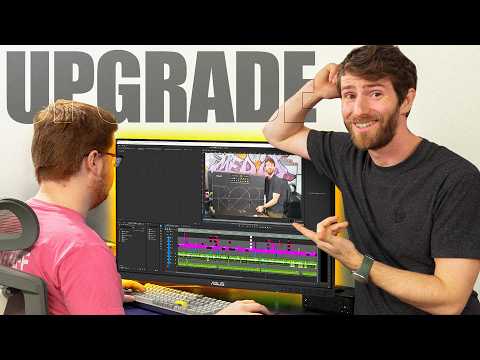
The speaker discusses an overdue monitor upgrade for their editing team, opting for ASUS ProArt displays over Apple's Studio Display. They highlight the ASUS PA32 QCVS, a 32-inch, 6K resolution monitor with 60 Hz refresh rate and 600 nits brightness, priced $300 less than the Studio Display. It features Thunderbolt 4 and a built-in KVM for controlling multiple systems.
The team also received one unit of the PA32 KXR, an 8K monitor with over 4,000 dimming zones and sustained 1,000 nits brightness, which is described as a "really, really special" display. There were 11 displays in the initial pile, with one allocated to Linus Torvalds' build. Some editing team members, now in supervisory roles, don't require the highest resolution day-to-day.
The older UCX displays, which the new models are replacing, are praised for their mini-LED backlight with local dimming, supporting HDR at up to 1200 nits peak brightness. However, the new PA32 QCVS units, while supporting HDR, lack local dimming and only reach about 600 nits peak brightness, meaning they won't have the same "pop" as a true HDR display. The reason for this "step down" is explained by the slow adoption of HDR workflows on YouTube, which proved more cumbersome than anticipated, and the "juice just hasn't really been worth the squeeze." Additionally, the blooming effect on the older displays with 1,000+ backlight zones was noticeable in daily work.
The new PA32 QCVS monitors offer significant advantages for video editing, primarily their 6K resolution. Editors appreciate the increased screen real estate and sharp image, even when not shooting above 4K. The matte coating on the new displays is a notable improvement, significantly reducing glare compared to the older models, which were almost like mirrors.
Connectivity on the PA32 QCVS includes HDMI 2.1, DisplayPort 1.4 for 6K 60 Hz, two Thunderbolt ports (one with 96 watts charging), a USB-C port, a headphone jack, and multiple USB Type-A and Type-C ports. The cable management is integrated into the stand.
The on-screen display offers a variety of color spaces and user modes. A new M model P3 color space is supported across all new ProArt models, designed for color consistency between Apple devices and ProArt displays. ASUS also provides a display widget center accessible via a QR code, allowing users to adjust settings through software on both Windows and macOS, eliminating the need to navigate buried on-screen display menus.
The PA32 KXR, the 8K monster, is highlighted for its incredible sharpness and reduced glare. Like the new Studio Display XDR and the old UCXs, it features mini-LED with full array local dimming, but boasts a massive 4,032 dimming zones—almost double the Studio Display XDR and about four times the older UCX models. It also uses ASUS's "nextG mini-LED light profile" to reduce haloing. While its peak brightness is around 1,200 nits, it includes extras like a built-in colorimeter and support for numerous color spaces and user modes. It's limited to 60 Hz, which is considered a fair trade-off for its 275 PPI density (compared to 218 PPI on its "little brother"). For color-critical 8K 60 Hz work, a faster DisplayPort connection is needed to avoid display stream compression.
The PA32 KXR features dual HDMIs, DisplayPort, and Thunderbolt 4 with up to 96 watts of charging. It comes with a calibration report, boasting a Delta E less than one and 98% sRGB color accuracy. The monitor includes a velvet-lined shroud for light control. The base is notably heavy, designed to support the monitor's considerable weight.
The 8K monitor is tested with Cyberpunk 2077, displaying stunning visual detail and photorealistic graphics, even if 8K for consumers might be 20 years away. The monitor supports DICOM, a feature also found in the Studio Display XDR and the PA32 QCVS.
Connor, an editor, evaluates his new PA32 QCVS, appreciating the anti-glare coating and the lack of eye strain from room lighting. While he doesn't immediately notice the impact of 6K resolution on his interface scaling, he values the high resolution for screenshots and the ability to punch in on words without losing quality when reviewing videos.
Finally, a third, more entry-level model is introduced: the PA27 JCV. This 27-inch, 5K display offers many of the same features as its larger counterparts, including a built-in KVM, Apple color space compatibility, and various color modes, all while maintaining a solid 218 PPI, priced between $700 and $800. The video concludes with thanks to ASUS for sponsoring the monitor upgrade.