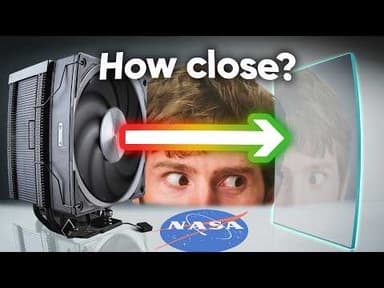
We Went to NASA To Solve a Computer Mystery
This video investigates how much space a fan needs to operate effectively before it experiences airflow starvation, a common problem in PC case design. The research was conducted at NASA's Langley Research Center in Virginia, collaborating with scientists to determine optimal distances for PC cooling.
The initial method used was "tufting," a low-tech but crucial aerodynamic testing technique involving small pieces of string (tufts) attached to the back of a Noctua NFA12X25 fan. Acrylic panels were used as airflow restrictors, and their distance from the fan was varied from 3.5 cm down to 0.5 cm to observe the effect on airflow. As expected, at ample distances, the fan performed well, drawing air in and blowing it out. However, when the panel got very close, specifically 1.5 to 2 cm from the fan face, the tufts near the center became slightly floppy. Getting even closer caused the fan to not only blow ineffectively but also start sucking the tufts back into the blades, indicating reversed airflow. To better visualize this, a NASA-grade ultraviolet lamp and a high-speed camera (Kronos 4K12) recording at 1,000 frames per second were used to capture the glowing tufts in slow motion, revealing increased turbulent flow and tufts dragging into the fan's low-pressure areas.