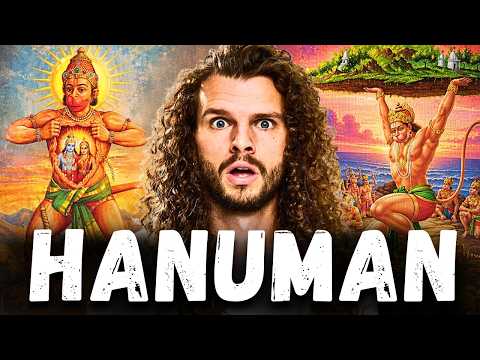
Why This Hindu Monkey God Will Never Die
Audio Summary
AI Summary
Every morning across India, hundreds of millions of Hindus recite 40 verses of prayer, not to a creator or a cosmic king, but to Hanuman, a monkey god. Ancient texts describe him as a warrior who could fly, once carried an entire mountain to save a dying man, and may still be alive today. The central question is how a supporting character, not a ruler or creator, became one of the most beloved figures in Hindu tradition. Hanuman's story is about unimaginable power used humbly for others.
Hinduism is not built with one founder or one main book, like Abrahamic religions. It's a religious civilization thousands of years old, with many major texts, divine figures, and complementary philosophies that vary regionally. Hanuman's story originates from the Ramayana, one of India's two great epics. More than just a book, it has been recited, performed, painted, sung, debated, retold, and filmed, shaping cultural understanding of virtues like loyalty, sacrifice, love, and leadership for 2,000 years.
Hanuman is not a god in the usual sense but a Vanara, meaning "forest man" in Sanskrit. Vanaras are described as upright, powerful, warrior-like beings with fur and tails, not quite monkey and not quite human. They wore clothes, built cities, had legal systems, funeral rites, and political alliances. Their capital, Kishkinda, was a real kingdom with its own succession issues. Early sculptures depict Vanaras standing like warriors, not crouching animals, emphasizing their existence on the edge of two worlds: the wilderness and civilization. Hanuman possessed the finest mind among them.
His father was Kesari, a Vanara king, and his mother, Anjana, a celestial being cursed to live on Earth as a Vanara until his birth. His divine father was Vayu, the god of wind, which is why Hanuman is also called Vayuputra, "son of the wind," and could fly faster than anyone.
As a baby, Hanuman displayed his extraordinary powers by attempting to eat the sun, mistaking it for a fruit. Indra, the king of the gods, struck him on the jaw with his thunderbolt, the Vajra, causing him to fall from the sky. Vayu, enraged, withdrew the wind from the entire world, leading to widespread suffocation and death. Shiva intervened to revive the child, and the gods, realizing their error, made amends. Indra granted Hanuman a body as strong and indestructible as the Vajra, ensuring it would never harm him again. Agni, the fire god, granted immunity to fire, and Varuna, the water god, immunity to water. The sun god bestowed the ability to change size, from as small as a thumb to vast enough to fill the sky. His name, Hanuman, is derived from "Hanu," the Sanskrit word for jaw, commemorating the blow.
Despite these unmatched powers, Hanuman became a menace in his childhood, disrupting sages and wrecking peaceful environments because nothing could hurt or stop him. The gods, losing patience, placed another curse on him: he would forget his powers until reminded. This curse, though a punishment, proved beneficial. By the time his powers returned, he had developed patience, loyalty, humility, and a spirit of service, preventing arrogance from accompanying his immense strength.
This is where Hanuman meets Rama, the prince of Ayodhya, living in a 14-year forest exile to honor his father's word. Rama's wife, Sita, and younger brother, Lakshmana, accompany him. The central conflict of the Ramayana unfolds when Ravana, the brilliant ten-headed king of Lanka, abducts Sita. Ravana, a powerful half-Brahmin, half-Rakshasa ruler, had earned blessings from Brahma that made him invulnerable to gods and celestial beings, but he overlooked humans, considering them beneath him. This oversight would prove fatal.
Near the end of Rama's exile, Ravana's sister, Surpanakha, approached Rama, was rejected, and returned to Ravana enraged. Upon hearing of Sita’s beauty and virtue, Ravana became obsessed, deceitfully separated her from Rama, and abducted her across the ocean to Lanka. Rama faced an impossible situation: his wife was gone, held captive by a divinely protected king on an island across a vast ocean.
Rama and Lakshmana searched for Sita until they reached Rishyamuka, a mountain inhabited by exiled Vanaras under King Sugriva. Hanuman was Sugriva's closest advisor. Sugriva sent Hanuman, disguised as a Brahman scholar, to investigate the armed strangers. Rama immediately noticed Hanuman's extraordinary command of language, perfect grammar, and educated tone, remarking that a ruler was fortunate to have such a minister. This highlighted Hanuman's intellect, which Rama admired. From that moment, Hanuman devoted his life to serving Rama, not for power or status, but out of loyalty to someone in dire need.
The poet and saint Tulsidas recorded a famous exchange where Rama teasingly asked Hanuman, "What are you, a monkey or a man?" Hanuman replied, "When I do not know who I am, I serve you. And when I do know who I am, you and I are one." This encapsulates Hanuman's essence: his power is rooted in devotion and loyalty.
Rama then helped Sugriva reclaim his kingdom, and in return, Sugriva dispatched search parties in every direction to find Sita. Hanuman traveled south until he reached the southern shore of India, where he learned Sita was held captive across the ocean. The news disheartened most searchers, but Hanuman, sitting dejected, was approached by Jambavan, the king of bears and a guru figure. Jambavan, an immortal Vanara, remembered Hanuman's true identity and the divine blessings he received as an infant. He simply reminded Hanuman of his birth and powers, breaking the curse.
The mountain beneath Hanuman trembled as he began to grow, becoming taller than trees, larger than other Vanaras, until he stood like a mountain himself. Understanding the full capacity of his recovered power, he declared he would not return without completing his friend's task. He climbed to the highest point and jumped, the force splitting the rocks beneath him as he shot into the sky.
The journey to Lanka was perilous. First, Manaka, a mountain rising from the sea, offered him rest, sent by the ocean out of gratitude to Rama's dynasty. Hanuman acknowledged the kindness but continued. Next, Surasa, the mother of serpents, sent by the gods to test him, rose in a terrifying form and demanded he enter her mouth. Hanuman reasoned with her, promising to enter her mouth on his return, but she refused. They engaged in a contest of growth: Hanuman grew to 10 yojanas, she to 20; he to 30, she to 40. Then, Hanuman suddenly shrank to the size of a thumb, darted into her mouth and out again, declaring the conditions met. Impressed by his intelligence and cleverness, Surasa blessed him. Finally, a demoness named Simhika, who dragged at his shadow from below, was destroyed.
Lanka appeared on the horizon, not a wasteland, but a city of staggering wealth with golden palaces, fortifications, broad roads, and lush gardens, all ruled by Ravana. Hanuman shrank to thumb-size, slipped through the gates, and quietly navigated palaces and guarded halls. He found Sita at the Ashoka Grove near the palace, exhausted and surrounded by Rakshasa guards. She had repeatedly refused Ravana's pressure to become his queen.
From the branches of a tree, Hanuman observed. He knew a sudden appearance might be mistaken for another of Ravana's tricks. So, he spoke softly in Sita's home language, retelling Rama's story of exile, search, grief, and pain, letting the words reach her before his physical presence. When she looked up, she was skeptical, demanding more proof. Hanuman described Rama in specific detail, known only to a loyal confidant. Then, he presented Rama's signet ring. Sita recognized it instantly, pressing it to her chest, assured that Rama had not stopped looking for her.
Hanuman offered to carry her out of Lanka immediately, but Sita refused, insisting that Rama must resolve the conflict openly and justly, choosing honor and dignity over a secret escape. She gave Hanuman a chudamani, a jewel from her hair, as proof for Rama.
Hanuman's mission was technically complete, but he chose not to simply leave. He decided Lanka needed to know what was coming. He wreaked havoc, challenged warriors, created chaos, and eventually allowed himself to be captured and brought before Ravana. Ravana ordered humiliation: Hanuman's tail was wrapped in oil-soaked cloth and set on fire, then he was dragged through the streets as a warning.
But Ravana underestimated Hanuman. Hanuman broke free, using his burning tail as a weapon. He leaped from rooftop to rooftop, setting Lanka ablaze. Palaces and gardens burned, turning the sky orange. Only the Ashoka Grove, where Sita was held, was intentionally spared. After the devastation, Hanuman raced to the ocean's edge, extinguished his tail, and took a breath. Lanka burned behind him; Rama awaited news of Sita. The story shifted from a rescue mission to war.
Rama's army reached Lanka by crossing the ocean on the Nala Setu, leading to one of the greatest battles in ancient literature. During the fighting, Lakshmana was gravely wounded. The physician stated that only the Sanjivani herb, growing in the Himalayas, could save him, and it had to be brought back before sunrise. The task seemed impossible.
Hanuman immediately flew to the Himalayas. In the pitch darkness, he couldn't identify the exact herb among hundreds of plants. A warrior, not a healer, he did the only thing he could: he dug his hands into the mountain's base and lifted the entire peak, carrying it south through the night sky. People looked up, seeing the vast figure racing across with the mountain. He returned just in time; Sushena found the herb, and Lakshmana lived.
The war concluded with Ravana's death at Rama's hands, and Sita was freed. After 14 years, Rama returned to Ayodhya and was crowned king. Gifts were given to those who served. When it was Hanuman's turn, Sita, prompted by Rama, gave him a pearl necklace, deeming him most worthy. Hanuman received it, then began biting open the pearls, examining and discarding them. Confused, someone asked what he was doing. Hanuman replied he was looking for Rama within the pearls, for without Rama, they held no value. When someone sarcastically asked if Rama lived inside him, Hanuman tore open his chest, revealing Rama and Sita living within his heart. This iconic image symbolizes that his power was never the center of his being; his devotion and loyalty were.
Rama declared there was nothing left to give Hanuman, as anything else would be smaller than what he already possessed. Hanuman made one request: "Let me remain as long as your story is still being told." This request is central to his lasting legacy. Hindu texts call him a Chiranjivi, "the one who does not die," not because death cannot touch him, but because the conditions for his departure have not yet arrived—the story of Rama and Sita is still being told.
Many Hindus believe Hanuman is still on Earth today, disguised, ordinary, and unnoticed, perhaps in a temple, a crowd, or quietly nearby whenever Rama's name is spoken. This means the being who once flew towards the sun, survived a thunderbolt, forgot and remembered his power, and carried mountains, could still be present as a vigilant friend. He asks for nothing, wants nothing, but lives on as an inspiration.
His legacy is repeated daily in the Hanuman Chalisa, a 40-verse prayer composed by Tulsidas in the 16th century. It explains why Hanuman is often invoked in ordinary life. It's a prayer of remembering his courage, strength, and devotion, almost like a mantra, drawing Hanuman towards those who recite it. In the vast tradition of Hinduism, with figures like Rama, Krishna, Shiva, and Vishnu, Hanuman stands out significantly. He is remembered not as a creator, destroyer, or cosmic ruler, but as one who served. This selflessness, loyalty, and devotion earned him a place alongside the other gods. He carried another person's mission as if it were his own life, demonstrating that the greatest use of extraordinary ability is to serve others in need.
This abridged history of Hanuman's story and legacy offers profound insights. These beings serve as reminders of how humans should be. The principles of character, leadership, and honor, so deeply ingrained in Hindu culture, are steeped in texts like the Ramayana. Hanuman's unwavering devotion, exemplified by his willingness to serve when he doesn't know who he is, and his oneness with Rama