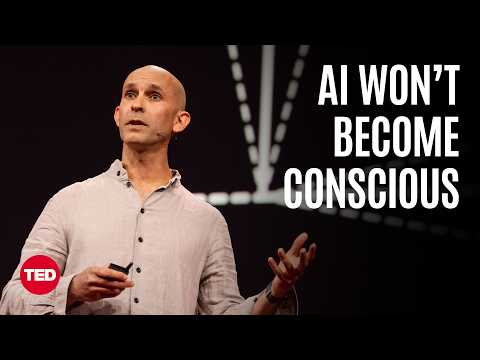
Why AI Is Unlikely to Become Conscious | Anil Seth | TED
AI Summary
For centuries, humanity has fantasized about creating artificial versions of ourselves, a dream reinvented with each technological wave. With AI, this dream includes the question of whether machines can become conscious, experiencing beauty or joy, or if they will remain merely objects. If AI can be conscious, it would usher in a new era where machines have inner lives and matter for their own sakes, potentially suffering in ways we don't recognize. The speaker, having studied brains and consciousness for nearly 30 years, believes conscious AI is not possible, despite many experts thinking it is inevitable or already here.
The core argument is that consciousness and intelligence are distinct. Intelligence is about "doing" – solving problems or assembling furniture. Consciousness is about "feeling and being" – the bitter tang of coffee or the warmth of a fire. Humans tend to conflate the two because they coexist in us, leading to the assumption that as AI gets smarter, it might become conscious. However, this is a reflection of human psychology, not reality. Language models like Claude or GPT simulate consciousness by reflecting our collective, digitized past, but they are not conscious. We project consciousness onto them, similar to seeing faces in clouds. The fact that no one worries about DeepMind's AlphaFold being conscious, despite its similar underlying algorithms to Claude or GPT, highlights our psychological bias. AlphaFold predicts protein structures, not words, and thus doesn't trigger our emotional strings in the same way.
The idea of conscious AI rests on the myth that the brain is a computer made of meat, and consciousness is a special algorithm that could run on silicon. However, the computer is just a metaphor for the brain, like plumbing or a telephone exchange once were. In a real brain, there's no sharp separation between mindware and wetware, unlike software and hardware. Brains cannot separate what they do from what they are; their function is not solely algorithmic. Beyond neural circuits exchanging signals, brains involve neurotransmitters, electromagnetic fields, and complex biological neurons, far exceeding the simplified components of AI. Therefore, consciousness is unlikely to be a matter of computation alone.
A computer simulation of a hurricane doesn't create real wind, nor does a simulation of a black hole create a real singularity. Similarly, a detailed simulation of a brain, no matter how complex, would not make it conscious. Consciousness is intimately connected to our nature as living creatures. Life, unlike computation, is about materiality, embedded in energy and matter flows, continually regenerating its own existence. Every conscious experience, from a blue sky to envy, is imbued with aliveness, a core relevance for survival. The fundamental feeling of being alive underpins all experience. Thus, it is life, not computation, that breathes fire into experience, meaning conscious AI would need to be living AI.
The speaker concludes by summarizing: we are built to see consciousness where it isn't due to psychological biases bundling language, intelligence, and consciousness. The brain is not just a computer, so consciousness isn't merely computational. And consciousness is deeply connected to life itself. AI is software, not a living mind; it might seem conscious but isn't.
This matters greatly for AI welfare. Influential groups advocate for AI rights based on potential consciousness. If true artificial consciousness were possible, such rights would be justified, given humanity's poor track record with non-human and human ethics. However, if conscious AI is an illusion, extending rights to these systems would sacrifice our ability to control or regulate them for no good reason. Conscious-seeming AI is dangerous: it makes us psychologically vulnerable, potentially leading us to trust harmful advice. Finally, the idea of conscious AI undermines human nature. By seeing our minds as computations detached from biology, we diminish what it means to be a living, breathing human. The dream of conscious AI and uploading our minds is a seductive but empty promise of "silicon oblivion," not post-human paradise. We need a different story, one where consciousness is tied to living flesh and blood, not the "dead sand of silicon." AI may claim intelligence, but consciousness remains ours to celebrate and share with other living creatures. We must not sell our minds so easily to machines, as it overestimates them and underestimates ourselves.