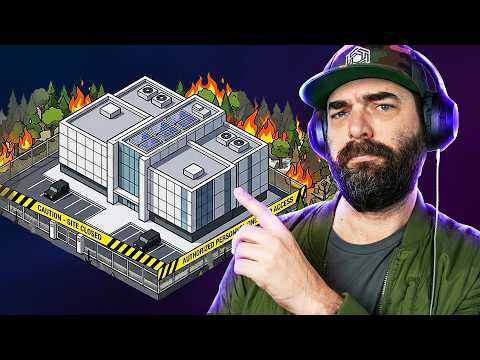
This Datacenter Problem Nobody's Talking About
AI Summary
Bernie Sanders and Alexandria Ocasio-Cortez have introduced the "Artificial Intelligence Data Center Moratorium Act," proposing a nationwide pause on new data center construction until federal AI legislation is enacted. This legislation would need to establish protections for workers and consumers, safeguard the environment, and defend civil rights. The proposed bill has sparked polarized reactions, with one side arguing it would hinder American progress and benefit China, while the other supports a complete halt to data center construction due to energy consumption and AI's perceived dangers.
The proponents of the moratorium highlight several key concerns. Foremost among these is the impact on residential energy costs. Data centers are significant consumers of electricity, and their construction is linked to rising energy prices for households. Reports indicate that in states with a high concentration of data centers, such as Illinois, Virginia, Ohio, Texas, and California, residents have experienced substantial increases in their electricity bills. The Department of Energy data suggests an average increase in electricity prices, with independent market monitors attributing a significant portion of this rise in capacity prices to data centers. A single data center campus can consume power equivalent to the population of San Francisco, and electricity demand from data centers is projected to grow by 15-20% annually. This creates a supply and demand imbalance; as data centers draw heavily on local electricity grids, they reduce the available supply, driving up prices for residential users who share the same grid.
Beyond energy costs, data centers also contribute to pollution and water usage issues. An example cited is a gas-powered data center in Memphis, which reportedly increased local air pollution, consumed a month's worth of water for 150 homes, and could use as much electricity as 200,000 homes annually. This means individuals who never directly use AI services can still be negatively affected through increased utility bills and environmental degradation in their communities.
Furthermore, Sanders and Ocasio-Cortez raised concerns about job displacement due to AI and the existential risks associated with the technology. They referenced opinions from figures like Jeffrey Hinton, who suggested a possibility of AI leading to humanity's destruction, and statements from tech CEOs comparing AI's impact to the industrial revolution, predicting widespread white-collar job losses. These points were presented as additional justifications for pausing data center development.
However, some argue that the tech industry is already addressing these concerns. Microsoft has pledged to fund its data center's energy needs, minimize water usage by replenishing more than it consumes, create local jobs, contribute to local tax bases, and invest in community AI training. Similarly, Google, Microsoft, and OpenAI have committed to funding the power plants and grid upgrades necessary for their data centers. These commitments suggest that the major tech companies are willing to bear the costs associated with their infrastructure, potentially alleviating the strain on existing grids and communities.
The arguments against the moratorium primarily revolve around maintaining global competitiveness and avoiding a disadvantage against countries like China. The concern is that halting construction in the U.S. would simply lead companies to build data centers elsewhere, potentially in regions with less stringent regulations. This could result in a loss of jobs and technological leadership for the United States.
A significant point of contention raised by the speaker is the potential unintended consequence of the moratorium on the supply and demand of computing power. The current AI landscape is marked by high demand for compute, which is why companies are eager to build more data centers. If new data center construction is paused, the supply of compute will be constrained, while demand is expected to continue rising. This scenario, the speaker argues, would disproportionately harm smaller businesses and individual users who cannot afford the potentially inflated costs of limited compute resources. Larger tech companies, with their substantial financial resources, would be better positioned to absorb these higher costs, thereby paradoxically increasing their power and control over AI access. This could lead to smaller entities being priced out of the market and individuals facing higher costs for AI services.
The speaker advocates for a middle-ground approach, suggesting that while data centers should continue to be built, the immense profits of trillion-dollar companies should fund their energy consumption and infrastructure needs. These companies should be responsible for replenishing water resources, creating jobs, and generating tax revenue in impacted communities, and investing in sustainable energy solutions. This approach, the speaker believes, would allow for continued AI development without placing undue burdens on existing communities or creating market disadvantages for smaller players.
Reflecting on the evolution of AI discourse, the speaker expresses nostalgia for a time when AI discussions were less politicized and divisive, lamenting that this era may be over. The speaker concludes by offering a weekly recap of AI news to help viewers stay informed with nuanced perspectives, differentiating from the often binary takes found on social media.