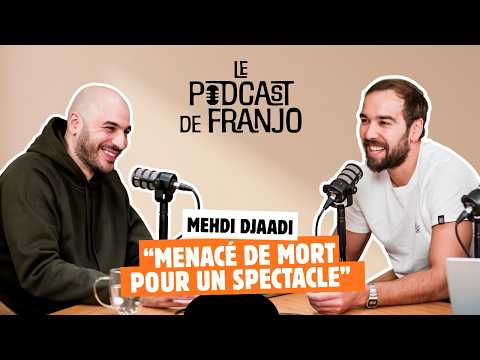
Menacé de mort pour son spectacle "coming out" - Mehdi Djaadi - Le Podcast de Franjo #8
AI Summary
In this episode of the Frano podcast, guest host Riad and host Frano welcome Medy Jad, a French actor and performer whose career spans from a César-nominated film debut to provocative solo stage shows. The conversation begins with a ChatGPT-generated summary of Medy’s background, which he confirms as accurate: born in Saint-Étienne in a working-class neighborhood, he found his calling in theater and made a significant cinematic debut in 2015 with *Je suis à vous tout de suite*. This success led to a nomination for the César for Most Promising Actor, an experience Medy describes as surreal, especially given the high-caliber actors in his cohort like Karim Leklou and Swann Arlaud.
The discussion shifts to Medy’s stage work, specifically his first major show, *Coming Out*. The show’s central narrative—a young man from a Muslim background converting to Catholicism—challenged French societal norms. Medy recounts the show’s "crash test" performance before 3,000 Catholics at Paray-le-Monial, which launched his career through word-of-mouth. However, the path was fraught with professional and personal obstacles. Medy explains that the French cultural establishment, which he describes as having a deep-seated anti-clericalism, largely boycotted him. Producers and mainstream media outlets refused to cover the show because he spoke positively about Christianity, an act he compares to a "crime of lèse-majesté" in the eyes of the secular elite.
More dangerously, the show’s theme of conversion made Medy a target for extremists. Following the 2020 terror attacks on Samuel Paty and the Nice cathedral, Medy received threats from a fringe of the Muslim community who labeled him an apostate. He was advised by the police to stop the show but refused, choosing instead to perform under police protection. By 2022, the nature of the threats shifted; he began receiving anonymous letters from the far-right. These critics argued that his conversion was merely a "veneer" and that he still belonged to the "re-migration" movement. Medy reflects on this period as a time when he had "no team," being rejected by religious extremists on one side and the secular cultural elite on the other.
Medy’s current show, *Couleur Framboise*, tackles the deeply personal and often taboo subject of male infertility. The show uses his own struggle to have children—marked by years of disappointment and multiple miscarriages—as a springboard for a broader sociological reflection. He incorporates a "dialogue of consciences" on stage, featuring Muslim, Catholic, and Atheist voices debating issues like IVF. Medy highlights the tension between faith and modern medicine, noting that while religion often views infertility as a divine trial, the medical world can sometimes be cold and hormone-driven. He cites alarming statistics, noting that one in four couples now faces infertility, with men being the cause in 40% of cases.
A major theme of the podcast is the "praise of nuance." Medy expresses frustration with the modern tendency to categorize individuals into rigid boxes. He describes himself as politically "ambidextrous," holding views that cross traditional lines. He admits to loving French gastronomy and the national flag—often seen as right-wing traits—while simultaneously advocating for ecological living and the humane treatment of migrants, which are typically left-wing positions. He critiques the "new inquisitors" of social media who judge others based on their level of "deconstruction." He also challenges the stereotype that people of North African descent must inherently belong to the political left, noting that many are successful, liberal professionals with conservative values.
To escape the pressures of his career and the toxicity of the digital world, Medy and his wife embarked on a 1,500-kilometer walk from Burgundy to Assisi, Italy. This "digital detox" was a radical attempt to "unpollute" his brain. Medy describes the initial withdrawal symptoms of social media addiction, where he would instinctively try to scroll on a phone he no longer used. He shares a striking insight: that modern man spends his life "caressing a pane of glass." This disconnection from the physical world, he argues, has led to a loss of collective culture and real human emotion. He advocates for a search for balance, setting strict boundaries on technology to preserve his mental health and his marriage.
Finally, Medy discusses his move from Paris to the Touraine region. While he misses the creative emulation of the capital, he finds profound value in the "cycle of the seasons" and a slower pace of life. He notes the irony of being a "bourgeois" who gardens while still being viewed as a "guy from the projects" by some. The conversation concludes with a look at the film industry’s new obsession with social media followers. Medy laments that talented actors are often overlooked in favor of influencers with large followings, as casting directors increasingly prioritize marketing potential over craft. Despite this, he remains committed to live theater, believing it is one of the few remaining spaces where people can experience genuine, unmediated human emotion.