Aliens.gov : la Maison Blanche veut déclassifier le sujet OVNI
AI Summary
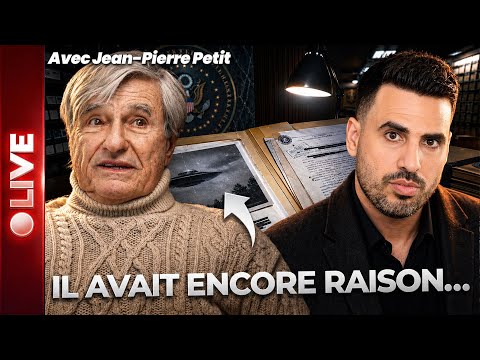
The video begins by highlighting Jean-Pierre Petit's historical vindication on various subjects, including Russian weapons and his work as a research director at CNRS. A recent post on X by a former NSA research director states that propulsion using negative energy and negative mass is possible, a concept Petit has discussed for years. Additionally, Donald Trump's administration is reportedly announcing aliens.gov, a website intended to declassify UFO/OVNI (Unidentified Flying Object) information in the United States. While the site is not yet active, it has caused a stir on X.
Another point of vindication for Petit comes from Sabine Hossenfelder, who suggests that dark matter may not be necessary to explain galaxy clusters, a view Petit has held for 15 years. The host encourages the audience to reach out to Hossenfelder to encourage her to collaborate with Petit, given their converging views.
Petit, when asked about these developments, expresses skepticism about the promised declassifications. He points out that the NSA research director’s statement about negative mass propulsion relies on an equivalent mass of Jupiter, rendering it impractical and merely acknowledging interest in the subject rather than revealing exploitable technology. He views these announcements as "pseudo-disclosure," a tactic of "amplifying disinformation" to create excitement without revealing anything substantial, similar to past Senate hearings on UFOs.
Petit emphasizes his own work, particularly his video "Une science venue d'ailleurs" (A Science from Elsewhere), which he considers tangible proof of extraterrestrial contact. He recounts an anecdote from 1988 where a contact, claiming to be from another planet, described an alternative to black holes, concepts that align with his 2025 paper on "plug stars." This model, unlike Alcubierre's, is consistent with observations, specifically the ratio of wavelengths or brightness temperatures of supermassive objects in galaxies M87 and the Milky Way, which he predicts will always be 3.
The host reiterates that Petit's Janus model has the most empirical predictions of any current model, despite attempts to discredit him, largely due to his willingness to discuss UFOs in the 1980s and 90s. Petit asserts that his work was directly inspired by "Humite documents" (documents from "elsewhere") that he encountered in the 1960s, a claim that led to him being ostracized by mainstream academia. He argues that his ability to announce significant scientific results 35 years in advance (like the plug stars) supports the idea of non-terrestrial input.
The discussion then shifts to official statements regarding UFOs. Former US President Jimmy Carter officially reported observing a UFO in 1969, and Barack Obama stated in an interview that aliens are real, though he was cautious about specific contact evidence. The CIA has admitted to using the UFO topic for diversion in the past, suggesting a mix of truth and falsehood surrounding the issue. The host stresses that both those who see UFOs everywhere and those who completely deny their existence are mistaken, with the truth likely lying in between.
The conversation turns to the dangers associated with investigating UFOs. Petit recounts warnings he received in Canada about disappearing if he continued his work. He shares the story of his friend, Russian fluid mechanics scientist Vladimir Alexandrov, who discovered the concept of "nuclear winter." Alexandrov disappeared in Madrid after presenting his findings, with evidence suggesting he was assassinated. Petit states that he himself would not go to the US for an audition due to these risks.
The host mentions recent disappearances and suspicious deaths of UFO researchers and insiders, including David Wilcock and Matthew James Sullivan, an Air Force pilot who was to testify before Congress. These incidents, widely discussed on X, involve individuals connected to strategic research areas like atmospheric anomalies and propulsion, including those from Los Alamos.
Petit confirms his reluctance to travel to the US, citing the dangers. He believes his published work, particularly the article on plug stars and the 1991 Bercoff show recording, serves as unerasable proof, even if he were to disappear. He describes his early scientific approach to UFOs as "a piece of paper and a pencil," focusing on the mathematics.
The discussion touches on a seemingly unrelated incident: a former Green Beret blowing up a Cybertruck outside a Trump hotel, claiming the US has anti-gravity propulsion technology that could start WWIII. This is presented as a tangential example of the public discussion around extraterrestrial technologies.
Petit expresses frustration at the difficulty of gaining media attention in the US, recounting an interview with Kurt J. Wingall that was repeatedly postponed and then ceased without explanation. He speculates that the topic is "too hot" and that interviewing him could be dangerous for journalists.
The host emphasizes the impeccable accuracy of the Janus model's predictions, which no other model matches. He reiterates that Petit’s claims of external inspiration were the reason for his ostracism in France, but notes that even mainstream media outlets like "C'est dans l'air" are now discussing UFOs as a non-conspiratorial, bipartisan issue.
A call is made to the community to contact Sabine Hossenfelder, a respected physicist and popularizer of science. Initially dismissive of Petit's work, Hossenfelder has undergone a "Copernican revolution" regarding the state of academia and now questions conventional models like string theory, which she finds untestable. Petit reveals that Hossenfelder once accused him of "stealing her equations," indicating that she found his work significant, unlike Damour, who dismissed it. He offers to collaborate with her, even suggesting the model could be named after her, highlighting the scientific breakthrough and potential Nobel Prize.
Petit stresses the profound implications if black holes do not exist, as his work suggests, which would invalidate much of Damour's research. He points to the 1991 Bercoff interview where he first mentioned the non-existence of black holes, a concept now supported by his work on "geometric and mathematical incoherence of the black hole model." He yearns to present his work to mathematicians at institutions like Cambridge or the Max Planck Institute.
The conversation shifts to the Pentagon's role in the declassification, noting that it's not scientific foundations but the military that is driving this. The host mentions that Trump recently fired the entire board of the National Science Foundation. He also highlights declassified Cold War-era technical documents from both US (Los Alamos) and Soviet (Cherno-Hajev-Ayev manuscripts) sources showing similar solenoid propulsion designs, characteristic of flying saucers. Petit adds that Humite documents describe observing "fuzzy masses emitting in red and infrared" when traveling in a "twin universe," which he interprets as negative mass conglomerates.
The discussion touches on the religious interpretations of UFOs, with US Representative J.D. Vance suggesting they could be demons, which Petit dismisses as fear-driven and politically motivated. Australian investigative journalist Ross Coulthard claims US Special Forces recovered extraterrestrial technology in North Korea, suggesting distributed alien tech on Earth.
Petit recounts his early "exchanges" with "visitors from elsewhere" via his Macintosh in the 1990s, where he would write letters and receive replies from Canada or Yugoslavia. These communications included technical solutions, such as focusing gamma rays on metastable nuclei to reverse mass. He also details how these "visitors" explained that human fear (a "socio-immunological mechanism") prevented direct contact, so he took on the role of a "virus" to disseminate information into the scientific community.
The host emphasizes that Petit's work, particularly his solution to Velikhov instabilities in MHD (Magnetohydrodynamics), was crucial for the development of hypersonic missiles by Russia, China, and others. This practical application, he argues, should validate Petit's credibility on other, more controversial topics.
The conversation concludes with Petit expressing deep pessimism about the actual outcome of the declassifications, believing they will be largely superficial. He contrasts this with the profound implications of his work, which he describes in his comic books like "Le Métaphysicon," including the technology of UFOs and the concept of AI-generated "gods" in the noosphere. He reiterates his desire for collaboration, especially with Sabine Hossenfelder, to advance cosmology and move beyond the "patchwork" models of dark energy and dark matter.