The Real Reason Some People Earn 10X More
AI Summary
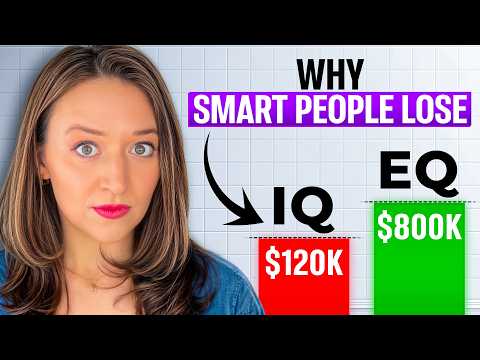
The video explores the concept of emotional intelligence (EQ) and its significant impact on career success and financial well-being, arguing that it's a crucial skill often overlooked. It contrasts two individuals with similar starting points: one earns $120,000 annually after 20 years, while the other leads a company, manages 30 people, and earns $300,000, possessing a vast professional network. The difference, the video posits, isn't necessarily higher IQ or more work, but a superior skill in emotional intelligence.
Traditionally, success was believed to hinge on cognitive abilities: intelligence, good grades, degrees, and credentials. These are indeed vital for entering professions like medicine or law, where they act as a filter. However, once individuals reach a certain level, they find themselves surrounded by equally intelligent and competent peers. At this stage, cognitive ability alone is no longer the primary differentiator for advancement.
Daniel Goleman, a prominent psychologist in the field, explains that while IQ predicts academic success and initial career entry, emotional intelligence takes over once you're in a profession alongside other smart individuals. This is why some brilliant people plateau, while others with potentially less raw intellect become exceptional leaders. It can explain why a technically skilled surgeon might not become chief of medicine due to poor interpersonal skills, or why a CEO might create chaos.
The video asserts that EQ is measurable and has a direct financial correlation. A study by TalentSmart, analyzing over 42,000 people, found that high EQ individuals earned an average of $29,000 more per year than their low EQ counterparts. Furthermore, each one-point increase in EQ was associated with an additional $1,300 in annual salary. Over a 30-year career, investing half of this annual difference ($14,500) at an 8% return could result in approximately $1.6 million in additional wealth. Investing the full $29,000 annually could lead to an additional $3.2 million. This financial advantage translates to improved quality of life, offering more flexibility, better healthcare, travel opportunities, and reduced financial stress, potentially allowing for earlier retirement.
Emotional intelligence affects various aspects of a person's professional and personal life, with these impacts compounding over time. The video outlines ten key areas:
1. **Income Growth:** Higher EQ leads to promotions, leadership opportunities, and expanded responsibilities, often resulting in significant pay jumps as one moves into higher executive roles.
2. **Leadership Opportunities:** Leaders are often chosen not just for their intelligence, but for their trustworthiness, ability to manage chaos, and the willingness of others to follow them.
3. **Business Scalability:** For business owners, EQ is crucial for effectively managing and empowering employees. This allows a business to scale beyond what one person can do alone, moving from self-employment to true business ownership.
4. **Network Quality:** A strong network is built on trust and likability, making people feel seen and valued—all EQ skills. A large network is only valuable if it's built on genuine connection and mutual respect, not self-interest.
5. **Investing Behavior:** EQ helps prevent destructive financial decisions driven by panic or greed, such as selling investments during market downturns. Emotional regulation keeps investors calm and making better choices.
6. **Burnout Prevention:** The ability to manage stress, stay regulated, and maintain sustainable performance has immense economic value. Setting boundaries and prioritizing life outside of work are key to preventing burnout, which can have severe financial and health consequences.
7. **Team Performance:** Google's Project Aristotle found that psychological safety, fostered by leaders with high EQ, was the most critical factor for team effectiveness, significantly impacting revenue targets.
8. **Audience and Client Trust:** People follow and trust individuals who make them feel understood and seen, which is a direct application of EQ.
9. **Career Durability:** Emotionally intelligent professionals adapt to feedback, recover from setbacks, maintain relationships during conflict, and remain employed and relevant longer.
10. **Relationship Stability:** Divorce is a major financial catastrophe. The ability to build and maintain strong relationships, both personal and professional, is directly linked to net worth.
These ten areas demonstrate how EQ influences financial outcomes and overall life satisfaction.
The video clarifies that emotional intelligence is not about being overly passive or "touchy-feely." Daniel Goleman's research breaks EQ into four core domains:
* **Self-awareness:** Understanding one's own emotions, reactions, and impact on others. This is the foundation for all other EQ skills.
* **Self-management:** Emotional self-control, adaptability, and resilience. This includes the ability to stay calm under stress and pause before reacting.
* **Social awareness:** Empathy, the ability to accurately read a room, understand others' feelings and needs, and manage organizational dynamics.
* **Relationship management:** Influence, communication, conflict resolution, teamwork, leadership, and inspiring others. This is where leadership and income scaling occur.
These are not "soft skills" but rather "economic skills" with tangible impacts on career and finances.
In the age of artificial intelligence (AI), human skills like EQ become even more critical. While AI can excel at processing information, analyzing data, and performing technical tasks, it struggles to replicate true influence, building trust, emotional presence, and conflict management. McKinsey predicts a 20% growth in demand for social and emotional skills by 2030, as these are areas where machines are far behind. The World Economic Forum also highlights resilience, flexibility, leadership, social influence, and self-awareness as crucial in an AI-driven workforce.
AI raises the baseline of common capabilities, making technical skills more accessible, but it doesn't enhance the "ceiling" of human potential, which is where EQ thrives. The ability to understand, inspire, and build trust with people is becoming a fundamental economic shift. As AI increasingly handles knowledge-based tasks, the value of human connection, emotional regulation, and interpersonal skills will only grow, making individuals who possess these traits irreplaceable.
The traditional advice to "just get smarter" and accumulate knowledge is still important, but among competent and intelligent peers, EQ becomes the key differentiator. It directly ties into earnings, career advancement, investment performance, career longevity, relationship strength, and ultimately, wealth accumulation.
A longitudinal study found that EQ measured in college predicted salaries 10-12 years later, even after controlling for other factors. A meta-analysis of nearly 51,000 participants confirmed a significant link between EQ and salary, career adaptability, job performance, satisfaction, and entrepreneurial success.
Crucially, emotional intelligence is a learnable skill. Communication can be improved, relationships built and repaired, and emotional regulation developed over time, offering a blueprint for a more successful life.
The video concludes by emphasizing that while intelligence once meant scoring high and knowing more, true intelligence now also encompasses inspiring others, building trust, demonstrating unwavering character during financial downturns, maintaining strong relationships, and avoiding financially destructive decisions. It could be the key to building a business and eventually decoupling income from hours worked. As Goleman stated, once you're in a profession with equally smart people, "that's where emotional intelligence kicks in." The ability to be someone people trust, follow, and want to work with is invaluable.