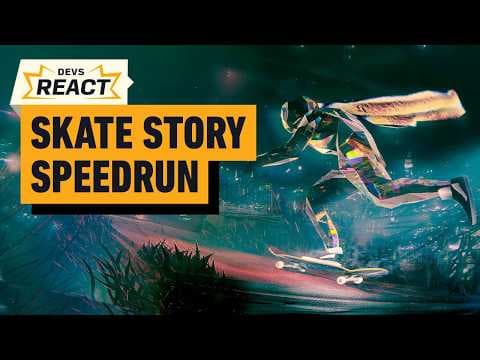
Skate Story Developer Reacts to Incredible Speedrun
Audio Summary
AI Summary
Sam, the developer of "Skate Story," provides commentary on a speedrun of his game, which he notes is the fastest in the world at 1 hour and 22 minutes, compared to the typical 6-7 hours of gameplay across nine chapters. He expresses surprise at the speedrunner's skill, even suggesting the speedrunner is better at the game than he is and could have been hired for QA. The game took six years to develop, with Sam initially aiming for a two-year release, but game development proved to be a lengthy process, especially with the creation of all nine chapters.
The game's narrative is loosely based on Dante's Inferno, with the first world drawing inspiration from the lowest levels of hell. The speedrunner quickly navigates through the initial tutorial and the first level, which took Sam months to iterate on. The first power slide section features hand-painted 4K textures for the road lines, designed to evoke a city atmosphere, especially on the Manhattan Bridge, a recurring element in the game.
In the second chapter, "Warm Milk," the speedrunner efficiently bypasses obstacles, including hot flames, and even goes out of bounds to skip an entire section, landing directly in chapter three. "Warm Milk" is themed around a skater being too hot to sleep, requiring them to "eat the moons" to get rest. Chapter three, "Laundry," involves the player collecting the devil's laundry in a cold environment, representing meaningless tasks imposed by the devil, a metaphor for the life of a skateboarder. The speedrunner demonstrates exceptional skill by collecting multiple laundry items simultaneously, a feat Sam had never witnessed before.
Chapter four introduces the nollie trick tutorial, which the speedrunner completes in two tricks, showcasing a deep understanding of the game's trick system. Sam explains that the trick system rewards momentum, variety, and big air, aiming for a more realistic skateboarding feel compared to other games that focus primarily on combos. The speedrunner then quickly obtains a coffee in a cafe level, which is based on a real-life cafe Sam frequented. This section also features a nod to Tony Hawk games with floating letters to collect. The speedrunner expertly skips entire letter collection sections by exploiting unusual angles and wall-riding, bypassing the "Tony Hawk quest" of this area.
Sam highlights that the game incorporates three main types of levels: Tony Hawk-style challenges, linear levels (progressing gate by gate), and boss fights. The boss fights were a significant development challenge, designed as park levels where players must deal damage to large objects, similar to Dark Souls or Tony Hawk competition levels. The speedrunner encounters the first boss, "The Blood Sear," a giant evil eye in chapter four. The original concept for boss fights involved doing tricks where the boss was looking. The speedrunner skillfully builds combos and performs complex tricks within the boss's gaze to deal damage, showcasing an impressive grasp of the combo system. After defeating the boss, the moon transforms into a basketball that the player "eats."
Moving into chapter five, a zone based on "the raft" where people are angry, the speedrunner again exploits physics glitches to pass through a door. Sam acknowledges that the game's physics are the "most broken part" but also a source of fun glitches, though not as extensively developed as in games like Skate 3 due to being a sole developer. This chapter also features path levels, which combine boss fight elements with linear progression, requiring players to perform tricks while navigating. The second boss, a giant jewel, uses the same shader as the player character, symbolizing its immense soul count compared to the player's single soul. The goal is to retrieve the jewel and return it to an "evil penguin."
Chapter six combines elements from previous levels, featuring a timer, breakable objects, and trick challenges. This level integrates components from various stages of development, some created in the first year and others in the last. The speedrunner cleverly uses the "session marker" feature to teleport back to the start and quickly clear moon projections. Sam's personal favorite boss fight appears in this chapter, as it was where he realized he could fuse path levels with boss fights. The speedrunner defeats this boss, which has multiple HP sections, in a single go, demonstrating remarkable efficiency.
Chapter eight, Sam's overall favorite chapter, is heavily story-driven and acts as a "bridge" in the game's song-like structure. It features another boss fight, which is Sam's second favorite. The flashing scenes in this chapter were a late addition, inspired by Evangelion. The speedrunner once again defeats the boss in one go by performing unique tricks and clearing sections before fully reaching the end of the world. He then enters a "spoiler section" which is a mock-up of the Unity editor, a complex area that took significant time to create. The speedrunner makes a rare mistake here, losing a few seconds.
The final chapter, chapter nine, took the longest to create and is set inside the final boss, a centipede, where the player skates down its throat. This chapter, while not strictly accurate to Dante's Inferno, takes place in its final depth. Unlike previous areas, players must perform "ultra big tricks" to clear gates and progress through linear sections. Sam observes the speedrunner's few mistakes and suggests further optimization could bring the speedrun time under an hour. Chapter nine remixes elements from previous areas, creating a "boss rush" that reintroduces earlier bosses in new, shorter forms, such as the purple moon. The music for these boss fights, particularly "The City Can't See" by Blood Cultures, is highlighted as a favorite. Sam explains that the music was integral to the game from the beginning, having contacted Blood Cultures early in development.
The game's combo system, unlike Tony Hawk, allows combos to continue even after a big push, mimicking real-life skateboarding. The speedrunner uses this to his advantage, building combos in prior sections to quickly defeat bosses in one trick. The speedrun concludes with the player as a small slug, hitting the final end, effectively skipping the entire final boss fight. Sam encourages players to experience the full game on Steam, PlayStation, or Switch, noting that while it took him six years to make, it can be beaten in six hours, or even less than an hour for exceptionally skilled players.