We Are All Getting Dumber... Some Faster Than Others
Audio Summary
AI Summary
The increasing convenience of modern life, driven by user-friendly technology, may be undermining our ability to learn basic concepts, take responsibility, and hold down jobs. Studies across personal finance, career skills, and critical thinking highlight this concerning trend. While technology's role in making life easier isn't inherently problematic, and intergenerational complaints about "kids these days" are common, researchers believe something genuinely different is happening now.
Modern tools, like social media and dating apps, often prioritize "easier" over "better," potentially hindering genuine connection or informed decision-making. AI tools, while capable of augmenting productivity, are frequently marketed as replacements for human thinking. The complexity of these tools, coupled with the simplified tasks they enable, raises concerns about future generations' capacity to maintain a complex world.
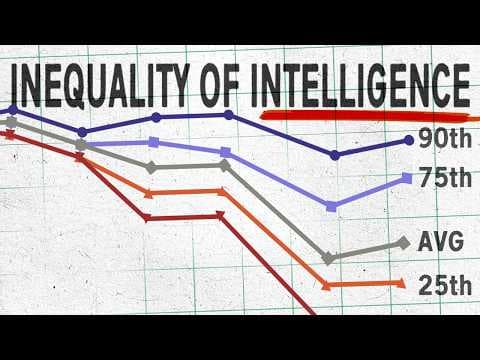
Historically, intelligence, as measured by IQ tests, rose significantly throughout the 20th century (the Flynn effect). However, since the mid-2000s, this trend has stalled or reversed in developed countries. Educational assessments in America show the largest declines in reading since 1990 and unprecedented drops in math scores for school-aged children. The latest OECD PISA results reveal a global decline in math performance. This indicates that, for the first time, generations are truly becoming less capable over time, with some declining faster than others.
This decline isn't limited to younger generations; even older individuals are experiencing a "case of the stupid," despite not being raised with modern technology. This suggests factors beyond screen time are at play. One major factor is that much modern technology, while removing friction, also removes the very elements that fostered capability. For example, balancing a checkbook, a task now almost obsolete, forced people to actively track their spending. Modern payment systems, like "buy now, pay later," are designed to reduce the friction of consumption, deliberately separating individuals from their financial decisions. Companies openly market this friction reduction to retailers as a selling point.
The drive for ease is also financially motivated. The complex and expensive nature of modern tools means that their audience often becomes the product. User-friendly interfaces encourage less thinking and more spending, generating revenue for designers. Platforms like Facebook, TikTok, and YouTube are primarily tools for harvesting attention, not just social connection or entertainment. Many modern tools sacrifice versatility and practical application for user-friendliness, leading to a generation less adept at troubleshooting basic problems because the "plumbing" is hidden.
While convenience is good, the constant removal of opportunities to figure things out, adapt, and take responsibility erodes skills vital for the workforce and society. This has led to observable consequences in the economy, particularly in the workplace. Recent surveys indicate that younger generations struggle with a lack of initiative, with managers often preferring older workers. This isn't just typical intergenerational grumbling; the specific complaint is that these workers, having been "coddled" by educational and consumer systems that remove ambiguity, are unprepared for tasks without clear rubrics or tutorials. Every "improvement" in these systems has removed a moment where a person had to stop, think, and decide for themselves.
The impact also extends to education, manifesting in diverging test scores. Recent OECD PISA results show a significant drop in math scores, with top-performing students largely maintaining their ground while bottom-performing students experienced drastic declines. This suggests that the convenience economy disproportionately affects those with the least ability to resist it. Remote learning during the pandemic exacerbated this, benefiting disciplined students while providing easier access to distractions like video games for others. Wealthier households can afford to create environments that still encourage problem-solving, while less affluent families may struggle to enforce screen time limits.
Finally, AI presents the third and potentially largest compounding problem. While theoretically a powerful learning tool, large language models are often used by students for cheating, with detection tools proving ineffective. This means a generation of students is passing through school without developing crucial problem-solving skills. In the job market, AI-written applications are met with AI filters, creating a detached hiring process where human interaction is minimized. Furthermore, AI is being sold as a cost-effective replacement for teachers and junior workers, removing the very roles that traditionally taught individuals how to "figure things out."
The obvious fix – reintroducing friction through stricter curricula, phone bans, real consequences for AI cheating, human-centric hiring, and financial products that demand conscious engagement – faces significant obstacles. The market rewards frictionless products, companies have vast resources to maintain engagement, and regulators struggle to keep pace with technological advancements. Budget cuts further push education systems towards AI solutions, prioritizing cost over human teachers. From a market perspective, the system is functioning as intended, but at the cost of human capability.