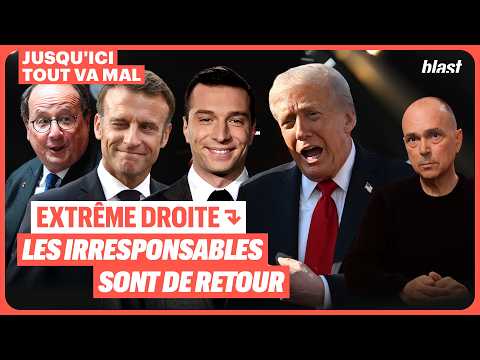
FACE À L'EXTRÊME DROITE, LES IRRESPONSABLES SONT DE RETOUR
AI Summary
The political landscape in France is currently defined by a disturbing surge in violence and a profound distortion of historical and economic realities. This summary examines the key points from the provided transcript, focusing on the targeted intimidation of political movements, the systemic nature of tax evasion, and the shifting rhetoric regarding international conflicts.
A central theme is the escalating physical and verbal aggression directed at La France Insoumise (LFI). The transcript details a series of attacks on LFI offices and campaign headquarters, including bomb threats and acts of vandalism by far-right groups. A particularly harrowing incident occurred in Strasbourg on the night of March 6, when Jamila Adou and her two children were threatened by a man wielding a knife. The assailant explicitly threatened to slit their throats because they were putting up campaign posters for a local LFI candidate. Despite these repeated acts of intimidation, which have been ongoing for months, there is a sense that little is being done to protect these activists.
This physical violence is mirrored by what the transcript describes as economic violence. It cites revelations from former Macronist minister Éric Lombard regarding the scale of tax avoidance in France. Approximately 50,000 of the wealthiest households utilize "super-optimization" strategies to bypass the tax system. While these methods are technically legal, they cost the French state an estimated 85 billion euros annually. The transcript highlights the irony of the reactionary press—specifically outlets like *Le Figaro* and *Le Point*, which are owned by billionaires—promoting these tax niches to their readers while simultaneously demanding cuts to public spending that benefits the poor. Under President Emmanuel Macron’s leadership since 2017, policies have reportedly benefited the top 5% of the population eighty times more than the bottom 5%, illustrating a significant widening of the wealth gap.
The discourse also touches on the "reversal of reality" in political rhetoric, exemplified by Jordan Bardella, the president of the Rassemblement National (RN). During a television interview, Bardella compared Jean-Luc Mélenchon to Jacques Doriot, a former communist who became a fascist and a Nazi collaborator during World War II. Bardella accused LFI of drifting toward fascist tendencies and fueling anti-Semitism. However, the transcript counters this by pointing to the RN's own history. The party was co-founded by Nazi collaborators, and its historical leader, Jean-Marie Le Pen, has been convicted multiple times for anti-Semitism and Holocaust denial. The media is criticized for its complicity in this rebranding, particularly for adopting the RN’s own terminology, such as calling extremist candidates "black sheep" (*brebis galeuse*). This phrase suggests that racist or anti-Semitic behavior is an isolated "slip-up" rather than a reflection of the party’s core DNA, which is described as viscero-racist and conspiracy-oriented.
In the international sphere, the transcript critiques the French government’s response to global conflicts. Following attacks by the United States and Israel against Iran, former Prime Minister Dominique de Villepin characterized the intervention as illegal and dangerous. Yet, President Macron’s official communication on the matter focused almost entirely on demanding that Iran negotiate in good faith, failing to condemn the initial strikes or the humanitarian crisis in Gaza and the West Bank. This selective application of international law is framed as a "profound indignity." The conflict has recently extended into Lebanon, where Israel ordered the evacuation of southern Beirut. Israeli officials have suggested that the Lebanese capital could soon resemble Khan Younis, a Palestinian city nearly entirely leveled by military action. When French Foreign Minister Jean-Noël Barreau was pressed in an interview to state whether the Israeli response was "disproportionate," he repeatedly evaded the question, focusing instead on administrative funds and blaming Hezbollah. This refusal to criticize the military action is interpreted as a form of consent to the ongoing civilian casualties.
The transcript further highlights the absurdity of contemporary media commentary through an anecdote about journalist Christine Kelly, who claimed in a column that she has never heard a "comprehensible definition" of a Nazi. This statement is presented as shocking, given the historical context of the Holocaust and the crimes of the Third Reich.
Finally, the summary addresses the question of responsibility for political violence. While the right-wing establishment and mainstream media often blame LFI’s "verbal excesses" for societal tensions, the transcript argues that the reverse is true. By constantly labeling LFI as a dangerous or extremist movement, the right and the Macronists are seen as directly responsible for the daily aggressions faced by LFI members. The transcript concludes with a sarcastic nod to François Hollande, who is reportedly positioning himself as the "candidate of last resort" for the 2027 presidential election, a prospect treated by the narrator as a moment of unintended comedy in an otherwise grim political era.