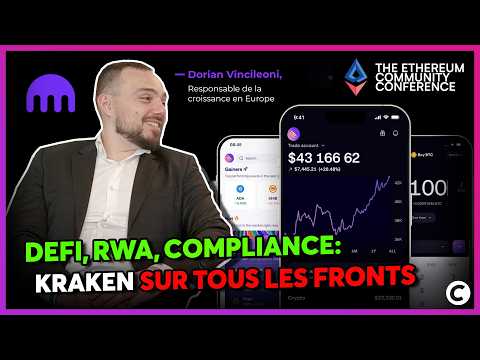
DeFi, RWA, compliance ... Kraken sur tous le fronts
AI Summary
Dorian from Kraken discusses the exchange's presence in the European market, emphasizing their full compliance with MiCA regulations. Kraken, founded in 2011, is presented as a pioneer in the cryptocurrency space, having navigated its entire history. A key differentiator highlighted is Kraken's impeccable security record, with no past hacks, contrasting with other major exchanges that have experienced breaches. The importance of a strong capital base and transparent communication during security incidents, like the recent Bybit hack, is noted as a sign of resilience and customer protection.
Kraken views Europe as a crucial market, having been an early adopter of Euro trading pairs as far back as 2014-2015. The speaker recalls Kraken's prominence in 2017 for facilitating Euro-to-crypto transactions. After a period of increased competition from newer platforms and products, Kraken has re-established its leadership, particularly by achieving full regulatory compliance in Europe. The company sees itself as a driver of innovation and narrative within the crypto space, aiming to set trends that others follow.
A significant new product discussed is "bundles," which are described as curated baskets of cryptocurrencies. Kraken's unique approach to bundles includes no management fees and the underlying assets being held in spot on the user's wallet, granting them direct control and the ability to liquidate or manage their holdings at any time. These bundles can be rebalanced automatically based on predefined proportions, such as a 50/50 Bitcoin-gold allocation to maintain a desired investment strategy.
Looking ahead, Kraken aims to expand bundles beyond just cryptocurrencies to include tokenized assets like stocks (Xtocks) and tokenized ETFs. This integration of traditional finance assets is part of the broader "Real World Assets" (RWA) narrative. The challenge in Europe lies in the complex regulatory framework for tokenized assets, but the ambition is to create bundles that offer broad diversification, potentially including S&P 500, Nasdaq, and gold ETFs alongside Bitcoin.
The conversation touches upon the convergence of cryptocurrency and traditional finance. The initial vision of crypto was to create an alternative system, but it's now increasingly engaging with and challenging the existing financial infrastructure. This evolution is seen as a natural progression, with the crypto ecosystem having matured through experimentation, successes, and failures.
The discussion delves into economic theory, referencing Gresham's Law and the idea that good money is hoarded while bad money circulates. Bitcoin is framed as potentially fulfilling the role of "good money," leading to its accumulation rather than spending. The growing interest from institutional players like banks and pension funds in Bitcoin and other cryptocurrencies is acknowledged. Kraken's partnership with NASDAQ to bring traditional stocks onto the blockchain is cited as an example of this integration, with Nasdaq-listed stocks potentially becoming available on Kraken in the near future.
Dorian expresses a nuanced optimism about the future. While the initial revolutionary aspirations of crypto might be tempered by the complexities of engaging with the established financial system, the focus is shifting towards incremental change. The scale of traditional markets compared to crypto is vast, with Bitcoin's market capitalization being a fraction of that of gold or the stock market. The concern is that if institutional adoption leads to a scenario where ETFs solely own Bitcoin, it might deviate from the original decentralized ethos.
Regarding Ethereum and smart contracts, the focus is on the ongoing development and construction by builders, particularly during this bear market. This period is described as the "best bear market" due to the lack of major ecosystem-wide failures, with core protocols functioning reliably. The decoupling of Ethereum's technology from its token price is seen as a positive sign for its long-term viability, even if it might reduce speculative interest driven by quick gains. The shift from an era of easy fortunes in crypto to a more challenging, albeit less volatile, market is noted, with current market downturns causing panic that was commonplace in earlier years.
When asked about constructing a balanced crypto portfolio, Dorian emphasizes that it's a personal endeavor. However, he suggests that Bitcoin should form a significant portion (40-60%) due to its reduced risk and potential for long-term performance, especially in an inflationary environment. Gold (20-25%) is recommended for its historical stability, with a preference for physically-backed tokenized gold like Pax Gold for interchangeability. The remaining portion is considered "gambling," with potential allocations to assets like Dogecoin for speculative gains and exposure to AI narratives within a 10-15% limit, acknowledging the risks associated with rapidly growing tech companies.
Stablecoins and DeFi are discussed in the context of generating yield. The regulatory landscape in Europe is seen as restrictive towards DeFi competing with traditional banking products. However, decentralized finance protocols still offer opportunities for yield generation on stablecoins through platforms like Kraken's "Defi Earn," which connects to on-chain vaults with verifiable risk levels.
Finally, Dorian offers a message to aspiring crypto investors: "it's never too late." He highlights that newcomers are entering a more established ecosystem with abundant, consolidated educational content, making "do your own research" more accessible than in the past. The key takeaway is that crypto is no longer just about Bitcoin; it's a broader ecosystem that is gaining serious consideration from major institutional players, suggesting it's not the time to withdraw but rather to engage.