So... We Aren't Even Trying To Hide it Anymore?
AI Summary
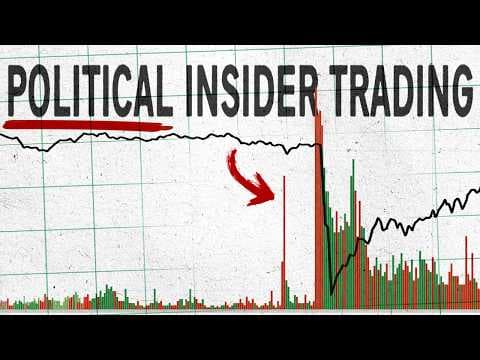
Earlier this week, an announcement on True Social by the president regarding productive talks with Iran to deescalate regional tensions, inferred a loosening of shipping traffic in the Strait of Hormuz. This suggested the potential for lower oil prices and a more positive outlook for financial markets. What caught attention was a significant spike in futures trading within these markets just 16 minutes before the announcement, indicating insider knowledge and potential profit. This mystery speculator could have made up to $60 million in 20 minutes.
Insider trading has become an expected occurrence in Washington, with officials often outperforming top hedge funds. While considered immoral and potentially treasonous, there's a prevailing indifference, with many assuming it doesn't significantly impact them personally. However, this week's trade garnered attention for two reasons: it occurred in a market directly affecting people through high oil prices, and its brazen nature. The trades involved hundreds of millions of dollars in notional value within 60 seconds, 15 minutes before the market-altering announcement, suggesting a deliberate lack of discretion.
This incident highlights that such activities are frequent, with insiders usually being more adept at concealment. Key changes have allowed this behavior to become so blatant, raising questions about the extent of political insider trading and its cost to the public. There's a bipartisan push to ban members of Congress from trading stocks, with a hearing on the matter recently held.
Many market-moving announcements follow a discernible pattern: good news is often released on Monday mornings before markets open, while bad news is typically buried at the end of the week after markets have closed. This isn't a new phenomenon; historically, it was good political practice to release bad news on a Friday afternoon to minimize its impact by Monday. However, as the market increasingly reflects national competence, these incentives have shifted, leading to directly profitable outcomes. Every major announcement mentioned thus far has been accompanied by suspicious corresponding trades.
This trend is facilitated by two main factors. Firstly, "bet on everything" markets utilizing cryptocurrencies have made it easier to profit from privileged knowledge and harder to track for those with insider information who aren't yet "above the law." Secondly, Washington is generating more market-moving "noise" than ever before. Government spending now accounts for a higher share of GDP than during World War II, and events like massive stimulus measures, global trade-altering tweets, and Fed policy meetings attracting huge viewership are not normal. Financial performance is now closely tied to government decisions. A study found that financial instability was markedly higher when Congress was in session, which also coincided with when most trading occurred – a surprise to no one.
The third reason for this pervasive issue is the lenient punishment for individuals identified as abusing their positions for personal profit, both legally and in terms of re-election chances. The public has become desensitized, leading many outlets to barely report on it. However, the attention this particularly egregious insider trade is receiving offers an opportunity to shed light on the broader problem, revealing the profits made by those playing the system and the costs incurred by the public.
A significant portion of shares and financial assets are owned by wealthy households, large institutions, or foreign investors. The indirect losses from insider trading, though a zero-sum game, are spread across many people who may not feel the impact directly, making it easy to ignore. However, tracking data from Stock Act disclosures provides insights.
Most House representatives and senators primarily hold "buy and hold" portfolios, with occasional trades not considered unusual for wealthy professionals. This suggests that the overall outperformance in congressional stock trades is largely driven by a small group of extremely active traders. In fact, most elected officials actually underperformed the market. Data from 2025 showed that just under a third of congressional portfolios outperformed the S&P 500, yet Congress as a whole was up over 20% above the broad market. This indicates that a few dozen officials are making substantial profits, significantly raising the average. Congress now makes over 10,000 trades a year, largely concentrated among a handful of individuals, with the median congressperson making only three trades. This indicates that those clearly manipulating the system are a minority.
Further data reveals that these active traders are largely more senior Congress members serving on numerous committees. Almost every year since disclosures were introduced, the party controlling the House outperformed the minority party in stock trades. Special committees grant them access to more information, enabling trades like Nancy Pelosi's in Nvidia while shaping the Chips Act, or Tommy Tuberville's dabbling in corn futures while on the Agricultural Committee. Research corroborates this, showing lawmakers' performance improves significantly after assuming leadership roles, outperforming peers by an unfathomably large 47 percentage points on average.
The process of accessing these public disclosures is intentionally difficult, with an outdated user interface. Fortunately, third-party websites track this data, providing user-friendly transparency, albeit because people try to profit by copying officials' trades. The Stock Act only applies to Congress members and their staff, excluding the president, cabinet members, and other high-ranking officials, as well as off-the-book transactions.
Collectively, legally disclosed congressional trading volume amounts to about a billion dollars annually. While significant for a "random" cross-section of the country, it's not enough to move markets independently. The true cost lies in how these financial incentives alter decision-making. Questions arise about whether policy decisions, such as those affecting farmers or the AI industry, are influenced by personal financial interests, or if geopolitical trust is undermined for oil futures profits. These decisions impact interest rates, trade deals, and currency strength. The economic uncertainty index is high, leading to increased interest rates on national debt, which will ultimately be paid through higher taxes, inflation, or economic default. While insider trading isn't solely responsible for debt risk premium, it creates direct financial incentives against resolving such issues.