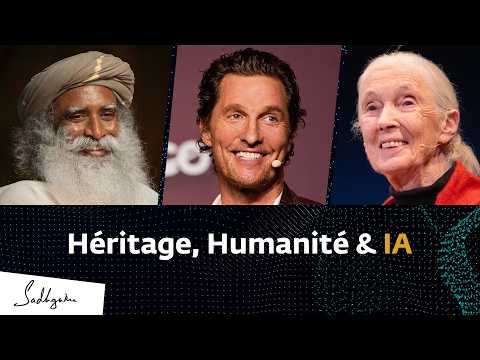
Héritage, Sens & l'IA — En conversation avec Sadhguru, Matthew McConaughey & Jane Goodall
AI Summary
The panel discussion, titled "Leading with Purpose," brought together a primatologist, an award-winning actor, and a renowned guru to explore the meaning of purposeful leadership and its application to pressing global issues like climate change and the rise of AI.
Jane Goodall, renowned primatologist, opened by stating that leadership is impossible without a purpose. Matthew McConaughey echoed this, emphasizing that purpose provides a reason to wake up, a sense of building momentum, and something to leave behind. He highlighted that having a purpose allows for a feeling of progress and growth, even through setbacks, and ideally creates a legacy that outlasts oneself. Sadhguru added that every life, from the smallest ant to humans, has an inherent purpose. However, for humans, the significant aspect is consciously identifying an inclusive purpose that extends beyond mere survival. He posited that true purpose is not something we create for ourselves, but rather an identified line of action that then guides us.
The conversation then shifted to climate action, a field all panelists are actively involved in. Sadhguru lamented that while his efforts in soil and tree regeneration are considered "amazing," they are merely a "drop in the ocean" compared to the scale of the problem. He stressed that the goal isn't personal accomplishment but finding a solution. He argued that the world knows the problem and vaguely the solution, but lacks collective action, with everyone expecting someone else to act. This realization led him to launch the "Save Soil" movement, taking on the "idiot" role because others wouldn't. He criticized the tendency to pass environmental problems to future generations.
Jane Goodall then shared insights into the work of the Jane Goodall Institute (JGI) and Roots & Shoots. She recounted her early ambition to live with wild animals in Africa, a dream dismissed by many but supported by her mother. Her groundbreaking work with chimpanzees challenged the scientific dogma of her time, which denied animals personality, mind, and emotions. Through her observations, she demonstrated the chimpanzees' complex social behaviors, tool use, cultures, and even their dark and altruistic sides, ultimately bridging the perceived gap between humans and animals in scientific understanding.
Goodall's focus shifted from pure research to conservation when she realized the drastic decline in chimpanzee populations and the destruction of their forest habitats across Africa. She observed that poverty was a major driver of environmental destruction, as local communities were forced to exploit natural resources for survival. This led to the creation of the TACARE program, a holistic, community-centric approach that involves asking villagers how JGI can help them, rather than dictating solutions. This program, now implemented across Tanzania and six other African countries, integrates advanced technologies like GIS, GPS, and satellite imagery.
Recognizing the critical role of youth, Goodall founded the Roots & Shoots program. Starting with 12 Tanzanian high school students, it has grown into a global initiative in 70 countries, engaging young people from kindergarten to university in projects that benefit people, animals, and the environment. Goodall emphasized that every individual has an impact on the planet and the program empowers youth to choose a positive impact.
Matthew McConaughey elaborated on his involvement with youth and climate, particularly through the Just Keep Livin' Foundation, co-founded with his wife Camila. This foundation provides educational programs in underserved schools in the US, focusing on fitness goals, nutrition, and community service. McConaughey highlighted the unexpected finding that the program provides a safe space for students. A key component is mandatory volunteering, which, to his surprise, 100% of the students embrace, fostering a sense of agency and gratitude. He emphasized that gratitude cultivates more reasons to be grateful, leading students to recognize and appreciate aspects of their lives they previously overlooked. The program helps students, some from challenging backgrounds, to find new paths and options, with many going on to excel academically.
McConaughey also discussed the Greenlight Grant initiative, which addresses the challenge of schools accessing federal funding for safety and mental health. He found that billions of dollars were available through bipartisan legislation, but schools struggled to apply due to lack of time and expertise in grant writing. His initiative, in partnership with Salesforce, provides grant writers to help schools navigate the complex application process, enabling them to secure crucial funding. He praised the concept of "agent force" as a human assistant, acknowledging its potential for productivity but also raising concerns about job displacement.
Sadhguru further expanded on the need for a spiritual approach to environmental issues, stating that the loss of 84% of the planet's vertebrate population in 70 years is not just an ecological problem but a spiritual one. He explained that the physical world is defined by boundaries, but a spiritual process involves transcending these physical and identity limitations. Without this, human capabilities will only lead to greater problems, as intelligence operates within the confines of our identifications. His core work is to expand human experience so that individuals feel interconnected with everything around them. He used the example of breathing to illustrate this inherent interconnectedness, where what one exhales, a tree inhales, and vice-versa.
He recounted the "Project Green Hands" initiative in southern India, launched after UN agencies predicted desertification. By engaging 62 million people to plant and nurture one tree each, they have planted 112 million trees, but he stressed this is still a "drop in the ocean." He emphasized the urgent need for 112 billion trees globally to reverse climate change and the alarming 85% decline in photosynthesis over the last 1000 years, leading to decreasing oxygen levels. He urged people to focus on increasing green cover, asserting that "every green leaf you add to this planet from now on is a tiny step towards mitigating climate change."
The discussion concluded with reflections on Artificial Intelligence (AI). Jane Goodall acknowledged AI's utility in conservation, using it with camera traps and satellite imagery to identify and even name chimpanzees, a stark contrast to her early, more intimate study methods. However, she expressed concern about AI falling into "wrong hands," citing examples of AI-powered surveillance in dictatorial regimes. She likened AI to a tool that can be used for good or ill, depending on the intentions of its users.
Sadhguru viewed AI as offering immense capabilities, potentially elevating humans to "super-humans." However, he cautioned that this power is beneficial only if human intentions and identities are inclusive. He acknowledged that technology cannot be stopped, as it represents human aspirations. The challenge lies in fulfilling these aspirations without destruction, minimizing the unavoidable "collateral damage" of rapid technological transitions with compassion and an inclusive approach. He warned that humanity's growing "footprint" necessitates universal thinking, as localized actions can have widespread destructive consequences. He reiterated that human intelligence, while a miracle, often becomes the source of suffering, and AI, as an extension of this intelligence, requires careful management to prevent it from turning against us.
Matthew McConaughey, while acknowledging AI's potential for misuse, expressed optimism that it will be used for good more often. He highlighted the "agent force" concept as a practical application, using AI to fill out 90% of complex grant applications for schools, thereby empowering principals to access vital funds. He also shared his personal use of AI for creative purposes, summarizing stories and generating art. He pondered whether humanity is creating a "digital god" and if people will bow to it instead of a spiritual one, expressing a slight worry about this path. However, overall, he remained enthusiastic and optimistic, viewing AI as another industrial revolution that will reshape society. He suggested that AI will serve as a mirror, reflecting humanity's true nature, and hoped the reflection would be a positive surprise.
The panelists agreed that AI is a tool, a mirror, and an extension of humanity. They expressed hope for its positive applications, emphasizing the need for engagement with determination, inclusion, and universality.