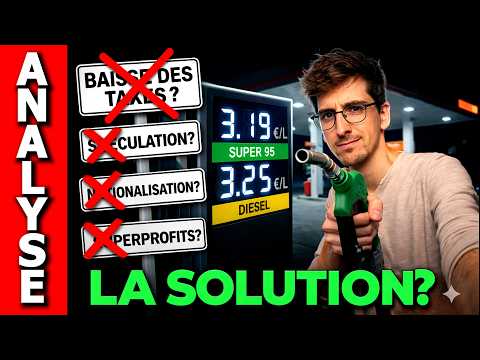
Ils vous mentent sur les prix de l’essence ! Préparez-vous au vrai choc !
AI Summary
The speaker begins by addressing the highly emotional and sensitive topic of fuel prices, noting that much of the public discourse is simplistic and misinformed. He references a previous video where he debunked dubious comparisons of pump prices over time, explaining that increases are largely due to carbon taxes, diesel tax adjustments, the euro's decline, and general inflation. While a tank of gas costs more today than 20 years ago, representing about a 26% loss in purchasing power for someone earning minimum wage, this isn't the 100% increase often claimed. He also points out that a shift from an old diesel car to a hybrid could offset some of this, though the increased cost of cars, even used ones, might negate any savings.
The issue of fuel prices is intertwined with the forced transition to electric vehicles and past tax hikes, which were a trigger for the Yellow Vest movement. He clarifies that the Yellow Vest protests were a broader reaction to a loss of middle-class purchasing power, not solely about fuel, and that subsequent government responses have deterred further large-scale demonstrations.
The current fuel price crisis has led to predictable political responses: the right blames excessive taxes, while the left calls for nationalization and taxing "super profits." The government, as usual, appears unprepared. The speaker promises to cut through the noise and provide essential information, even if it's not what people want to hear.
He then tackles the issue of fuel taxes, often compared unfavorably to neighboring countries like Spain. While France's fuel prices are indeed higher than many EU countries, they are not the highest (e.g., Greece, Germany, Netherlands, and Denmark have higher prices). He explains that the pump price consists of crude oil cost, refining, transport, distributor margin, and taxes. Taxes, specifically excise duties, vary across Europe. France's excise duty on unleaded gasoline is around 68-70 cents per liter, compared to Spain's 50 cents. The EU sets a minimum excise duty of about 36 cents for unleaded and 33 cents for diesel, preventing countries from going below this to avoid unfair competition.
A common complaint is the "tax on tax" – 20% VAT applied to the price of fuel, which already includes excise duties. The speaker clarifies that this isn't unique to France; an EU directive from 2006 defines the selling price for VAT calculation as including all costs, taxes, and duties. This applies to many products, not just fuel (e.g., alcohol, tobacco, labor costs). He argues that this specific complaint about VAT on excise duty on fuel is misguided because excise duty is a fixed tax. If the state, which is currently in deficit, were to remove VAT on excise duty, it would simply increase the excise duty by the same amount to recoup the revenue, resulting in no real change for consumers.
He also addresses proposals to reduce the general VAT on fuel from 20% to 5.5%. The EU mandates a minimum VAT of 15% on fuel. Therefore, France could only lower it by 5 points, from 20% to 15%. This would reduce the price by only about 9 cents per liter. A 1-cent reduction in fuel tax revenue costs the state 500 million euros annually. Lowering VAT to 15% would cost 4.5 billion euros, far exceeding any current fiscal surplus. If the state were to eliminate its "surplus" from fuel taxes, it would only result in a 6.4-cent reduction per liter.
Maximally, if France were to reduce VAT to 15% and excise duties to the EU minimums, it would result in a roughly 39-cent reduction per liter, still leaving prices above 2 euros. However, this would lead to a 19.5 billion euro annual revenue loss. This is impossible because France is currently under an excessive deficit procedure by the EU, requiring strict control over public spending to reduce its record deficits by 2029. Non-compliance could result in fines of up to 0.1% of GDP (30 billion euros) and jeopardize France's ability to finance its debt through the European Central Bank. Therefore, significant tax cuts or new spending programs are not feasible.
The speaker then debunks a proposal by Alexandre Jardin, who suggested reallocating 19 billion euros from wind energy subsidies to lower fuel prices by 35-40 cents. Jardin claimed this money was for unnecessary wind projects and infrastructure. The speaker refutes this by explaining that the 10 billion for offshore wind infrastructure is spread over 20 years and for projects not yet built. The 9 billion euros for existing wind installations are guaranteed price commitments that cannot be unilaterally canceled without incurring massive compensation costs and damaging France's international credibility. These subsidies are often driven by EU renewable energy targets, which are increasing, and not by domestic political whims. He explains that these "guaranteed price" systems make wind and solar attractive investments, even when they are not profitable on their own, and that they paradoxically contribute to state deficits during periods of low or negative electricity prices.
He concludes on the tax issue by reiterating that the state is not "gorging" on fuel taxes. Any small fiscal surplus is negligible, and the state's long-term interest lies in lower fuel prices to stimulate broader economic activity and consumption, which generate more overall tax revenue. The idea of significant tax cuts is politically motivated but fiscally and legally unfeasible within the EU framework and France's current deficit situation.
The speaker then turns to the left's proposed solution: nationalizing Total and coordinated European bulk purchasing of oil. He dismisses Fabien Roussel's idea of nationalizing Total, explaining that it wouldn't prevent price shocks and is based on a misunderstanding of international oil markets. EU countries have diverse interests and supply chains, making coordinated purchasing difficult. Furthermore, merely buying crude oil isn't enough; refining capacity and specific oil qualities are crucial. Producers would not sell at below-market rates out of generosity. Nationalizing Total would cost 175 billion euros (at current share prices), which would likely be borrowed, with the company's profits then used to pay interest on that debt, offering no net gain. Expropriation would lead to international retaliation and severely damage France's economic credibility.
Finally, he discusses the idea of a "super profits" tax on energy companies, noting that five European countries are pushing for this. A similar EU solidarity contribution was adopted in 2022. While more intelligent than nationalization, he points out that such taxes are difficult to implement effectively due to corporate tax optimization and the global nature of oil companies' profits. It would be hard to tax profits made abroad or prevent companies from shifting them.
The core problem, which he says no one is addressing, is the rising price of oil due to blockages in the Strait of Hormuz and damage to production and refining capacities in Iran, the Gulf, and Russia (due to Ukrainian attacks). This creates a global supply deficit, leading to shortages. No amount of tax manipulation or nationalization will solve a physical shortage. Emergency measures like monitoring distributor margins, minor fiscal redistribution, and using strategic reserves can only temporarily mitigate the problem if the crisis is short-lived and speculative. He criticizes the government and markets for betting on a quick resolution, ignoring the potential for prolonged shortages. He promises to address the true problem of potential fuel shortages and their management in a future episode.