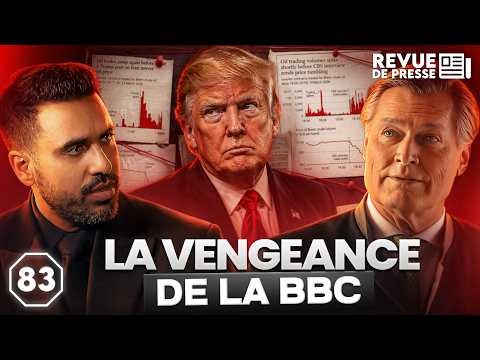
La vengeance de la BBC sur Trump #Octogone83
AI Summary
The discussion opens with a focus on Adelaide, Australia, highlighting its strategic importance to the Australian economy as a gateway to the Indian Ocean. Despite its importance, Adelaide faces challenges similar to other remote cities like Alice Springs, particularly concerning energy security. The city was considered a potential candidate for an energy lockdown, though other regions, like Southeast Asia, experienced this first. Gunther Polly, an expert on Australian viticulture, notes that Adelaide's climate and culture bear resemblance to San Francisco. He elaborates on the Barossa Valley, a region renowned for its 17th-century European grapevines, established by French Huguenots and South African traders. These vines are unique as they are planted directly in the earth, ungrafted, and grown without fertilizers, irrigation, or pesticides, preserving original biodiversity.
A significant event discussed is Elon Musk's 2017 challenge to address South Australia's energy crisis. Faced with issues in solar energy storage, the province tasked Musk with installing a 100 MW battery system within 100 days, with no payment if he failed. Musk succeeded within the timeframe, securing a major contract for his lithium batteries and proving his capability in building such large-scale energy storage systems.
The conversation then shifts to a legal dispute between Donald Trump and the BBC. The BBC is accused of defamation for allegedly truncating Trump's speech, creating the impression that he incited insurrection on January 6th. The discussion highlights the significant financial penalties associated with defamation lawsuits in the US, contrasting them with the lower damages typically awarded in France. This legal battle is framed against the backdrop of financial market volatility, particularly concerning the Strait of Hormuz. It's noted that announcements of peace or conflict in the region lead to speculative trading, with fortunes being made in short timeframes. Glenn Greenwald's reporting on the financial gains of individuals close to Trump, such as Jared Kushner, is mentioned, raising questions about potential insider trading. Hunter Biden's financial dealings are also brought up in relation to potential corruption.
Gunther Polly explains the complexities of the oil market, distinguishing between paper contracts and the physical oil market. He notes that speculative trading, especially around geopolitical events like those concerning the Strait of Hormuz, can lead to fortunes being made by those with privileged information, potentially just minutes before public announcements. While Trump's family is not directly accused, the proximity to Trump is suggested as a key factor in such well-timed market movements. The BBC's potential financial peril is discussed, with the understanding that as a state-funded entity, any judgment against it would ultimately fall on the English state.
The discussion touches upon internal dissent within the MAGA movement, with Tucker Carlson publicly apologizing for past endorsements of Trump, suggesting a strategic move to regain electoral support. The concept of "draining the swamp" and fighting insider trading, a key Trump campaign promise, is contrasted with the alleged insider trading activities of figures like Nancy Pelosi.
The conversation then delves into the political and technological landscape, with a focus on Palantir's manifest. The manifest is described as a doctrine advocating for increased military involvement, national service, and a correction of post-war armament policies in Germany and Japan. Palantir's call for a "technological republic" and its potential contradiction of advocating for both robot armies and national service is noted. The manifest is interpreted as a shift from a company merely selling technology to one providing moral and ideological direction, particularly in the context of military applications and geopolitical objectives. The concern is raised that this represents a privatization of state functions and a potentially dangerous influence on governance.
Gunther observes that such a document from a private company would have been impossible a decade ago, suggesting a growing reliance on private entities for moral and strategic guidance by states. The discussion highlights Europe's perceived moral failings and the erosion of human rights, leading to a situation where individuals can be stripped of their citizenship and rights. The role of technology, particularly artificial intelligence in warfare, is a recurring theme, with Palantir's involvement in developing AI for "assassination" being explicitly mentioned.
The conversation then shifts to the geopolitical situation involving Russia, Israel, and Iran. Russia's declaration of liberating Luhansk is mentioned, along with its ongoing military operations in Ukraine. The diplomatic escalation between Russia and Israel is discussed, stemming from allegations of Israeli companies compromising Russian internet security. Russia's response, detaining Israeli citizens, is seen as a deliberate message. The increasing data capture and surveillance capabilities are highlighted as a new frontier in warfare, with both China and Russia developing isolated internet systems to counter perceived Western and Israeli intelligence gathering.
The discussion touches upon the conflict in Lebanon, with Israel's strategic objective of creating a buffer zone in southern Lebanon. The use of language to describe Israeli actions, such as "renovation" instead of "demolition" or "annexation," is noted as a rhetorical strategy. The potential for Israel to expand its territory under the current political climate is raised, with concerns for Lebanon's territorial integrity. The lack of respect for international agreements and human rights is identified as a driver of extremism.
Finally, the conversation briefly touches upon the US administration's stance on anti-Semitism, with a declaration that those who promote it could be denied entry into the country. However, a Haaretz report suggests that accusations of anti-Semitism could be leveled against any criticism of the state of Israel. The segment concludes with a reflection on the difficulty of engaging in dialogue and the need for creative solutions in a world characterized by extremism and a lack of respect for established norms.