Honest Review of the COROS Pace 4 (Scientific Test)
AI Summary
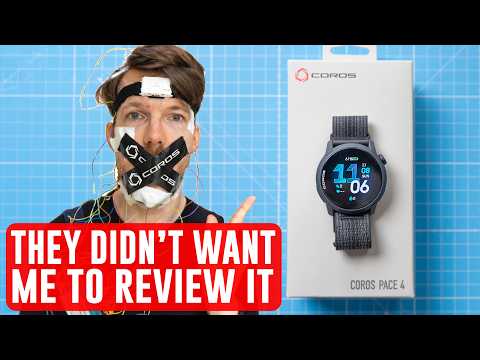
This summary provides a data-driven review of the Coros Pace 4, as presented by Rob, a post-doctoral scientist specializing in biological data analysis. Because the reviewer purchased the device independently after being "ghosted" by the brand, the analysis is strictly based on raw data comparisons against high-end reference sensors. The review focuses on three primary pillars: heart rate accuracy across various activities, sleep stage tracking, and GPS reliability.
### Introduction and Context
The reviewer emphasizes that his analysis is entirely objective, utilizing unfiltered data to evaluate how the Pace 4 compares to its predecessors and competitors. While he has historically enjoyed Coros products, he notes that this review comes later than others because he had to wait for a retail unit. His background in data science informs his methodology, which involves comparing the Pace 4 against "gold standard" or "silver standard" reference devices to determine if the watch is "good enough" for serious athletic training.
### Heart Rate Accuracy: Indoor Cycling and General Performance
Rob begins by testing the Pace 4’s heart rate sensor during indoor cycling, using a Polar H10 chest strap as the reference. Indoor cycling is considered a relatively easy task for wrist-based sensors because there is less arm movement. The Pace 4 performed admirably here, achieving a correlation of 0.97. This puts it in the "upper middle class" of devices.
While there were occasional minor delays in picking up rapid increases or decreases in heart rate, the overall agreement was high. The Pace 4's performance in this category is very similar to the previous Pace 3. Although it doesn't quite reach the top-tier accuracy of Apple or Huawei devices, the reviewer concludes that for indoor cycling, the Pace 4 is perfectly sufficient and would not require an external heart rate strap.
### The Running Struggle: Cadence Lock Issues
The results for outdoor running were significantly less impressive. While some steady-state runs looked decent, the Pace 4 struggled during interval training. The reviewer identified a recurring problem known as "cadence lock," where the watch mistakenly tracks the frequency of the runner's steps (cadence) instead of their actual heart rate. In several sessions, the Pace 4 showed a heart rate of around 160 bpm when the actual heart rate was much lower.
Compared to the competition, the Pace 4 sits in the middle of the pack for running. It was outperformed by the Apple Watch, Pixel Watch, and various Garmin models (including the 165, 570, and 970). Because running is a primary use case for this watch, the reviewer expresses disappointment. He suggests that runners who want accurate data should pair the Pace 4 with an external monitor, such as the Coros bicep strap or an ECG chest strap.
### Outdoor Cycling and Weightlifting
Surprisingly, the Pace 4 performed better during outdoor cycling than it did during running. Outdoor cycling is usually difficult for wrist sensors due to road vibrations and wrist positioning, yet the Pace 4 managed to stay close to the reference device. It ranked in the "second tier" of devices, performing nearly as well as dedicated bicep-worn sensors.
Conversely, weightlifting performance was poor, with a correlation of only 0.8. The watch consistently failed to detect heart rate peaks during sets, likely due to muscle tension in the arm interfering with blood flow readings. However, the reviewer notes that this is a common failure for almost all wrist-based wearables, and he recommends a chest strap for any gym-based training.
### Sleep Stage Tracking: A Significant Weakness
To test sleep tracking, Rob compared the Pace 4 against the Zmax EEG headband, a high-fidelity device that measures brain waves. The Pace 4 did not perform well in this category. It correctly identified deep sleep only about 50% of the time and light sleep 55% of the time. The most significant failure was in REM sleep tracking, where the agreement was only 40%.
The watch often confused REM sleep with light sleep and tended to over-report deep sleep. Compared to the "top five" brands for sleep tracking—Apple, Google/Fitbit, Whoop, Oura, and Eight Sleep—the Coros Pace 4 lags significantly behind. The reviewer concludes that sleep tracking is clearly not a priority for Coros, as the Pace 4 performs similarly to the older Pace Pro and Pace 3 models in this regard.
### GPS Reliability: A Major Strength
Where the Pace 4 truly shines is in its GPS performance. Rob tested the device using a high-accuracy mode in both running and cycling environments. In running tests conducted at Park Belvadier, the watch maintained highly consistent signals, even when running near large walls that typically cause interference. There were only a few brief moments of deviation before the signal "snapped back" to the correct path.
During city cycling commutes, the GPS remained impressively stable despite the presence of tall buildings. The signals from multiple rides overlapped almost perfectly, outperforming many competitors that struggle with "GPS drift" in urban areas. The reviewer ranks the Pace 4’s GPS on par with the best devices from Garmin and Suunto.
### Final Verdict
The Coros Pace 4 is a mixed bag that excels in specific areas. Its primary strengths are its lightweight design, excellent battery life, and top-tier GPS accuracy. However, its built-in heart rate sensor is unreliable for running due to cadence lock, and its sleep tracking capabilities are subpar.
The reviewer’s final recommendation is nuanced: if you value GPS accuracy and battery life, the Pace 4 is a solid value proposition, provided you pair it with an external heart rate monitor for running and weightlifting. If you are looking for an all-in-one "wellness" device that tracks sleep and daily health metrics accurately, a Pixel Watch or Apple Watch would be a better choice, though you would sacrifice the superior GPS and battery performance found in the Pace 4.