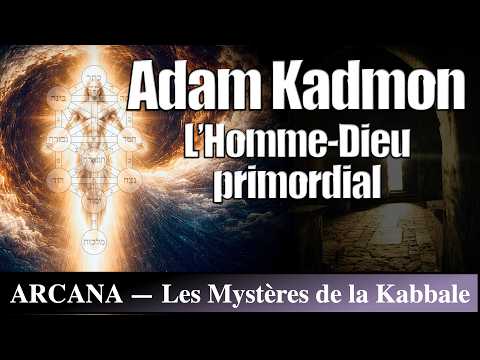
Adam Kadmon : l’homme primordial - Les Mystères de la Kabbale
AI Summary
The cabalistic tradition introduces Adam Cadmon, or the primordial man, a cosmic being that existed before the world's creation. This figure symbolizes the structure of the universe, God, and humanity, all conceived as sharing a common symbolic architecture. Adam Cadmon, often translated as "primordial man" or "original man," is central to esoteric Jewish theology, fundamentally shaping the cabalistic understanding of creation, the cosmos, and the divine-human relationship.
It's crucial not to mistake Adam Cadmon for a mythical character like Noah or Abraham. Instead, he represents a metaphysical principle, a cosmic archetype that symbolically illustrates how divinity manifests in the world. Etymologically, "Adam Cadmon" means "ancient Adam" or "primordial Adam." He should not be confused with Adam Rishon, the first man in the biblical Genesis narrative, who belongs to the manifested world of creation. Adam Cadmon exists at a prior cosmic level, that of the divine plan itself, in emanation.
In medieval Kabbalah, Adam Cadmon embodies several fundamental dimensions of cosmogony. Firstly, he is the initial manifestation of divine light. Secondly, he forms the archetypal structure of the universe, serving as the primordial model for creation's unfolding. Finally, he symbolizes the ten sephirot—divine attributes or powers through which divinity reveals and organizes the world. Thus, Adam Cadmon is both a symbolic anthropomorphic figure representing the universe as a cosmic human body and a divine reality shaped by the organization of spiritual light. This image conveys the idea that the universe possesses an intelligible and ordered structure, with the human form serving as the most accessible analogy for the human mind. Through this figure, Kabbalah asserts that humanity, the world, and the divine share a single symbolic architecture.
To grasp this concept fully, one must trace its origins to the heart of Jewish mysticism and its Greek influences. The idea of Adam Cadmon didn't suddenly emerge in medieval Kabbalah; it evolved through a long process of Jewish mystical thought, nourished by both internal Judaic religious traditions and, significantly, Hellenistic philosophical influences. Before becoming a core cabalistic notion, the idea of a celestial primordial man appeared in ancient mystical and speculative currents, notably in ancient Jewish literature, such as the Palaces literature or the Merkaba celestial chariot writings. Merkaba mystics sought spiritual ascent through prayer, asceticism, and meditation, journeying through celestial spheres to contemplate the divine throne. In these texts, God is sometimes described with highly symbolic anthropomorphic images to express inaccessible divine reality.
Among the prominent texts of this tradition is the *Shiur Qoma*, "The Measure of the Body," which symbolically describes the gigantic dimensions of the divine body. The limbs of this cosmic figure are measured in immense proportions, expressing the infinity of divine power. These descriptions are not to be taken literally; they are esoteric and symbolic, aiming to convey the cosmic structure of the divine.
This representation of a cosmic divine body constitutes a prototype for the idea of Adam Cadmon. As Gershom Scholem demonstrated, this tradition reflects an ancient tendency in Jewish mysticism to depict the divine structure as a symbolic anthropomorphic body to express the relationship between God, the cosmos, and humanity.
Even before the celestial palaces literature and the Midrashic tradition, the Hellenistic Jewish philosopher Philo of Alexandria, in the 1st century, laid an early foundation. Living in a Greek-influenced environment, Philo sought to reconcile Jewish biblical tradition with Platonic philosophy. In his interpretation of Genesis, Philo distinguished between two humanities: the celestial man, created directly in God's image, bodiless and belonging to the world of intelligible realities; and the terrestrial man, fashioned from clay and belonging to the tangible world of matter. This distinction stems from a philosophical reading of two key Genesis passages on human creation: Genesis 1:26 ("Let us make man in our image, after our likeness") and Genesis 2:7 ("The Lord God formed man of the dust of the ground, and breathed into his nostrils the breath of life; and man became a living soul").
In his treatise *De Opificio Mundi*, Philo explains that these two accounts describe different events: the first concerns the ideal, spiritual human creation, while the second describes the appearance of material man. This concept draws directly from Plato's theory of forms, where sensible realities are imperfect copies of intelligible archetypes. From this perspective, the idea of a primordial celestial man existing before terrestrial humanity is a direct precedent for the cabalistic concept of Adam Cadmon. This initial idea was later adopted in Jewish mysticism over subsequent centuries for the development of medieval Kabbalah's cosmology.
Symbolic anthropomorphism was integrated into a more structured metaphysical vision based on the theory of the ten sephirot—divine attributes through which divinity manifests in creation. Between the 10th and 13th centuries, medieval Kabbalah progressively developed a complex cosmology explaining the relationship between the divine infinite and the tangible world. In this view, divine creation is not a single act but a process of progressive emanation of divine light from the infinite source of divinity, which cabalists call *Ein Sof* (literally, "the infinite" or "without limit"). *Ein Sof*, the cause of causes, represents God's absolute, transcendent dimension—an unlimited and unknowable reality beyond all human form and thought.
For medieval cabalists, the world cannot directly originate from this absolute infinity; it must pass through a series of mediations and progressive manifestations. It is in this cosmological context that Adam Cadmon emerges, representing the first cosmic form produced by divine light even before the appearance of spiritual and material worlds. This is an extremely high metaphysical level, representing the original plan of creation.
In cabalistic tradition, Adam Cadmon is often described through anthropomorphic symbolism. Cabalists depict the structure of creation as a gigantic human body, where different body parts correspond to the ten sephirot, the divine attributes. These ten spheres or vessels are the modalities through which divinity reveals, structures, and acts directly in the universe. A law of correspondences exists between the sephirot and the human body:
* The head corresponds to Keter (the crown).
* The brain is represented by Chokmah and Binah (wisdom and intelligence).
* The two arms are illustrated by Hesed and Geburah (grace and rigor).
* The torso is the image of Tipheret (beauty or harmony).
* The two legs represent Netzach and Hod (victory and glory).
* The foundation corresponds to Yesod (the foundation).
* Finally, the base is Malkuth (the kingdom).
This structure corresponds to the symbolic representation of the Tree of Life, or the sephirot, which form the symbolic map of cabalistic cosmology. The image of Adam Cadmon thus allows the universe to be conceived as a living organism, where each part corresponds to a specific spiritual, intellectual, or moral function. This analogy between man and cosmos is a fundamental principle in esoteric thought.
Furthermore, Adam Cadmon also encompasses the concept of the four worlds. In classical cabalistic cosmology, creation unfolds through four major levels of existence:
1. *Atziluth*, the world of emanation, for the sephirot Keter, Chokmah, and Binah.
2. *Briah*, the world of creation, for Hesed, Gevurah, and Tipheret.
3. *Yetzirah*, the world of formation, for Netzach, Hod, and Yesod.
4. *Assiah*, the world of action or materialization, carried by the sephira Malkuth.
These worlds represent the progressive stages by which divine light densifies to give birth to the material world. Thus, Adam Cadmon represents the cosmic matrix or *materia prima* of creation. As such, one of the most important aspects of the Adam Cadmon concept is the idea that the structure of the cosmos and that of the human being are fundamentally analogous—the idea of macrocosm and microcosm. Kabbalah asserts that man was created *b'tzelem Elohim*, meaning the human form symbolically reflects the universe's organization. Adam Cadmon represents the divine macrocosm, the universe in its spiritual dimension, while man represents the microcosm, reproducing the cosmic structure on his own scale. This correspondence between macrocosm and microcosm became a major principle of Western esotericism, particularly in hermeticism, alchemy, and many initiatic traditions.
In summary, classical cabalistic thought expresses through Adam Cadmon a central idea of Jewish cosmogony: the universe, humanity, and the divine share the same symbolic structure and nature. However, the history and concepts of this symbol did not stop there. Kabbalah evolved profoundly from the 16th century, and Adam Cadmon became even more complex.
While Adam Cadmon appeared in medieval Kabbalah, it was in Lurianic Kabbalah that this concept gained its most elaborate form and significant cosmogonic role. This mystical tradition developed from the 16th century around the teachings of the cabalist Isaac Luria, known as "Ari the Lion." Although Luria left few writings, his doctrine was systematized and transmitted by his disciples, notably Hayyim Vital in his work *Etz Chayim* (The Tree of Life).
In this cosmological system, creation unfolds through a series of successive stages:
1. *Ein Sof*, the absolute divine infinite.
2. *Tzimtzum*, or divine contraction. According to this doctrine, before creation, the divine infinite filled all existence, leaving no space for a world distinct from God. For creation to appear, *Ein Sof* had to contract its own light, creating a symbolic void where the universe could manifest. This withdrawal is not a real absence of God but a voluntary self-limitation of divinity, allowing a distinct cosmic order to emerge. Scholem summarizes this principle by explaining that *Tzimtzum* represents the act by which God withdraws into Himself to make room for creation.
3. The appearance of the divine ray, *Kav*. After this initial contraction, a ray of divine light penetrates the vacant space left by the *Tzimtzum*. This ray represents the first ordered manifestation of divine light in the process of creation or emanation. It serves as the channel through which divinity begins to structure the cosmos. It is precisely in this first configuration of divine light that Adam Cadmon manifests, corresponding to the initial ordered manifestation of divine light in the cosmic space created by the preceding contraction. In this perspective, Adam Cadmon can be understood as the matrix of all future creation, virtually containing all spiritual structures that will later manifest in the worlds. At this stage, divine light emanates directly from Adam Cadmon's cosmic body and diffuses through various symbolic openings, producing the emanation of the ten Sephirot and the creation of the four planes of existence: Atziluth, Briah, Yetzirah, and Assiah (the tangible world of matter). This anthropomorphic imagery should not be read literally; it is a symbolic language representing the process by which divine light progressively unfolds and manifests creation.
According to Lurianic Kabbalah, the next phase of emanation is *Shevirat HaKelim*, or the "breaking of the vessels" (sephirot). The initial structures designed to receive divine light, called "vessels," could not withstand its intensity. The power of the divine emanation was too great for the receptacles. Under this pressure, the lower seven vessels broke. This cosmic rupture caused fragments of the vessels to disperse into the lower levels of reality, carrying with them sparks of divine light. These sparks became mixed with matter and scattered throughout the world. For Lurianic cabalists, this event explains the origin of disorder and evil in the universe; evil is not an independent creation of God but results from a rupture in the primordial order of creation. This cosmic vision introduces a dramatic dimension into cabalistic theology: creation is not a perfectly harmonious order from its origin but a universe marked by an initial rupture.
Faced with this fragmentation of the cosmos, Lurianic Kabbalah introduced another fundamental notion: *Tikkun*, meaning the "repair" or "restoration" of the world. According to this doctrine, humanity's spiritual mission is to liberate the sparks of light dispersed in matter and restore creation's original harmony. Thus, every righteous action, every spiritual or religious act, contributes to this work of cosmic repair. *Tikkun* is not just a moral or religious concept but possesses a cosmic dimension; humanity becomes an actor in the process of reintegrating creation into the divine order. In this perspective, Adam Cadmon represents the primordial state of the universe before the cosmic fracture, while *Tikkun* represents the process by which creation tends to regain its original unity. Thus, in Lurianic Kabbalah, Adam Cadmon is not merely a cosmological image; he also becomes the symbol of creation's lost unity that humanity is called to restore.
While Adam Cadmon is central to cabalistic cosmology, the idea of a cosmogonic primordial man is not unique to Jewish mysticism. Comparable concepts appear in several ancient religious and philosophical traditions, particularly in Gnostic and Hermetic currents. These traditions also developed the notion of a celestial human archetype, prior to material creation and directly participating in divine reality.
Among these equivalent esoteric figures, one of the most important is Adama, the primordial man. In several Gnostic systems from the early centuries CE, the figure of Adama or Adama Anthropos appears, often described as the original celestial man. The Greek term Adama literally means "the invincible" or "the indestructible." In these doctrines, it denotes the spiritual archetype of humanity. Adama is not the Adam of the biblical narrative but a celestial reality prior to material creation. In the Ophite tradition, a Gnostic current of antiquity, Adama is described as the primordial man residing in the divine world, representing the perfect image of humanity as it existed in the *Pleroma* (divine fullness). Conversely, the terrestrial Adam is merely a degraded reflection of this celestial archetype, separated from his divine spiritual nature. In these systems, humanity's fall corresponds to the descent of this archetype into matter or its fragmentation in the material world. This idea presents analogies with the cabalistic doctrine of the dispersion of divine sparks or the breaking of the vessels. Thus, the Gnostic Adama and the cabalistic Adam Cadmon fulfill similar symbolic functions: both represent the spiritual archetype of original humanity and the cosmic structure of creation, in God's image.
A comparable idea also appears in Hermetic literature, notably in the *Corpus Hermeticum*, a collection of philosophical and mystical texts composed in the early centuries CE. In the Hermetic treatise known as *Poimandres*, there is talk of the birth of a primordial man, born from the divine intellect (understood as the image of God or the Logos of God). This celestial man contemplates creation and possesses a luminous and divine nature. However, fascinated by the material world, he descends into the sphere of nature and decides to unite with it, marking the beginning of the human condition or the fall—separation from the spiritual world. It's important to note that Gnostic and Hermetic schools predate Kabbalah and were not influenced by it. However, it is highly probable that Jewish Kabbalah freely drew inspiration from the concept of the Gnostic Adama and Hermetic concepts. In any case, the idea of a primordial celestial man preceding terrestrial humanity thus appears as a recurrent motif in several ancient spiritual and religious traditions.
For instance, in China, creation begins with the primordial god-man Pangu, who divides himself to form the different elements of creation. A similar myth is found with Ymir, the frost giant of Norse myths, whose body's destruction by Odin and his brothers forms all elements of creation. Numerous similar archetypes are found in different cultures, notably the chimeric monster among the Aztecs.
Returning to Adam Cadmon, from the Renaissance onwards, the discovery of Kabbalah by Christian intellectuals in Europe led to the dissemination of these concepts in Western esoteric thought. Mystics such as Giovanni Pico della Mirandola, Marsilio Ficino, and Johann Reuchlin saw Kabbalah as an ancient tradition containing truths compatible with Christian theology. In this context, "Christian Kabbalah" emerged. In their interpretation, Adam Cadmon is likened to the Logos (translated as "Word" in French), the divine principle presented in the prologue of John's Gospel: "In the beginning was the Word, and the Word was with God, and the Word was God." Thus, some authors interpreted Adam Cadmon as a symbolic representation of the divine cosmic structure compatible with the Greek Logos. Also, in an esoteric Christian reinterpretation, *Tikkun* (the restoration of the world) is presented as the act of Jesus, seen as the new cosmic Adam. In this sense, Christ would represent the accomplishment or restoration of original humanity.
Beyond these various interpretations, the figure of Adam Cadmon expresses a fundamental idea that permeates numerous spiritual traditions: that of a unity or symbolic resemblance between God, the cosmos, and humanity. Hence the famous phrase from the *Corpus Hermeticum*: "Therefore, let us dare to say, the terrestrial man is a mortal God, and the celestial God is an immortal man."
Adam Cadmon is less a being than a metaphysical principle, that of the original unity between God, the world, and humanity.