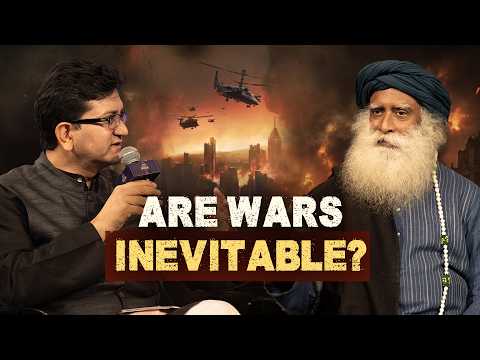
Wars, God-Makers & Quantum Entanglement | Prasoon Joshi & Sadhguru
AI Summary
The discussion delves into profound aspects of existence, consciousness, and the human condition, contrasting them with the limitations of logic and material pursuits. It begins by highlighting the immense destructive potential of nuclear arsenals held by major powers, underscoring the catastrophic consequences of limited identities and unchecked empowerment.
A central theme is the nature of creation and the human desire to be a creator. The speaker posits that creation is a continuous, self-generating process, and human beings' tendency to claim authorship stems from an instinctual drive for superiority, exemplified by peacocks displaying their plumage or dominant fish in a school. This instinct, while crucial for survival in the animal kingdom, is deemed inappropriate for crafting human societies, which should ideally function consciously rather than instinctively. The shift from terms like "unfortunate" to "loser" in some societies is seen as a symptom of this overemphasis on winning and losing, a trend attributed to American influence.
The conversation then explores the distinction between an idle mind and an empty mind. While an idle mind, characterized by a lack of mental engagement, can be a "devil's workshop," an empty mind, achieved through deep meditative states of alertness and stillness, is described as a "divine workshop" leading to profound inner experiences. This contrasts with the Western notion of meditation inviting negative forces.
The concept of consecration (Pranatishta) is explored in depth. It's defined not as an authority but as a tool for well-being and enhancement. The speaker recounts a personal experience in a cave once inhabited by Jain monks 1900 years ago, where despite the passage of time and the presence of modern trash, the space vibrated with an palpable energy. This imprint is attributed to the monks' profound consciousness, which transcended physical limitations. This is contrasted with the fleeting nature of material achievements and even scientific discoveries, which may be lost to time.
The discussion dismisses psychoanalysis as a limited approach, arguing that human intellect, based on accumulated memory, cannot fully grasp the vastness of existence. True understanding comes through experience, not logical deduction. Memory itself is presented as both a foundation and a boundary, shaping our identity and limiting our perception. Transcending memory and tapping into a non-memory-based intelligence is key to making a significant impact.
The speaker emphasizes that human activities, thoughts, and emotions hold meaning only within the human sphere and are insignificant to the larger cosmos. However, genuine consciousness can lead to a profound connection with existence. The analogy of the human body as a "body of memory" – evolutionary, genetic, karmic, and even muscle memory – is drawn.
The concept of consecration is further elaborated through analogies like agriculture (transforming mud into food) and digestion (food into flesh and bone). The easiest, yet most challenging, thing to consecrate is a human being due to their inherent unreliability. The speaker differentiates between different types of consecrated spaces: some, like lingams, merely reverberate with energy, while others, like the Adiyogi Alayam, are knowledge spaces that recognize and interact with individuals based on their receptivity. This interaction is not psychological preconditioning but a recognition of sensitivity.
The discussion touches upon the historical uprooting of consecrated spaces and practices globally, attributing it to aggressive religious processes and a desire to establish singular authorities. Consecration, in contrast, is presented as a tool for personal enhancement, not for imposing authority. The annual whitewashing of homes in India, symbolizing a fresh start and shedding old energies, is cited as a form of consecration. Deeper cleansing through practices like fire washes (Klesa Kriya) and air washes are also mentioned, with remarkable results observed in children with ADHD.
The speaker challenges the notion of quantum entanglement, preferring the term "quantum coherence," and asserts that everything is inherently coherent. Our perception of separation stems from a limited, "keyhole vision." Yoga, by definition, signifies union and coherence. Transcending logic allows for the recognition of this inherent coherence, even in seemingly disparate elements like mango and neem trees growing from the same soil.
The conversation then pivots to the role of logic in modern society. While logic is essential for survival and forms the foundation of knowledge, it is insufficient for understanding the true nature of existence or the "magic of life." The speaker notes the increasing reliance on logic and the rise in psychological issues, potentially linked to factors like nutritional deficiencies and chemical infusions in food. The importance of a balanced approach, with "feet well planted on the ground but head in the sky," is advocated.
The concept of "emptying the mind" is clarified: it's about achieving a state of alert stillness, not idleness, which leads to divine experiences. The invention of zero in India is presented not just as a mathematical concept but as a spiritual one, symbolizing the interconnectedness of zero and infinity. Modern science's discovery of the vast emptiness within atoms and the cosmos is seen as corroborating this ancient understanding.
Empowerment without inclusiveness is identified as a dangerous path, leading to destruction. The speaker highlights how cutting-edge scientific advancements are often first applied to military purposes. True empowerment, rooted in an inclusive identity with the cosmos, is crucial for avoiding destructive tendencies.
The nature of spirituality is also discussed. It's not about seeking contentment as an escape from dissatisfaction, but a process of empowerment. Spirituality is not a disability but the highest level of empowerment, enabling effective involvement or conscious withdrawal. The speaker shares a personal anecdote about his ability to remain in a state of deep stillness, demonstrating a high level of control over his physiological responses.
The discussion concludes by emphasizing that life is one's karma – one's making. While external circumstances are not always controllable, how one responds to them is a choice. The distinction between an idle person (potentially a "devil's workshop") and an idle mind (a "divine workshop") is reiterated. The importance of conscious living, understanding the interconnectedness of all things, and embracing an inclusive identity are presented as the path forward for humanity, especially in the face of immense technological power and potential for destruction.