Valve on Steam Controller Pricing, the RAM Shortage, and the Latest on Steam Deck 2
Audio Summary
AI Summary
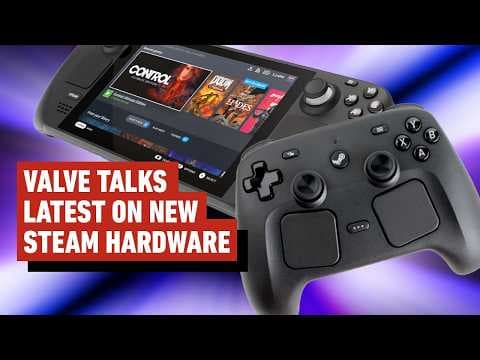
Bo Moore from IGN is joined by Pierre-Loup and Steve from Valve to discuss the Steam Controller and other Valve hardware initiatives. Pierre-Loup, working on the platform side, develops Steam OS and various hardware. Steve Cardinelli, a mechanical engineer, has been instrumental in bringing the Steam Controller from inception to mass production.
When asked about essential features for a "pro" or high-end controller, Valve emphasizes providing as many advanced inputs as possible to allow players to customize their gameplay. Gyro and trackpads are highlighted as crucial for these advanced controllers, offering a high skill ceiling for competitive games and a comfortable alternative for casual games like deck builders. Despite similar high-end PC controllers costing upwards of $150-$200, the Steam Controller is priced at $99. This was achieved through disciplined engineering and design, focusing on input parity with the Steam Deck to maintain familiarity and avoid unnecessary cost additions, while still delivering value.
Regarding the use of trackpads, Valve receives indirect feedback but observes extensive in-game usage. Trackpads are employed for camera controls in third and first-person games, and for assigning radial and virtual menus on the left trackpad, particularly for PC games designed for mouse and keyboard with numerous hotkeys. While desktop navigation is also a use case, the primary adoption is for in-game functionality. Users have successfully played complex games like Crusader Kings and RTS titles, which typically require fine mouse control, using community configurations. The trackpads on the Steam Deck and the new Steam Controller have significantly improved the experience of playing these mouse-and-keyboard-centric games in different parts of the house.
An update on Steam Machine and Steam Frame indicates that while exact timeline details are not available, Valve is actively working on their release and expects to share news soon. The Steam Controller serves as a building block for the Steam Machine experience, particularly for "Steam Machine verified" and out-of-box processes, offering a more seamless experience. However, the controller is also designed to be a standalone product for general PC desktop users.
The Steam Controller is primarily built for PCs or machines running Steam. Console support for platforms like Xbox, PS5, or Switch was not a primary goal. This is because these platforms have fixed expectations for controllers, with specific control sets and APIs that do not fully leverage the Steam Controller's advanced features. The Steam Controller is intended to be paired with Steam or client applications that communicate with Steam, such as remote play on mobile devices or smart TVs. While it can function as a basic mouse and keyboard on non-Steam platforms, its full potential is realized within the Steam ecosystem. Valve has also ensured that third-party applications can be added to Steam, allowing users to benefit from the full configuration layer.
Regarding Steam Deck stock, Valve acknowledges current shortages and difficulties with shipping, memory, and other components. They are working diligently to address these issues, recognizing the high demand from customers. To mitigate costs during the RAM shortage affecting the Steam Deck and forthcoming Steam Machine, Valve is actively keeping options open and collaborating with multiple manufacturers. This strategy of avoiding single-source parts has proven useful in navigating supply chain challenges, as demonstrated during the microcontroller shortage during COVID times. They anticipate navigating the current memory shortage in a similar manner.
The original plan for the Steam Controller, Steam Machine, and potentially Steam Frame was to launch simultaneously. The controller is now being released ahead of the others. Valve clarifies that there isn't an arbitrary tie between product launches. The controller is a standalone product that they wanted to get to customers as soon as it was ready, without waiting for the Steam Machine. While the Steam Machine is harder to ship without a controller, the controller itself is expected to be primarily used by a desktop PC audience, in addition to Steam Machine and Steam Deck users. The delay for the Steam Machine is attributed to logistics, supply, and getting it into users' hands, rather than a lack of readiness. The core experience for the Steam Machine is considered "pretty much there," akin to a docked Steam Deck with more GPU horsepower, with ongoing polish and feature work.
Pierre-Loup and Steve shared examples of creative trackpad usage. Pierre-Loup highlighted the impressive ability to play games with many hotkeys, like Factorio, using nested menus and modifier keys to map over 30 hotkeys. Steve mentioned the depth of functionality, where a trackpad can host a radial menu with 20 inputs, which can then change contextually. His personal favorite, however, is a simpler use: the right trackpad as a mouse and the left trackpad split as a D-pad for left and right mouse clicks, making casual deck-builder games incredibly comfortable to play. This illustrates the controller's ability to offer advanced use cases while still being user-friendly out of the box as a traditional controller.
Finally, when asked about Steam Deck 2, Valve confirmed they are "hard at work on it." They emphasized a continuous development process, where learnings from previous hardware projects, including the original Steam Controller, Steam Machines, and Steam Deck, contribute to future iterations.