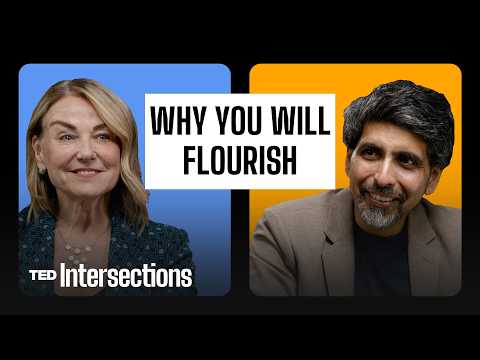
Why the Future is Human … Plus AI | Esther Perel and Sal Khan
AI Summary
The conversation begins with a concern about increasing disembodiment in society, where people gather, party, and drink less, and a significant portion of restaurant food is consumed off-premises. This suggests a difficulty in dealing with the inherent messiness of human life.
When asked to redesign a system from scratch, the first speaker initially deflects, stating there's no single system they would redesign entirely. However, they identify the mental health system as one they know well and believe requires significant improvement. This includes institutional changes, training, service delivery, and better integration with legal and medical systems. Their personal work focuses on micro-systems like couples, families, and groups.
The second speaker, responding to the same question, chooses the education system. They emphasize the need for a personalized approach, contrasting it with the current one-size-fits-all model. Historically, personalized education, like Alexander the Great's tutelage by Aristotle, was available to those with resources. Modern mass public education, while utopian in its ideal, necessitates compromises such as batching students and standardized curricula, which penalize students for not grasping concepts immediately. The speaker advocates for a mastery-based system, where students can continue learning until they achieve proficiency, similar to learning a musical instrument or a sport. They also suggest that higher education credentials should reflect knowledge rather than time spent in a chair.
The discussion then turns to the relational component of education, which the second speaker believes is crucial and often overlooked. While in-person schooling is valued for fostering social connections and conflict resolution, these "soft skills" are not formally recognized on transcripts. The first speaker interjects, noting that relationship skills and relational intelligence have historically been considered "soft" and "feminine," often disregarded despite being highly valued in principle. However, this is changing, with these skills now being recognized as "hard skills" essential for the workplace and thus likely to be valued by the education system.
Both speakers agree that employers are increasingly prioritizing "durable skills" such as communication, collaboration, creativity, and listening, especially in the age of AI. These are seen as fundamental human skills that make individuals better human beings, transcending the traditional view of vocational training as "less than" pure academics.
Regarding the most urgent conversation the world needs to have but isn't ready for, the second speaker highlights potential major disruptions across almost every dimension of life in the next 5 to 10 years, particularly in the world of work due to automation. They express concern that new jobs may not be created quickly enough to offset job displacement, leading to political polarization. They also foresee a re-emergence of people seeking transcendent or spiritual purpose as AI encroaches on uniquely human domains.
The first speaker believes the world needs to discuss relationships, which are undergoing a "massive makeover." Traditional norms based on duty, obligation, and community are shifting towards individualism and negotiation, demanding adaptability, flexibility, and excellent communication skills. They lament the lack of "moonshots" for relationships, questioning how to define family, circles of care, and relationship boundaries in this new landscape, especially with the advent of AI companionship.
Concerns about the future of human connection revolve around a "contactless world" where many points of human interaction are being deleted. This leads to humans becoming "more machine," seeking predictability and perfection in relationships that apps provide. The worry is an inability to deal with the "messiness of human life." However, what excites them is the resilience of fundamental human needs, which will drive people to find ways to connect, even with machines, and express their longings. The proliferation of small groups forming around shared purposes or activities is seen as a positive counter-trend to screen fatigue.
The second speaker describes the current era as a "singularity" where AI, biotech, and genetic manipulation are converging, creating an unpredictable future. This inherent uncertainty is frightening. The first speaker counters that uncertainty has always existed, but humanity once relied on religion as an intermediary to deal with the unknown, suffering, and existential dilemmas. While modern society may not be more uncertain, it has lost the mechanisms for coping with it.
Both agree that a revival of religion or religion-adjacent structures might occur, which could be a positive development. They acknowledge that historical uncertainties were often about basic survival, whereas modern uncertainties are more meta-level, concerning human purpose and AI's capabilities. The loss of a clear "place" in the world is a significant concern, but also an opportunity to rebuild and resurrect essential human connections, rituals, and cultural relationships. The future promises abundance and scientific breakthroughs, but the crucial shift is from "human versus AI" to "human plus AI."
Finally, the question of what humans still need to learn leads to a reflection on whether we are getting better at living or just better at optimizing. The first speaker argues that in love and intimacy, there's a risk of optimizing it into something manageable, measurable, and disposable, borrowing metrics from markets and effectively engaging in "emotional capitalism." This approach, driven by a "return on investment" mentality, leads people to commodify each other and seek "perfect" partners, resisting "good" in pursuit of "better."
The second speaker hopes for a transition from an "optimization state" to a "thriving state." They link the optimization mindset to decades of prioritizing measurable outcomes like GDP and stock market performance. While initial optimization for financial gain provides significant benefits, beyond a certain point, the incremental benefit diminishes. Applying this same optimization mentality to relationships can lead to frustration and prevent genuine thriving. Both conclude that "emotional capitalism" is evident in intimate lives, with people hedging bets and seeking maximized returns. Despite these challenges, there is hope for a future where people invest more in each other and return to thriving, driven by a hopeful-mystic outlook.