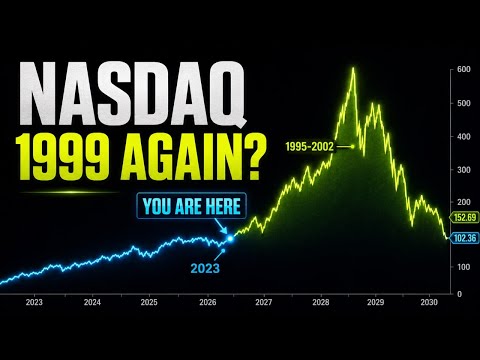
Is the Nasdaq Repeating the 1999 Bubble Setup?
AI Summary
The speaker begins by acknowledging the current market situation, likening it to the 1999 bubble setup, characterized by a "mega shoot the moon move." They question if the market has gone "too far too quickly" and indicate a focus on identifying warning signs that could signal an end to this upward trend. While past indicators like CapEx spending have been monitored, they are considered lagging. The discussion then shifts to forward indications, starting with Bitcoin.
Bitcoin is currently off its session lows but still slightly down, puzzling many given the NASDAQ's "melting up" trend. The speaker aims to provide perspective on whether this is a genuine melt-up or if a rollover is imminent, or if there's further upside potential. Drawing parallels to the Fed's cycle, specifically late 2019 when the Fed stopped Quantitative Tightening (QT) and expanded its balance sheet, a similar outcome is observed today: a tech-led melt-up in equities. Bitcoin, during the previous Fed pivot, saw a quick move up, a lower low, then an ascent. The expectation is for Bitcoin to catch up, currently showing slight upward consolidation, which is ultimately bullish. Tech, driven by AI build-out, is leading for good reason. The speaker anticipates Bitcoin accumulation over the next few days, possibly shifting to a bi-monthly cadence for strategy plans.
The inverted channel for Bitcoin is discussed, which previously helped set expectations for a breakdown and retest. Now, a resumption down is observed, with a potential target around $88,000. The speaker mentions personal investments in "Block B" (likely Block, Inc.), which has performed well despite being high-risk.
The NASDAQ is fighting off red, while geopolitical tensions in the Strait of Hormuz worsen. A meeting between President Trump and President Xi on the 15th is anticipated, potentially impacting China-US relations. The price of oil remains just below $100, trading in unison with the 10-year yield. A breakout in oil prices could accelerate swiftly, posing a major problem.
A comparison of Block's performance against Bitcoin is made, suggesting Block has outperformed year-to-date when accounting for distributions. The speaker then addresses whether it's too late to enter the market, emphasizing concentrated selections in Bitcoin/crypto, followed by tech stocks (NVIDIA, Tesla), indexes (FNGU, TQQQ), and MicroStrategy/GBTC, advocating for diversified concentration. Current market performance highlights include NVIDIA up 21%, MicroStrategy up 33%, Tesla up 12%, GBTC up 3%, and FNGU up 21%. Tech is leading, while Bitcoin and crypto await a catalyst.
The discussion moves to the concept of negative exclusions in trading, advising against them based on past analysis. The current massive wave in stocks allows for delaying the launch of V4 stocks.
Three key points from "Stackholder" are introduced as a framework for understanding the market:
1. **Fiat supply expands to accommodate gargantuan debt loads (Fiscal Dominance):** This is where the Fed expands its balance sheet, not outright QE. The speaker questions the new Fed chair's talk of bringing down the balance sheet and the implications of the "Clarity Act." This fiscal dominance is seen as the reason Bitcoin and equities bottomed despite tight monetary policy, which is unusual.
2. **Token consumption grows exponentially as AI agents work around the clock:** The speaker's personal token usage has grown exponentially, and this trend is expected to continue with AI agents, robotics, and automation. Significant growth in token usage is projected by 2030.
3. **AI proliferates into the real world via robotics, smart centers, etc.:** The build-out of AI is just beginning, constrained by a lack of available chips. These constraints are expected to be overcome, leading to continued massive exponential growth.
Comparing the current market to the 1999 track, the speaker suggests there's still a long way to go. A typical 10% market pullback is expected between now and the end of September, coinciding with midterm elections and a new Fed chair. However, the market might already be "front-running" these events. The unprecedented market surge following the unresolved geopolitical situation in the Strait of Hormuz is noted.
Visual comparisons of the NASDAQ's current trajectory against the 1999-2000 period show that the current performance is significantly underperforming the 1999 track, even when adjusting for mid-90s moves or aligning troughs. This suggests that if the current market is compared to 1999, there's still substantial room for valuations to grow, as current valuations do not show "bubble type territory" across broad equity markets.
Earnings are identified as the primary driver of the current market move, with Deutsche Bank reporting the highest earnings beats in 11 years, primarily from hyperscalers like Amazon, Google, and NVIDIA (whose earnings are due at month-end). Long-term yields spiking up could be a concern, but the Fed's monetary policy is currently easing, not tightening, which is a significant differentiator from the dot-com bubble era. PMIs are also moving into expansion territory, unlike their deterioration in 2000.
The narrative of re-acceleration, confirmed by the options market, has replaced the previous concerns of a hard landing and geopolitical shock. The AI CapEx super cycle is emerging, with the market favoring CapEx spenders. Buybacks, a major passive force in the markets, are increasing by 3% this year, indicating continued, though not dramatically higher, passive flows into indexes.
The speaker concludes by emphasizing the three qualifiers: fiat printing for debt service (fiscal dominance), the reality and early stages of the AI build-out with massive exponential growth, and companies like NVIDIA investing in their ecosystem rather than just buybacks, which is seen as a smart move. These factors, particularly the Fed's current easing stance and expanding PMIs, suggest there is still considerable room for growth. The speaker will provide a detailed breakdown of the biggest qualifiers in an upcoming session and plans for real-time monitoring of market flags.