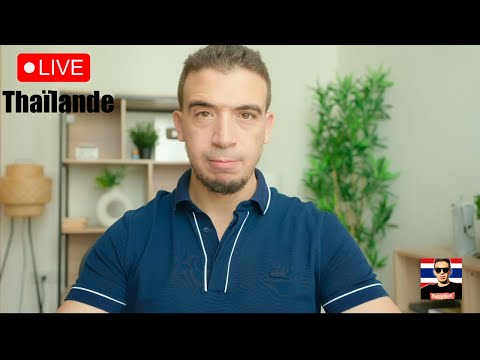
🔴 LIVE MATINAL THAÏLANDE : EXPATS INQUIETS
AI Summary
The speaker, broadcasting from Bangkok, Thailand, welcomes viewers to an early morning live session. He notes the significant time difference with the West, feeling as though he's already had a productive day. He mentions releasing a video on his secondary channel addressing common questions about bank loans.
He shares his recent exploration of Chiang Mai in Northern Thailand, a city he finds appealing for potential future living. He contrasts Chiang Mai with Bangkok, citing Bangkok's noise pollution and traffic as drawbacks, though acknowledging its advantages. He observes that people's preferences for living locations in Thailand vary greatly based on personality and life stage. For a young, single individual, he suggests places like Pattaya or Phuket might offer more opportunities for social activities, but for himself, now with a family, his perspective has shifted.
He expresses a preference for the types of conversations and people he encounters in Bangkok and Chiang Mai over those in beach destinations like Koh Samui or Pattaya. He describes the latter as often centered around beach clubs and less aligned with his aspirations.
Regarding the fuel shortage, he notes it's currently manageable. He highlights the growing popularity of electric and hybrid vehicles in Thailand, with Chinese brands like BYD and Geely making significant inroads into the market, evidenced by over 10,000 orders in Thailand in the previous month.
He reiterates that his YouTube channel, Sabri Expat, reflects his personal views and experiences, and he respects that others may have different perspectives. He emphasizes that while he cannot live in Pattaya, he acknowledges that some defend it by pointing to areas like Jomtien, suggesting that those who criticize Pattaya might not be aware of its different facets.
A significant portion of the discussion revolves around the practicalities of buying property in Thailand. He clarifies that foreigners cannot own land outright. While they can own a house, the land remains Thai-owned. The common practice is a 30-year leasehold, renewable up to 90 years, which he deems sufficient. He warns against the common workaround of creating a Thai company to circumvent land ownership restrictions, highlighting the risks associated with non-active companies, potential immigration checks, and the legal complexities involved. His team at "Thai Expat" focuses on guiding clients away from these "grey areas" to avoid future problems.
He then opens the floor for questions, with a viewer asking about buying property in Koh Samui. He explains that while condos are an option, foreigners are limited to 49% of a condominium's total area. He recounts a situation where a client was pressured by agents to buy a condo through a company due to the foreign quota being full. He advised against this, emphasizing the administrative burden of maintaining a company and the unnecessary risk. Ultimately, the client heeded his advice and did not purchase. He stresses that his service aims to save clients time and mitigate risks, often proving to be cost-effective by preventing costly mistakes.
He touches upon the challenges of expatriates feeling insecure due to visa renewals, contrasting it with the stability of residency in France. He cautions against breaking the law, as it can lead to deportation. He also discusses the phenomenon of "myth-telling" among some expats, particularly in Bali, where individuals may exaggerate their business success.
The speaker clarifies the role of "French lawyers" in Thailand, stating that French citizens cannot legally practice law there. These individuals are often consultants who work with Thai lawyers. He highlights the significant cost difference between these consultants and direct engagement with Thai legal professionals, citing an example where a French consultant charged 120,000 baht for services that a qualified Thai lawyer could provide for 40,000 baht. His team now exclusively works with direct Thai legal contacts.
He emphasizes the importance of trustworthy contacts for networking and business, noting that his reliable Thai lawyer contact can introduce him to other professionals like accountants or specialized lawyers, provided he maintains a professional relationship.
He addresses the question of whether the tourism crisis might lead to discounted Elite visas, stating it's unlikely, as the visa's premium nature is tied to its exclusivity and price.
Regarding property rental income, he explains that while Thai individuals often don't form companies for this purpose, it's generally advisable for foreigners to do so for legal compliance. He shares a personal anecdote about recovering his security deposit by threatening to involve legal scrutiny regarding the landlord's tax declarations, demonstrating the importance of understanding local laws and customs.
He discourages the idea of expatriating to Italy for digital nomads, firmly advocating for Thailand as the best compromise in Asia, citing its balance of good living, diverse landscapes, food, and acceptance of foreigners. He dismisses Vietnam and Indonesia as comparable alternatives.
He touches upon the phenomenon of YouTubers copying his content, noting that while some may attempt to replicate his style, they often struggle to gain traction. He also mentions that the number of expatriates in Thailand is not excessively high, around 30,000-40,000.
When asked about opening a business, specifically a gelato shop, he highlights a successful gelato maker in Koh Samui, Laurent of Rossini, as an example of quality. He reiterates that success hinges on excelling in one's chosen field, not just the business idea itself.
He discusses the visa LTR (Long-Term Resident) as a potentially advantageous option, particularly for investors, and advises against generic visa advice, encouraging personalized consultations. He also clarifies that the 30-day visa exemption has been reduced from 60 days due to many individuals exploiting the longer period for business activities.
He addresses the concern about expatriates being on an "ejector seat," reassuring viewers that visa renewals are generally straightforward if one adheres to the law and avoids illegal activities. He stresses the importance of not taking risks with substances or breaking the law.
He reflects on his own journey, noting that his perspective has shifted from individualistic to family-oriented, influencing his decisions and risk assessment. He also mentions his scientific background, which informs his problem-solving approach, always seeking multiple solutions.
Regarding retirement in Thailand, he suggests it's not a viable option for a comfortable lifestyle, advising those seeking retirement to consider other avenues.
He concludes by emphasizing the value of his "Thai Expat" service, which offers comprehensive, long-term support from initial planning to relocation, a level of dedication he believes is unmatched by other providers. He highlights his team's commitment and the positive feedback received. He also promotes his secondary channel, "Sabri Expat," for tutorials.
Finally, he reiterates the importance of taking action on expatriation plans and not waiting for the "perfect moment." He acknowledges that family and friends might express skepticism but encourages viewers to trust their own decisions and experiences. He emphasizes that Thailand is a country that deserves respect and offers a high quality of life.