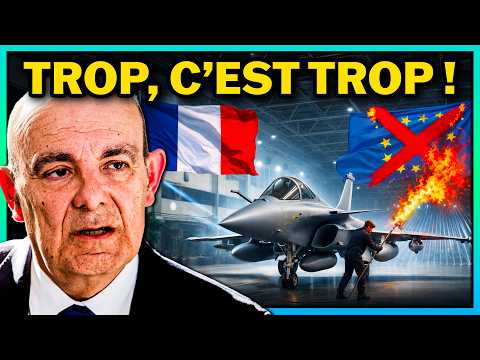
💥 Dassault dit NON à Macron, NON à l'Europe et NON à Airbus !
AI Summary
Dassault Aviation is a unique entity in the global aerospace industry: small, powerful, and famously unyielding. For eight years, the company has been at the center of a high-stakes European dispute regarding the Future Combat Air System (FCAS, or SCAF in French). This €100 billion project is intended to secure European air superiority for decades, uniting the military programs of France, Germany, and Spain. However, progress has stalled because Dassault refuses to compromise on its independence or share its most valuable industrial secrets.
The conflict pits two very different philosophies against each other. On one side is Dassault Aviation, a century-old French family business with a reputation for excellence, known for the Rafale and Falcon jets. On the other is Airbus, a multinational giant that Dassault views primarily as a vehicle for German interests. The SCAF project, born from a 2017 agreement between Emmanuel Macron and Angela Merkel, aims to create a "Next Generation Fighter" (NGF) by 2040. This is not just a plane, but a "system of systems" involving autonomous drones and a real-time combat cloud.
The friction arises from the project's governance. While Dassault was named the lead contractor for the jet, Airbus represents both Germany and Spain, effectively giving it two votes against Dassault’s one. Éric Trapier, the CEO of Dassault, has been vocal about his refusal to yield. The core issue is technological sharing. While Dassault agrees to share "foreground" information—technology developed specifically for SCAF—it categorically refuses to hand over its "background" knowledge. This includes a century of accumulated expertise, flight algorithms, and the secrets behind the Rafale. For Dassault, these are strategic assets that cannot be surrendered to competitors.
This culture of saying "no" is deeply rooted in the company’s history, beginning with its founder, Marcel Bloch. In 1940, Bloch refused to build planes for the Nazi regime. As a result, he was deported to Buchenwald. He survived the camp thanks to the protection of communist resistance members, an experience that led him to support the communist newspaper *L'Humanité* for the rest of his life, despite being a Gaullist billionaire. After the war, he changed his name to Dassault—the *nom de guerre* used by his brother in the resistance—and rebuilt his empire. Today, the Dassault family remains the third wealthiest in France, maintaining a 66% stake in the company and 80% of the voting rights. This family-led structure is rare among major global aircraft manufacturers and allows the company to prioritize long-term strategy over short-term political pressure.
The company’s history is not without controversy. Serge Dassault, Marcel’s son, led the company for over 30 years but faced legal battles over tax fraud and a vote-buying system in Corbeil-Essonnes. Despite these scandals, the company’s industrial philosophy remained unchanged: total independence. Under current CEO Éric Trapier, a 40-year veteran of the firm, the company continues to insist on doing everything from A to Z without external dependence.
Dassault’s skepticism of European partnerships is backed by historical precedent. In the 1980s, France withdrew from a joint European fighter project due to similar disagreements. While Germany, the UK, Italy, and Spain went on to build the Eurofighter Typhoon, France built the Rafale alone. Decades later, the Rafale is considered a massive success—a 100% French aircraft with zero foreign dependence. In contrast, the Eurofighter project suffered from massive cost overruns and a fragmented production line where different components were built in different countries to satisfy political quotas. The Eurofighter ended up being significantly more expensive per unit than the Rafale. Dassault fears that the SCAF project is heading toward the same inefficient "cooperation" model that Airbus favors.
Looking ahead, there are three possible outcomes for the SCAF project. The first is a "divorce," where the project is split. Dassault would develop a specialized French jet capable of carrying nuclear weapons and landing on aircraft carriers, while Airbus would build a different fighter for the German Luftwaffe, with both companies cooperating only on peripheral systems like drones and engines. The second scenario is that Dassault goes solo once again. The company is already preparing a "Plan B": the Rafale F5 and F6. These future iterations would feature high-powered radar, hypersonic nuclear missiles, and loyal wingman drones. Trapier has noted that this path is more economical as it recycles 70% of existing Rafale technology.
The third and most pessimistic scenario is that Germany abandons the European project entirely in favor of American aircraft. Berlin has already ordered 35 F-35s from Lockheed Martin. The transcript describes the F-35 as a "subscription" model; because the US controls the source code and maintenance, European nations have little control over their own fleet.
Ultimately, Dassault Aviation remains in a position of strength. With a massive order book and 68% of its revenue coming from exports, the company does not need SCAF to survive. Its valuation approaches €30 billion, and its expertise remains unparalleled. The transcript concludes that when a company possesses skills that no one else can replicate, it earns the right to say "no." While a failure of the SCAF project would be a blow to European unity and taxpayers, Dassault’s history suggests it will emerge stronger by sticking to its principles of independence and secrecy.