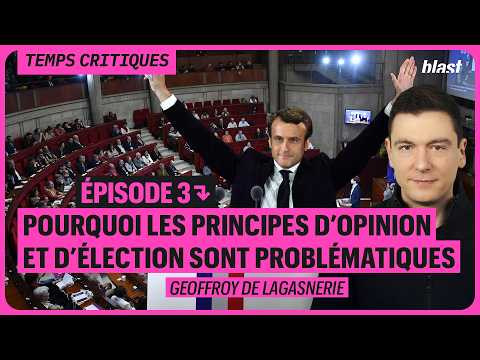
POURQUOI LES PRINCIPES D’OPINION ET D’ÉLECTION SONT PROBLÉMATIQUES
AI Summary
Is democracy the ultimate end of history, or can we, as progressives, imagine and desire a different way to organize our political lives? This is the central question posed in this analysis, which argues that France is currently in a state of "democratic asphyxiation." While democracy is often discussed through grand principles like popular sovereignty or the general will, in practice, it is merely a technical institutional framework. It is a method for answering a fundamental question: which small group of individuals should be granted the power to legislate and govern?
In any complex society, the myth of direct, unanimous, and permanent participation by everyone is a fantasy. Politics will always require delegation, specialization, and the formation of a small group to make decisions for the collective. Once we view democracy as a technical tool rather than a sacred ideal, we can critically examine whether its primary institutions—general elections and parliamentary assemblies—are truly the most effective means of governance.
The current democratic record is arguably negative, characterized by ecocidal legislation, the rise of fascist impulses, mass incarceration, exploding inequality, and the dismantling of public services. Despite this, there is a profound inertia because moving beyond democracy feels like jumping into a void. However, since the 1970s, various experiments in "deliberative democracy"—or what might better be termed "specific elaboration platforms"—offer a concrete alternative.
These experiments involve drawing a large group of citizens by lot (sortition). These individuals are not elected, cannot be re-elected, and do not represent political parties. They meet in an assembly to deliberate on a specific issue after months of listening to scientists, experts, and activists. The results of these assemblies, such as those seen in France regarding climate and end-of-life issues or in other countries regarding renewable energy, are revealing.
When we compare the opinions of these citizens before and after the deliberative process, two things happen: opinions do not fragment; they converge. More importantly, they almost systematically shift toward the left. This "progressive hegemony" suggests that when individuals are given the time and information to move beyond spontaneous reactions, they adopt a more social and ecological perspective. For instance, in Texas, a citizen assembly on clean energy saw support for wind and solar power jump from 52% to 84%, leading the state to become a leader in wind energy. Similarly, the French Citizens' Convention for Climate produced 149 proposals that were praised by the left but denounced by the right as "anti-growth" and "ideological."
This leads to a crucial sociological observation: current democratic institutions suffer from a "law of universal right-wing drift." When the left takes power, it moves right; when the right takes power, it moves further right. The current system acts against progressivism. To break this cycle, we must create institutions that "left-ize" (gauchiser) participants through deliberation rather than "right-izing" them through the pressures of power.
The primary target of this critique is the election. It is contradictory for progressives to critique the biases of dominant media and the manipulation of public thought while simultaneously fetishizing a system based on "spontaneous representation." Sociologists like Pierre Bourdieu have argued that the political vote is to the community what the market is to the economy: an aggregation of individual, often uninformed, behaviors. By basing a system on spontaneous opinion, democracy condemns itself to conservatism, reflecting the rumors, propaganda, and misinformation prevalent in society. Studies on immigration show that reactionary views are almost always based on false perceptions regarding the number and status of migrants.
A system that grants legitimacy based on spontaneous, biased representation is fundamentally irrational. True political legitimacy should not be founded on the quantity of votes (the "numberist" approach) but on the quantity of time, reflection, and elaboration invested in a subject. We must move from the "dogma of felt opinion" to the "dogma of constructed opinion." A rational political culture would value the deconstruction of one's own spontaneous beliefs.
Furthermore, we must challenge the institution of parliament. Modern parliaments are not places of deliberation; they are theaters of inertia. Because members are elected and obsessed with re-election, they are tethered to spontaneous public opinion and party discipline. In a parliament, no rational argument ever changes a vote; members follow a pre-established line. This "mental restriction," as philosopher Simone Weil described it, destroys political imagination.
The current model also relies on the myth of "universal competence," where a single deputy or minister is expected to decide on everything from military programming to ecology in a single day. This favors professional politicians over specialists and results in a political language of empty slogans. A more rational approach would involve multiple "specific elaboration platforms" for different topics. No one has an opinion on everything, and competence is only acquired through specific study.
If we face a complex, uncertain issue—like the future of nuclear energy—it is far more rational to obey a decision made by a group of citizens who spent months studying the data than one made by a parliament driven by party interests or a referendum influenced by media campaigns.
Ultimately, we have nothing to fear from moving beyond democracy. Democracy gives us a "fictitious sense of participation" while exposing us to the very real risks of manipulation and social violence. By substituting the culture of the vote with a culture of inquiry, specific expertise, and deep elaboration, we can reopen political history and pursue a truly progressive future.