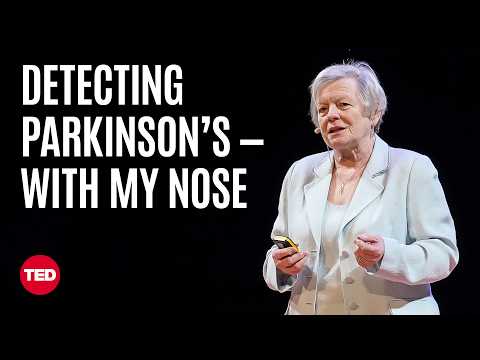
The Nurse Who Can Smell Parkinson’s | Joy Milne | TED
AI Summary
I was born with a unique ability: a nose that can diagnose. My grandmother, who also possessed this heightened sense of smell, or hereditary hyperosmia, warned me, "You can tell nobody! They won't like it." She helped me understand and navigate this world of scents, teaching me to differentiate "volatiles" within a smell.
My nursing career in 1968, particularly in long Nightingale wards, exposed me to a vast medical olfactory library, my "nursing bag of smells," from various diseases. My husband, Les, whom I met at 16, had a distinctive male musk smell. When he was 31, it began to change, a change I instinctively recognized as a disease. Twelve years later, he was diagnosed with Parkinson's.
At our first Parkinson's meeting, I was overwhelmed by a familiar smell, the same one I had noticed in Les years earlier. I realized I could differentiate between those with and without Parkinson's. Les, a doctor, quickly understood the significance: we had potentially found an early diagnostic biomarker for Parkinson's disease.
Les encouraged me to share this discovery. At a Parkinson's UK lecture, I asked why the smell wasn't being used for early diagnosis. This led to a collaboration with Dr. Tilo Kunath and Professor Perdita Barran. To test my ability, 12 participants – six with Parkinson's and six controls – wore t-shirts for 24 hours. I was given 24 bagged t-shirt neck cuttings to smell.
The results were astonishing: I accurately identified all Parkinson's patients. The smell was indeed strongest at the mid-back of the neck, not the armpits. Crucially, I had one false positive who, six months later, was diagnosed with Parkinson's, meaning I had pre-diagnosed someone. This launched "Nose to Diagnose."
Now, using GCMS machines, we are analyzing volatile compounds from skin swabs. We've processed over 2,000 samples, identifying Parkinson's smells, understanding sebum changes, and developing a fast, five-minute non-invasive diagnostic test. Our goal is to make this simple swab test available in every hospital worldwide.
Les, before his death, made me promise to continue this research. His hope, and mine, is to diagnose Parkinson's earlier, before irreversible neural damage occurs. Early diagnosis could significantly improve the lives of those with Parkinson's, especially women who are often misdiagnosed, and young onset patients suffering severe pain. My grandmother's words now echo differently: "Go on, lass, tell the world."