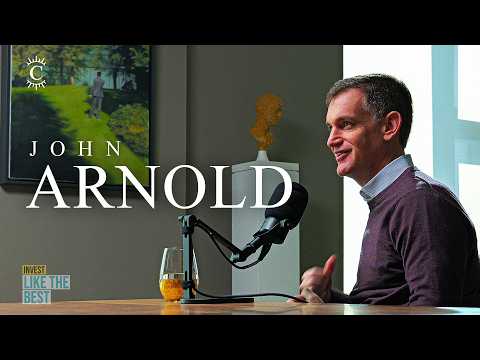
The World's Greatest Energy Trader on Markets, China, and AI
AI Summary
John Arnold, widely regarded as the most successful energy trader in history, provides a masterclass in "cultivating a seat"—the process of building a structural advantage to gain superior perspective, information, and systems. In this wide-ranging discussion, he applies his rigorous analytical framework to the rise of China, the future of the American energy grid, and the reform of broken social systems.
**Lessons from China: Speed and Scale**
Arnold’s recent travels through China revealed a country that has moved beyond replicating Western models to leapfrogging them. The primary takeaway is the unprecedented speed and scale of Chinese industrialization. For example, the EV manufacturer Neo built a factory from the first shovel in the ground to the first car off the line in just 17 months. This efficiency is supported by an incredibly dense supply chain where all major suppliers are often located within a 200-mile radius.
The Chinese government’s "five-year plans" create intense provincial competition. Local leaders are evaluated on GDP and their ability to foster strategic industries like robotics or EVs. This leads to massive overcapacity and low profitability in the short term, but it forces an "evolutionary" process where only the most efficient and technologically advanced companies survive to become global competitors. Arnold notes a significant shift in Chinese sentiment; they no longer feel they need to learn from the West. Instead, they believe they are now the ones who will be teaching the rest of the world.
**The Art of Trading: Building "The Seat"**
Arnold attributes his trading success to passion and the deliberate construction of an information advantage. He describes his early days in the baseball card market as a teenager, where he learned the fundamentals of market making and arbitrage by exploiting geographic price differences. This foundation carried into his career at Enron and later his own fund, Centaurus.
To stay ahead, Arnold built "the best seat in the industry." He utilized a high fee structure (3% management and 35% performance) to reinvest heavily in the business. This capital allowed him to hire the best fundamental analysts, buy proprietary data sources, and build superior trade-entry systems. By becoming the largest market maker in natural gas, he gained a "flywheel" effect: he could move large positions with minimal slippage while gaining insight into the psychology and positioning of other market participants.
**The US Energy Crisis: Demand vs. NIMBYism**
Transitioning to the current energy landscape, Arnold identifies a major shift: for the first time in decades, US energy demand is surging, driven largely by AI and data centers. He warns that the energy system could become a bottleneck for American innovation. While the "Big Tech" firms have the capital to fund this expansion, the US faces a significant structural hurdle: the inability to build infrastructure quickly.
Unlike China, the US is hampered by "NIMBYism" (Not In My Backyard) and a fragmented regulatory environment. Local communities can use existing laws to delay critical transmission and generation projects for a decade or more. Arnold argues that federal permitting reform is the most urgent bipartisan issue in Washington. Without it, the US cannot move power from remote renewable sources to the load centers that need it.
Regarding specific technologies, Arnold is pragmatic. He notes that while solar panel costs are falling, the "delivered" cost of solar power is rising due to the inflationary costs of land, labor, and transmission. He is particularly optimistic about advanced geothermal energy, which leverages the existing skills of the oil and gas workforce. Conversely, he views advanced nuclear and fusion as promising but economically unproven, likely requiring another 10 to 15 years to achieve meaningful scale.
**Philanthropy and Systemic Reform**
Arnold’s approach to philanthropy is as analytical as his trading. He believes foundations should take risks that the private sector and government avoid, and he argues that foundations should eventually "spend down" rather than become permanent, risk-averse bureaucracies.
His foundation focuses on improving the "rules of the system" across several sectors:
* **Criminal Justice:** Arnold advocates for focusing on the "probability of being caught" rather than the severity of sentences. He notes that while wealthy communities often trade privacy for security through heavy surveillance, lower-income communities are frequently denied the same security benefits.
* **Healthcare:** He critiques the "financialization" of healthcare, where providers exploit regulatory loopholes to maximize profits at the expense of patients and taxpayers. He cites the "cat-and-mouse game" of pricing for products like skin substitutes as evidence of a system where incentives are misaligned with outcomes.
* **Education:** Despite the promise of "EdTech," Arnold remains skeptical, noting that decades of technology in the classroom have not improved outcomes. He believes the future lies in using AI to solve the "engagement" problem, though results have yet to materialize in the data.
**Conclusion**
Despite the political dysfunction and structural challenges in the US, Arnold remains hopeful, citing the country's historical resilience and capacity for innovation. He concludes with a personal lesson on the importance of honest feedback, recalling how his brother once told him he had "changed for the worse" during his peak trading years. This act of courage forced Arnold to step back and ensure that his life was as high-performing as his business.