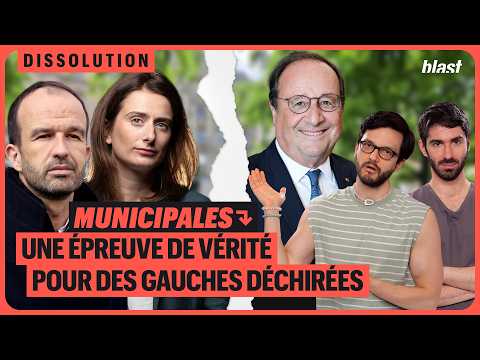
MUNICIPALES : UNE ÉPREUVE DE VÉRITÉ POUR DES GAUCHES DÉCHIRÉES
AI Summary
This summary analyzes the political landscape following the first round of the French municipal elections, focusing on the performance of major parties, media influence, and the underlying "democratic crisis."
### The Far-Right: Local Strongholds vs. National Limits
The Rassemblement National (RN) achieved significant scores in its historical strongholds. Figures such as Louis Aliot in Perpignan, David Rachline in Fréjus, and Steve Briois in Hénin-Beaumont secured or are positioned to secure mayoralties. However, the transcript argues that this "triumph" is exaggerated. While the far-right performs well nationally, it struggles to translate that power into local governance. Municipal elections require technical expertise in managing schools, water, and waste—areas where the RN is perceived as weak. Consequently, many far-right voters pivot to the traditional right (Les Républicains, or LR) for local administration. LR remains a dominant force, leading in nearly half of all towns with over 9,000 inhabitants, though they continue to struggle in major cities.
### The "Union of the Right" and Media Figures
A notable development is the emergence of the "Union of the Right." In Nice, Eric Ciotti’s radicalized right-wing strategy appears validated, as he leads Christian Estrosi with over 40% of the vote. Nice is described as a "laboratory" for this alliance. In Paris, the RN collapsed to 1.6%, but media figure Sarah Knafo (Reconquête) surpassed 10%. Knafo’s success is attributed largely to her massive national media exposure. She has called for a "hand extended" to Rachida Dati (LR) to form a united right-wing front, though Dati has so far opted for an alliance with centrists.
The media’s role in these elections is heavily criticized. The transcript highlights the suspension of journalist Nathalie Saint-Cric after she referred to Eric Ciotti as "Benito" (Mussolini) off-guard. This is contrasted with the perceived lack of accountability for other media figures, such as the Duhamel family, who hold significant influence across multiple networks.
### The Left: LFI’s Rise and the Green Decline
La France Insoumise (LFI) emerged as a significant municipal power, contrary to media predictions. By mobilizing youth and working-class neighborhoods—a tactic the media disparagingly labels the "Gaza strategy"—LFI achieved 10–15% in many cities. This makes them an unavoidable partner for the rest of the left.
Conversely, the Greens (EELV) suffered major setbacks, losing ground in cities they previously controlled, with the exception of Lyon. The party is currently paralyzed by an internal divide between the social-democratic reformism of the Socialist Party (PS) and the more radical stance of LFI.
### The Second Round: The "Anti-Fascist Front"
As the second round approaches, the primary tension lies in the formation of an "Anti-Fascist Front." LFI, through Manuel Bompard, has called for a systematic merger of left-wing lists to block the far-right. However, the PS remains divided. National figures like François Hollande and Raphaël Glucksmann refuse any alliance with LFI, banking on a "useful vote" strategy driven by the fear of the right.
In contrast, local realities often force cooperation. In Toulouse, the PS and LFI successfully merged their lists, creating a genuine opportunity to flip the city to the left. However, in Marseille and Paris, PS leaders have rejected LFI’s "extended hand," citing personal insults and ethical differences. The transcript suggests this refusal to unite, even in the face of a far-right threat, stems from the PS’s refusal to accept LFI’s growing hegemony.
### The Myth of the Democratic Crisis
The most striking feature of these elections is the record-low turnout. With participation at roughly 57%, the "favorite election of the French" has seen a massive defection. The transcript challenges the standard media narrative of a "democratic crisis" or "voter fatigue."
Instead of blaming the citizens’ "moral duty," the analysis points to a failure of the political and media classes. The "crisis" is described as a convenient excuse for those in power to avoid changing a system that no longer interests the public. When institutions and media fail to provide projects that impact real life, voters disengage. The current system is "clogged," characterized by a record number of towns with only a single candidate list and councils that hold absolute power without a true majority of the population's support.
### Conclusion: Media Responsibility and the Call to Action
The transcript concludes with a sharp critique of public service broadcasting. It notes that major channels dedicated significant time to airing far-right speeches in full before abruptly switching to sports coverage, effectively ending political debate. The final message is an appeal for citizens to "politicize" themselves and reclaim these abandoned democratic spaces. The "democratic crisis" is not an inevitability but a result of the spectacle currently offered by the political and media elite. Despite the cynicism of the process, the act of voting remains a necessary tool to counter the influence of established power brokers.