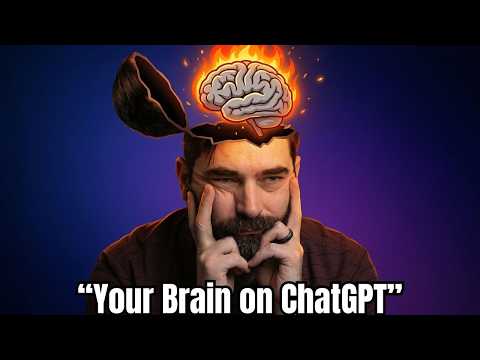
AI Is Frying Your Brain
AI Summary
The promise of Artificial Intelligence has long been centered on the idea of radical productivity and the reduction of human workload. However, a growing body of research and anecdotal evidence suggests a counter-intuitive reality: AI is not making work easier; it is intensifying it, leading to a phenomenon now described as "AI brain fry." This summary explores the cognitive costs of offloading mental labor to machines, the paradox of increased speed, and the scientific evidence suggesting that our reliance on these tools may be causing our critical thinking skills to atrophy.
**The Intensification of Work and Workload Creep**
A primary insight from recent research, including an eight-month study by the Harvard Business Review (HBR), is that AI does not necessarily reduce the volume of work. Instead, it often expands the scope of an individual’s responsibilities. Because AI can fill gaps in knowledge, employees are increasingly stepping into roles previously held by others—such as designers writing code or researchers performing engineering tasks. While this appears to be a productivity win, it leads to "workload creep."
Rather than using the time saved by AI to rest or focus on high-value tasks, workers tend to stack additional AI-assisted tasks onto their plates. This removes the "natural pauses" in a workday. The ease of prompting means work often bleeds into non-work hours; people find themselves "prompting" during lunch or late at night because the barrier to entry feels so low. Over time, this continuous involvement prevents the brain from achieving the recovery it needs, leading to cognitive fatigue and burnout.
**The Paradox of Speed and the Shift to "Reviewer" Status**
The transcript highlights a paradox: while individual tasks become faster, the overall workday becomes harder. If a task that once took three hours now takes 45 minutes, the human worker does not simply stop; they take on more tasks to fill the capacity. This results in a massive increase in context switching. Moving between six different AI-assisted problems in a day is significantly more "brutely expensive" for the human brain than focusing deeply on a single problem for several hours.
Furthermore, the nature of the work itself changes. In the pre-AI era, many professionals functioned as "creators" or "makers," a role that is generally energizing. With the integration of AI, the role shifts toward being a "reviewer," "judge," or "quality inspector" of an endless assembly line of machine-generated content. You must constantly evaluate if the output is correct, safe, or architecturally sound. Creating is inherently energizing, whereas the constant vigilance required for oversight and quality control is deeply draining.
**Scientific Evidence of "Brain Fry" and Cognitive Debt**
The Harvard Business Review’s study of nearly 1,500 workers identified "AI brain fry" as a real clinical experience characterized by mental fog, difficulty focusing, slower decision-making, and headaches. Interestingly, the study found that productivity actually peaks when using three AI tools; adding a fourth tool causes productivity to drop as the cognitive load of managing and orchestrating multiple threads becomes too high.
The impact on the brain’s "thinking muscle" is further corroborated by an MIT study titled "Your Brain on ChatGPT." By monitoring brain signals via EEGs, researchers found that participants who relied on Large Language Models (LLMs) for writing tasks showed significantly less brain activity than those who worked without them. When the LLM-reliant group was later asked to write using only their brains, they struggled immensely. Their cognitive muscles had essentially fatigued or atrophied from lack of use. Conversely, those who used their brains first and then used AI as an extension of their thinking performed much better. This suggests that outsourcing "first-draft thinking" to AI makes it harder to think from scratch in the future, creating a form of "cognitive debt."
**The FOMO Treadmill and Thinking Atrophy**
The rapid pace of AI development creates a "FOMO (Fear Of Missing Out) treadmill." The constant release of new models, agents, and frameworks creates a sense of perpetual obsolescence. This pressure forces users to stay "tapped in" to a fire hose of information, which further contributes to mental exhaustion.
The transcript notes that heavy AI users often find themselves unable to reason through problems on a whiteboard or brainstorm original ideas because they have spent months outsourcing these "muscles" to a chatbot. This leads to a convergence of thought; as seen in the MIT study, AI-assisted work tends to sound the same because it is based on the "average" of human knowledge, whereas "brain-only" work retains unique variability.
**Conclusions and Practical Advice**
The speaker concludes that while AI is a powerful tool, it must be used consciously to avoid mental mush. To combat the negative effects of AI intensification, several strategies are proposed:
* **Time-boxing:** Set strict limits on AI use rather than leaving it open-ended.
* **Separating Thinking from Execution:** Dedicate mornings to "brain-only" thinking using analog tools like pen and paper, and save the afternoon for AI-assisted execution.
* **Accepting "Good Enough":** Stop over-optimizing AI output, as the effort to reach perfection is often where the most draining review work occurs.
* **Strategic Learning:** Use AI to learn everything (deep research) rather than using it so you don't have to learn anything.
Ultimately, the goal is to move from a "fire hose" of constant, overwhelming AI interaction to a "guarded hose" approach, ensuring that the technology remains an extension of human intelligence rather than a replacement for it.