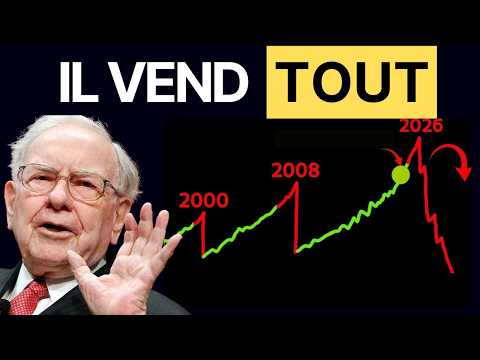
IA : Warren Buffett se prépare au Krach boursier (Moi à ça)
AI Summary
The current market is experiencing exponential growth in value stocks, leading some to believe a stock market crash is imminent. This video aims to explore how to detect, anticipate, and prepare for such an event, focusing on key indicators beyond market noise.
A primary risk factor identified is the significant inflow of leveraged funds and options into the market, further amplified by ETFs. This concentration has led to large-cap stocks dominating indices and has pushed leverage levels to historic highs, yet the market continues to climb. This influx of capital indicates growing market nervousness and volatility, but not necessarily the end of the bull run. Investments in Artificial Intelligence (AI) are also boosting the economy by driving demand for infrastructure, manufacturing, and logistics.
While concerns about debt, particularly credit cards, are high, the video emphasizes that household mortgage debt is at an all-time low. This resilience in consumer balance sheets, with debt levels relative to assets at their lowest point, prevents a systemic crisis. Corrections and volatility are possible due to leverage and market flows, but a true crash is unlikely as long as AI investments continue to deliver and don't result in widespread losses. The AI boom is even positively impacting the broader economy, potentially offsetting a downturn that might otherwise have occurred.
However, several risks remain. Leverage, concentration in certain stocks, and momentum investing, where everyone chases the same performing assets, are creating a FOMO (Fear Of Missing Out) effect. The depletion of oil stocks to compensate for supply issues is unsustainable and will eventually need to be addressed. Geopolitically, Iran needs oil revenue to sustain its regime, and the US also benefits from a resolution. Diplomatic efforts, such as Trump's engagement with China regarding Taiwan, suggest a desire for stability.
A significant financial challenge is the refinancing of $7 trillion in debt this year, originally taken at 1-2% interest during the COVID-19 pandemic. This debt must now be refinanced at over 4-5%, requiring substantial new capital. Failure to secure this funding could force the Federal Reserve or US banks to absorb the debt, increasing interest burdens.
Comparing the current AI bubble to the dot-com bubble, the video highlights key differences. Firstly, many AI-related companies are already profitable, unlike during the dot-com era. Secondly, current economies are experiencing inflation and stagflation, with governments employing negative real interest rates, fiscal deficits, and extensive stimulus measures – conditions absent during the dot-com boom, which was fueled by economic performance. Today's markets and economies are largely subsidized by governments.
While government debt is a concern, the video points out that households and businesses are healthier. Following the subprime crisis, governments absorbed significant debt, relieving households and corporations. This prevents a systemic debt crisis on the scale of 2008, even though nominal debt amounts are higher. The video stresses that comparing current debt figures to the past requires accounting for inflation; billions today do not hold the same value as billions in 2008. The critical metric for household debt and systemic risk is the "yellow curve" (referring to a specific chart), which, despite a slight deterioration, remains far from crisis levels.
The global financial landscape is characterized by ample liquidity (M2 money supply growth) and continuous investment in stocks by both retail and institutional investors. AI and defense spending are comparable in scale, injecting significant capital into various industries, fostering remanufacturing and economic recovery, particularly in the US. Potential resolutions to conflicts like the Iran issue and the Ukraine war could further stimulate economic growth.
Despite claims that markets are expensive, valuations have actually decreased relative to rising profits. The market's upward trajectory, while exponential and potentially alarming, is still driven by profits, not just speculation. While future profit projections might be overly optimistic, it's difficult to ascertain definitively without further time. The market appears to be pricing in current profits and growth, particularly in AI-related sectors.
A reduced float (available shares) is a critical factor. With many large institutional holders of companies like Microsoft and Nvidia unlikely to sell, and limited new shares available, increased demand from ETFs, momentum trading, and retail investors creates significant upward pressure on prices.
The market exhibits a dichotomy: AI-related hardware is booming, while businesses facing AI disruption are struggling. Some companies in traditional sectors are not only resisting AI but using it to increase profits, yet their stock prices are declining. This divergence is explained by the fact that while some companies are being disrupted, others are successfully integrating AI to enhance their profitability and are actively repurchasing shares. This share buyback activity further reduces the available supply of stock. If the market re-evaluates AI's disruptive impact, or if these companies leverage AI more effectively, a rotation into these undervalued, profitable, and share-repurchasing companies could occur, potentially driving up their stock prices.
This rotation could see capital shifting from AI-focused stocks to sectors like manufacturing, energy, and software that are currently undervalued but have strong profit growth and are engaging in share buybacks. This dynamic, coupled with reduced supply through buybacks and potentially new share issuances for capital expenditure, creates a complex market environment.
The speed of market movements, rather than the fear of a crash itself, is a key challenge. The momentum strategy, favored by ETFs, is currently performing exceptionally well, but this should serve as a warning sign for potential rotations into more defensive sectors like value stocks and cyclicals, especially as inflation persists. While some inflation might be transient, rising production costs are likely to be passed on to consumers in the B2B sector. However, B2C price increases are becoming unsustainable, leading to reduced consumer spending.
The current market is characterized by a split: AI companies continue to perform, while those tied to the real economy are struggling, particularly as interest rates approach 5%, making credit-financed economic growth and consumption more difficult. Rising energy costs could also lead to social unrest and political pressure to regulate industries perceived as driving inflation, such as AI and data centers.
Donald Trump's potential re-election could lead to policies favoring tax cuts and economic stimulus, potentially benefiting value and cyclical stocks, as well as small-cap companies. Emerging markets and Europe might also outperform in an inflationary environment, with a focus on tangible assets like materials, commodities, and industrials.
Historically, bubbles ultimately collapse due to credit issues. Rising interest rates will eventually make it difficult for even large tech companies to finance their operations. While many companies currently have substantial cash reserves and borrowing capacity, sustained high rates and increasing debt burdens will eventually limit investment. The market is pricing in capital expenditures extending to 2028-2030, which could be jeopardized if credit becomes constrained.
Central bank decisions are also a critical factor. Social pressures from rising food and energy prices, coupled with potential cascading production cost inflation and reduced share buybacks, could force companies to rely more heavily on corporate debt. This could lead to a concentration in corporate credit, with investors favoring debt from large AI companies, potentially starving smaller, real economy businesses of capital. This concentration in both equity and credit markets risks asphyxiating the real economy, which is a significant source of employment.
The "winner-take-all" dynamic of the AI boom has limits. Large tech companies may eventually reduce or halt share buybacks, diminishing the artificial support for their stock prices. Continued share price growth will then depend on sustained capital inflows. Furthermore, as these companies transition from light capex models to heavy industrial investments (data centers, electricity generation), their need for capital will increase. This could lead to increased equity issuance, diluting existing shareholders unless demand remains robust. This shift signals a potential reversal of fortunes, where the quality companies of tomorrow may not be the same ones that dominated the last decade.
Tangible assets, including materials, commodities, and industrials, are likely to perform well. Central banks, facing inflationary pressures, may be forced to raise rates or maintain them at levels that still favor real assets. While indices like the S&P 500 may appear fairly valued on average, there's a significant divergence, with many tech stocks trading at high multiples while other sectors are undervalued. This weighted average masks the underlying market realities, necessitating a deeper look beyond headline figures.
The video concludes that while volatility and corrections are probable, systemic elements for a widespread crash are not currently evident. The AI boom could continue for months or even years, with potential for sub-waves and rotations within the market. The ultimate impact of AI and the market's valuation of it will be determined over time. The presenter encourages viewer engagement on their investment strategies and plans.