Science4All est mourant
AI Summary
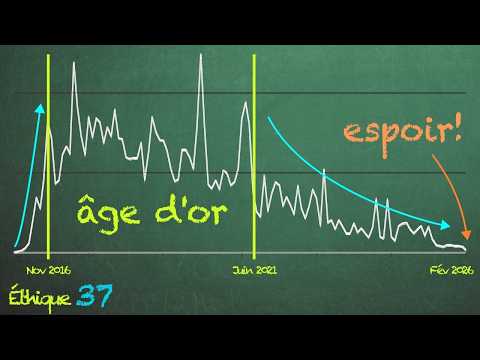
The landscape of scientific communication on YouTube is undergoing a terminal decline, a phenomenon that the creator of the channel *Science for All* (SfA) describes as the "death" of scientific YouTube. By analyzing his own channel's data, the speaker reveals a depressing trend: watch time peaked in 2017, remained stable until early 2021, and has since crumbled to a near-standstill. While personal motivation played a small role—especially since the channel has been a purely volunteer effort since late 2021—the speaker argues that this decline is actually symptomatic of a fundamental and alarming shift in how social media and recommendation algorithms function.
To understand this collapse, one must look at the evolution of social platforms. Before 2012, networks were truly "social," focused on connecting friends and maintaining real-world relationships. This transitioned into a "parasocial" era, where influencers and creators became the stars, fostering one-way relationships with millions of subscribers. This was the golden age for channels like SfA. However, the rise of TikTok ushered in the "asocial" era. In this new paradigm, the connection between a creator and an audience is severed. Recommendation AIs no longer prioritize who you choose to follow; instead, they serve content designed solely to trigger a reaction and maximize time on the platform. On modern apps, the identity of the creator has become irrelevant—users consume media without ever knowing or caring who produced it.
This shift has devastating consequences for content quality. Recommendation AIs are now "over-optimized." The speaker illustrates this with a mathematical example: if an AI must choose between a video with a 4% click-through rate and one with 5%, it will eventually stop showing the 4% video entirely to maximize total platform views. This creates a highly non-linear environment where a 10% improvement in a video's "attractiveness" doesn't just result in 10% more views, but can multiply exposure by a factor of 100. Consequently, creators are forced to prioritize "form" over "substance," designing titles and thumbnails before even considering the actual scientific content.
Beyond being "asocial," these networks are becoming "anti-social." With the emergence of generative AI in 2022, platforms are increasingly flooded with "AI slop"—automated, addictive content designed to hijack attention. Furthermore, tech giants like Meta are pushing AI "companions" and chatbots as substitutes for human relationships, even for minors. This occurs in a context where digital social isolation is already a crisis. Throughout this evolution, the quality of information has remained a "mute news" item—ignored by platforms and academia alike. High-quality information is thousands of times more expensive to produce because it requires rigorous research, yet it is inherently less "attractive" to algorithms than addictive, low-quality "slop."
The political climate has further darkened this outlook. The speaker points to Elon Musk’s takeover of Twitter and a fictionalized or future-dated 2025 scenario where Donald Trump consolidates power over US tech giants, militarizing AI leaders from OpenAI, Meta, and Palantir. This "techno-imperialist" hegemony threatens scientific vulgarization, investigative journalism, and democratic deliberation.
However, the speaker highlights a sudden "surge of optimism" triggered by events in February 2026, which he labels "Mensis Spei" (the Month of Hope). For the first time, democratic institutions began to legally target recommendation AIs. The European Commission issued a preliminary opinion stating that TikTok’s addictive features and personalized recommendation systems violate the Digital Services Act (DSA). Simultaneously, a French bill proposed giving recommendation AIs "editorial responsibility," meaning they would be legally treated like newspaper editors rather than mere hosts. This would make platforms liable for the massive amplification of defamation or hate speech. In the United States, a landmark lawsuit in California accused Meta and Google of profiting from "addictogenic" designs, challenging the legal immunity typically provided by Section 230.
To reclaim a democratic digital space, the speaker advocates for structural changes. He mentions "Eurosky," a European version of Blue Sky that utilizes the AT protocol. This protocol allows for "interoperability," meaning users could keep their data but choose which application or recommendation algorithm they want to use. There is also a push to integrate "vertical interoperability" into the Digital Markets Act (DMA), which would force "gatekeepers" like YouTube to allow users to view content through third-party apps and use alternative recommendation algorithms, such as the one developed by the "Tournesol" association.
While the speaker doubts *Science for All* will ever return to its former prestige, he is shifting his focus toward long-term solutions. He has opened a low-frequency newsletter to maintain a direct connection with his audience, bypassing algorithms. More importantly, thanks to funding from the Fondation de France, he has become the first full-time employee of the Tournesol association. His mission is to build a democratic, European-governed information space. He calls on his audience to support this cause through donations to Tournesol and by alerting politicians, journalists, and researchers to the disproportionate power of recommendation AIs. The goal is to move away from information flows controlled by private foreign interests and toward a system that prioritizes democratic norms and high-quality information. In his view, February 2026 provided the tools for change; it is now up to society to use them.