Okuninushi, le dieu qui revint des Enfers - Mythologie Japonaise
AI Summary
In the vast tapestry of Japanese mythology, long before the arrival of the celestial gods, a pivotal deity named Okuninushi had to endure death, journey through the underworld, and experience resurrection to establish the foundations of the human world. As a central figure in Shintoism, Okuninushi is revered as a great civilizer associated with medicine, agriculture, fertility, marriage, and prosperity. Unlike historical figures who were divinized later, such as the scholar Sugawara no Michizane, Okuninushi appears in ancient sources like the *Kojiki* as a kami from the very beginning. While some scholars suggest his myths might echo distant Jomon-period traditions, he remains a purely mythological descendant of the storm god Susanoo and Princess Koshinada Hime.
Okuninushi’s primary place of worship is the Izumo-taisha shrine, one of Japan’s oldest and most significant religious sites. Every year, during the tenth lunar month known as *Kamiarizuki*, deities from across Japan are said to gather there for divine deliberations, with Okuninushi occupying a central role. His legend begins in the province of Izumo, where he lived as the youngest of eighty brothers. These brothers were cruel and ambitious, and all sought to marry the beautiful Princess Yagami of the neighboring Inaba province. They forced Okuninushi to accompany them on their journey merely as a humble luggage bearer.
The most famous episode of this journey involves the White Hare of Inaba. The eighty brothers encountered a hairless rabbit in agony on a beach. Maliciously, they advised the creature to wash in salt water and dry itself in the wind, which only intensified its suffering. When Okuninushi arrived, he showed genuine compassion, instructing the rabbit to wash in the fresh water of a river delta and cover its body with pollen. Healed and grateful, the rabbit—who had lost its fur after tricking a group of sharks into forming a bridge—predicted that Okuninushi, not his brothers, would win the hand of Princess Yagami. This prophecy came true, fueling the brothers' murderous jealousy.
The brothers attempted to kill Okuninushi twice. First, they forced him to catch a "red boar" at the foot of Mount Tema, which was actually a red-hot boulder they rolled down the slope. Okuninushi was crushed and burned to death. His mother, Sashikuni Waka Hime, pleaded with the celestial gods, who sent the goddesses Kizagai Hime and Omugi Hime to restore him to life. Soon after, the brothers trapped him in a split tree trunk, crushing him again. Once more, his mother intervened to resurrect him. Fearing for his life, she advised him to seek counsel from his ancestor Susanoo in the underworld, the realm of Yomi.
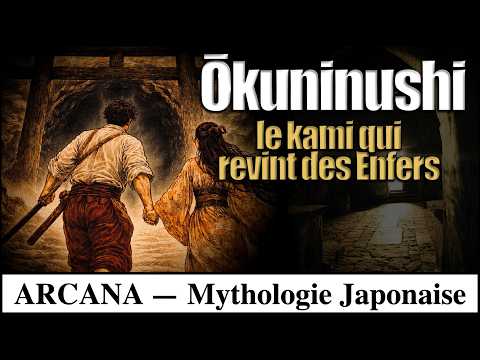
Okuninushi’s descent into Yomi marks a transformative "katabasis." There, he met Susanoo’s daughter, Suseri Hime. The two fell instantly in love, but Susanoo was unimpressed by this earthly intruder and subjected him to several deadly trials. He was locked in a cage of snakes and then a cage of wasps, surviving both thanks to magical scarves provided by Suseri. Susanoo then shot an arrow into a meadow and set the field on fire while Okuninushi searched for it. The hero survived by hiding in a mouse hole. Finally, Susanoo tasked him with removing lice from his hair. With Suseri’s help, Okuninushi used berries and red earth to trick Susanoo into thinking he was succeeding. While the older god slept, Okuninushi tied Susanoo’s hair to the palace beams, stole his magic sword, bow, and arrows, and fled with Suseri.
As they escaped, Susanoo awoke and chased them to the borders of Yomi. Seeing their determination, he relented and offered a final blessing, advising Okuninushi to use the stolen weapons to defeat his brothers and to build a magnificent palace at the foot of Mount Uka—the site of the Izumo Shrine. Upon returning to the world of the living, Okuninushi successfully routed his brothers and became the master of Izumo. Though his many marriages caused some domestic tension, he reigned until the arrival of Ninigi no Mikoto, the descendant of the sun goddess Amaterasu. To maintain harmony between the terrestrial and celestial gods, Okuninushi voluntarily ceded his earthly sovereignty, choosing to retire as a guardian of the invisible realm and the spiritual bonds between humans and kami.
In Shinto theology, Okuninushi represents the "Kunitsukuri," the construction and pacification of the land. He is the deity of "Musubi," the sacred power of connection that binds communities and couples together. His story is not one of moral sin but of transformation through endurance. His journey mirrors universal archetypes: he is a civilizer like the Sumerian Enki, a seeker of wisdom through suffering like the Norse Odin, and a figure of death and rebirth like Orpheus, Dionysus, or Osiris. Ultimately, Okuninushi stands as a fundamental mediator who structured the reality of the earthly world through resilience, adaptation, and the eventual pursuit of cosmic harmony.