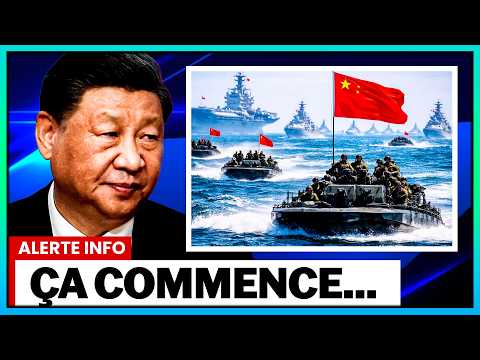
🇹🇼 Taïwan : La CHINE vient de franchir la LIGNE ROUGE...
AI Summary
In late December, China conducted its largest-ever military exercises around Taiwan, involving fighter jets, dozens of drones, blockade simulations, and live fire for the first time. Following this, during his New Year's speech, Xi Jinping instituted a commemorative day for the "recovery" of Taiwan on October 25th, notably using the term "recovery" instead of "reunification." The Economist had previously featured the Taiwan Strait on its cover in 2021, labeling it the world's most dangerous place, a situation that has since worsened. While global attention is fixed on Iran and the Strait of Hormuz, China is preparing to reclaim what it sees as its "treasure island," the most coveted resource of the 21st century: silicon chips essential for global electronics.
Taiwan, despite its small size, supplies 62% of the world's advanced electronic chips. The strait around the archipelago facilitates a quarter of global trade. China seeks to regain control of the island, which increasingly asserts its desire for independence. The economic cost of such an attempt is projected by Bloomberg to exceed $10 trillion in the first year alone, surpassing the economic impact of both Covid-19 and the 2008 crisis. This figure is staggering, especially considering Taiwan faces a Chinese army of 2 million soldiers, eager to act for the "great renewal of the Chinese nation," with American forces nearby ready to intervene. The region is experiencing escalating tensions.
The discussion will address the risks for Taiwan if Beijing acts on its threats, the risks for Beijing if it uses force, and the global implications for daily life and finances if the strait is closed.
Morris Chang, a protégé of integrated circuit inventor Jack Kilby, founded Taiwan Semiconductor Manufacturing Company (TSMC) in 1987 after leaving Texas Instruments. His vision was to specialize in manufacturing integrated circuits for tech giants like IBM and Apple. Forty years later, TSMC is valued at over $1 trillion, focusing solely on high-precision subcontracting in the exponentially growing semiconductor market. It accounts for 70% of the world's semiconductor foundry revenue.
Chip foundries are factories where circuits are etched onto silicon wafers in cleanrooms, where the air is 1,000 times purer than in an operating room. Even the slightest dust or vibration can ruin an entire production batch. TSMC's most advanced chips are etched at 2 nanometers, a scale approaching atomic level—a feat no other entity can achieve industrially. TSMC's clients include leading tech companies like Apple, Nvidia, AMD, Qualcomm, Broadcom, and Intel. These companies design their chips but rely on TSMC for manufacturing. The combined market capitalization of TSMC's ten largest clients exceeds $14 trillion, representing over 30% of the S&P 500. A disruption in TSMC's production would lead to global chaos.
Beyond its role as the world's chip factory, Taiwan is also a strategic choke point on one of the planet's busiest trade routes, similar to Hormuz. The recent two-week closure of a oil-rich strait cost the global economy $2 trillion. A similar scenario in Taiwan, which handles nearly half of the world's container ship fleet and over $2.4 trillion in goods annually, would be far more catastrophic, potentially costing three to five times more than the Iranian blockade.
For decades, a delicate balance prevailed: American military dominance, Chinese patience, Taiwan's avoidance of provocation, and thriving cross-strait trade. However, this equilibrium is shifting. In 1996, during the Third Taiwan Strait Crisis, Bill Clinton's deployment of an aircraft carrier deterred Beijing. Today, China's navy is the world's largest by number of ships, possessing three aircraft carriers and ballistic missiles capable of targeting aircraft carriers, along with submarine warfare capabilities comparable to the U.S. The Pentagon now considers the Chinese military a "near-equal force." Geography favors Beijing, as Chinese forces would fight on home ground while U.S. forces would face extended supply lines. China's industrial base can also outpace the U.S. in producing ships and missiles.
Beijing's patience is also waning. Unlike his predecessors, Xi Jinping no longer waits for future generations to resolve the Taiwan issue. Since his ascent to power, his rhetoric has hardened, declaring reunification "inevitable" in 2019 and reserving the right to use force. In 2024, he stated that "no one can stop it," and in 2026, he instituted the "Taiwan Recovery Day." Military exercises around the island are becoming more frequent, realistic, and extensive, reflecting China's diminishing patience. Chinese military aircraft regularly violate Taiwanese air defense zones, and warships patrol closer to the coast, increasing the risk of escalation.
The third reason for the shift is Taiwan's evolving identity. While some Taiwanese felt Chinese 30-40 years ago, that sentiment has largely disappeared. The Chinese Communist Party claims Taiwan as its province, but has never governed it. October 25th, the date chosen by Xi Jinping, commemorates Japan's official surrender of Taiwan to China in 1945 after 50 years of colonization. However, after losing the Chinese Civil War in 1949, Chiang Kai-shek retreated to Taiwan, establishing a separate government. Taiwan democratized in the 1990s, forging a distinct identity. The pro-independence Democratic Progressive Party (DPP) continues to win elections, further distancing the island from the mainland—a trend deemed unacceptable by Beijing.
Taiwan's final card is Washington's protection, which has lasted for nearly 50 years. However, Donald Trump has suggested Taiwan should pay for its own defense and could potentially suspend the Taiwan Relations Act, abandoning the island to China—another unacceptable outcome. While Xi Jinping has not set a date for reunification, he has set an "irreversible course."
Bloomberg has modeled five scenarios for the Taiwan Strait:
1. **Open War:** China invades Taiwan, the U.S. intervenes, leading to a global conflict. Estimated cost: $10.6 trillion in the first year (9.6% of global GDP), far exceeding Covid-19 (4%) and the 2008 crisis (2%). China's GDP would drop by 11%, the U.S. by 6.6%, and Taiwan's economy by 40%. Europe would suffer a 10.9% shock due to reliance on Asian supply chains, South Korea 23%, and Japan 14.7%. Global smartphone production would plummet by 80%, with Apple losing 90% of iPhone sales as Taiwan is the sole manufacturer of their chips. The automotive industry would also be severely hit, affecting millions of vehicles. This scenario does not account for critical mineral export cuts by China or a stock market crash. This scenario is considered the most extreme and undesirable.
2. **Blockade:** No invasion, but China encircles and blocks all inbound and outbound traffic to Taiwan. Chip stockpiles would deplete in weeks, slowing global production lines. Cost: 5.3% of global GDP. Taiwan's economy would shrink by 12.5%.
3. **Escalation of Tensions (Most Probable):** No open conflict, but increased maritime incidents, aerial incursions, cross-sanctions, and legal warfare. The cost appears modest at 0.2% of global GDP, but it's a "slow poison" that increases insurance costs, diverts trade routes, and drives away investors.
4. **Current Status Quo:** The existing precarious balance holds. Bloomberg warns this balance is unlikely to last, as the world is already shifting towards scenario 3.
5. **Rapprochement (Optimistic):** Beijing and Taipei find common ground. Bloomberg mentions this for completeness but deems it "highly improbable."
The good news is that the first scenario, armed conflict, is also highly improbable, as China views invasion as too risky, and failure would be catastrophic for the Communist Party and Xi Jinping. However, the risk has been steadily increasing since 2013.
In anticipation of a potential blockade (scenario 2), the world is trying to reduce its dependence on Taiwan. TSMC is building factories in the U.S., Japan, and Germany. Intel is attempting to revive its foundries, and Europe has enacted the European Chips Act. Experts, however, state that none of these new facilities will be able to replace Taiwan's production before 2030, leaving a four-year window of maximum vulnerability.
For portfolio managers, this issue warrants close attention. Major U.S. tech companies, representing over 30% of the S&P 500, rely heavily on AI promises, which in turn depend on chips manufactured on this 36,000 km² island under constant pressure from China, the world's largest trading power and a rival to the economic and military superpower. Even without armed conflict, consequences are already evident: maritime insurance premiums in the region are rising, European companies are stockpiling chips, and defense budgets in Asia are exploding. The question remains whether the world can adapt quickly enough within this four-year period.